AI Use & Transparency: AI tools were used to support source discovery and to structure the article for clarity. All research, verification, drafting, and final editorial decisions are fully human led. Learn about our AI policy.
The UK doesn't get many livestock disease alerts that feel genuinely urgent. This one does.
On 14 August, the UK Chief Veterinary Officer issued a warning that bluetongue virus is spreading across the Southwest of England and parts of Wales, and that recent hot, humid conditions have been creating near ideal conditions for the biting midges that carry it. Farmers are being urged, emphatically to vaccinate their animals now. Not soon. Now.
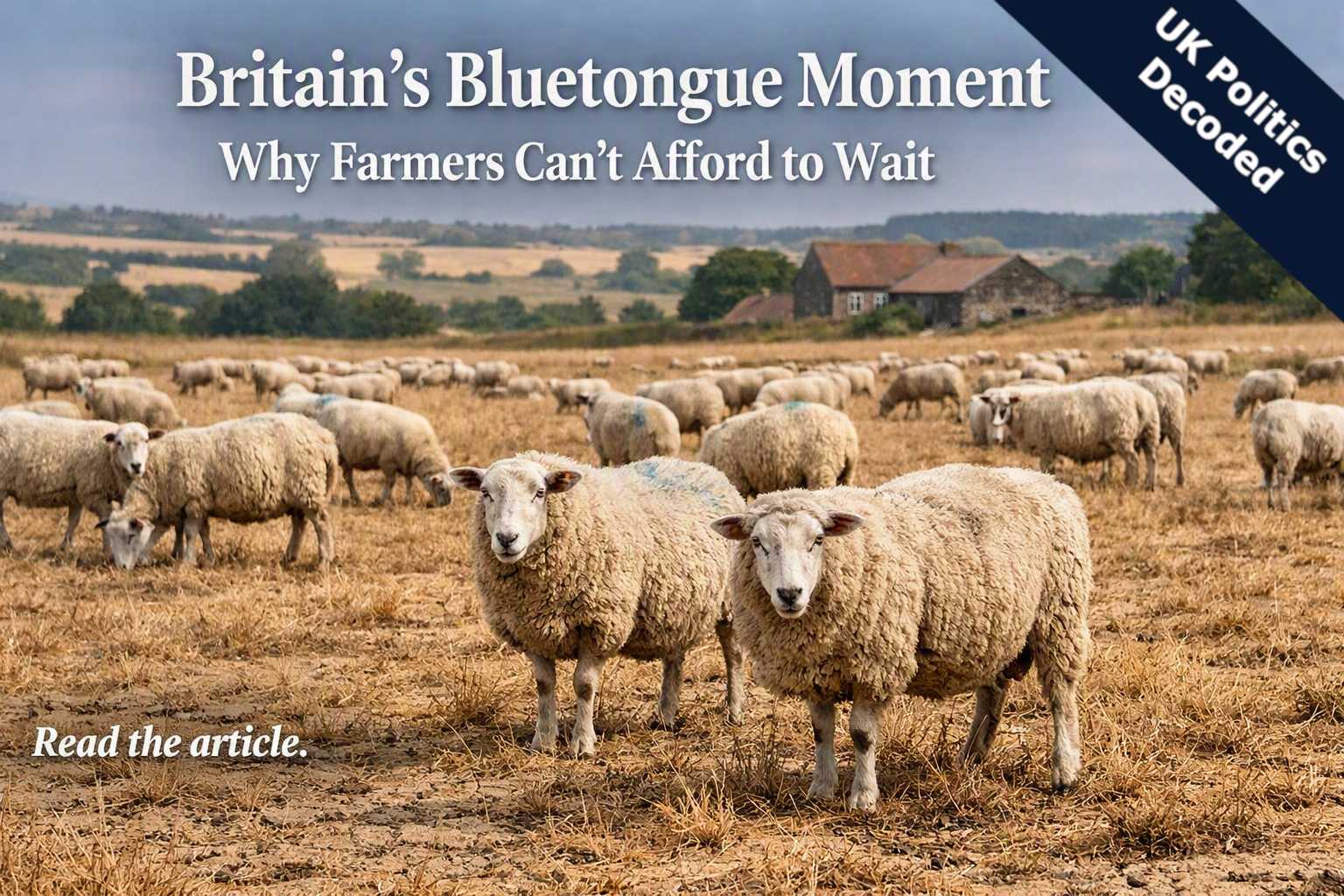
Bluetongue doesn't threaten humans, and it poses no risk to food safety. But it can devastate a flock. Sheep are the most vulnerable, the virus causes fever, lameness, swelling of the mouth, tongue and face, breathing difficulties, and in the worst cases abortions and stillbirths. For animals already weakened by drought parched pastures, that's a serious compounding blow.
What strikes me most about the government's messaging this week is how it echoes the advice issued during the 2023-24 bluetongue incursion, when serotype 3 first arrived on British shores via the Netherlands. The difference now is that the disease isn't just arriving anymore. It's moving. And the weather is helping it.
Biting midges thrive in warm, humid air, precisely what much of England has had for weeks. There's rarely a clean line between climate conditions and disease spread, but the link between midge activity and warm, wet summers is well established in the science. Vets on the frontline aren't surprised by this outbreak. They're stretched.
Vaccination is the primary tool available to farmers right now. Three vaccines have been authorised in Great Britain for bluetongue serotype 3, and Defra says it has been working with manufacturers to keep supply in step with demand. Farmers and vets are being urged to place orders early to make sure they can access stock.
There's a detail in the official guidance that doesn't always cut through, immunity takes time to build. A vaccine given today offers no protection tomorrow. That's why the Chief Veterinary Officer's message isn't just a nudge toward vaccination, it's an explicit call to have that conversation with your vet before the situation deteriorates further. Even animals in areas where disease is already circulating can still benefit, experts say.
I find myself thinking about what this means in practice for farmers in the Southwest. These are the same people who've spent much of this summer managing a drought serious enough to prompt a £65 million government support package earlier this month. The ground has been cracked and dry. Feed costs have risen. And now bluetongue is spreading through the region. Farming Minister Stephen Morgan acknowledged this week that the outbreak is "coming at a particularly tough time," and while that's the standard register for a ministerial statement, it's an unusually candid acknowledgement of compounding pressures.
The movement picture adds another layer of complexity. Separate restricted zones are in place in both England and Wales. Movement within those zones no longer requires a licence, but controls remain between UK countries, and pre-movement testing is still required for cross country transfers. For farmers considering autumn markets or moving animals to different grazing, navigating those rules on top of everything else is a real operational burden.
There's a broader question here about preparedness that I keep returning to. Bluetongue serotype 3 wasn't on most UK farmers radar before it arrived in 2023. It came via wind borne midges from continental Europe, no border, no warning. The government's response, including vaccine authorisation, APHA field support and the restricted zone framework, has followed the established playbook reasonably well. But playbooks assume predictable behaviour. Summer outbreaks in a warming climate don't always cooperate.
The Pirbright Institute, which processes diagnostic samples, is currently handling a significant spike in submissions. Vets have been asked to ensure their documentation is complete and accurate to avoid delays a small detail that carries real weight when a farmer is waiting to find out whether their animals are infected. The gap between prompt confirmation and a prolonged wait can be the difference between acting quickly and being left in limbo.
If you keep livestock in England or Wales, sheep especially but also cattle, goats, deer, and camelids such as llamas and alpacas, the message this week is unambiguous. Contact your vet. Ask about vaccination. Check your animals every day for symptoms including fever, lameness, facial swelling or discharge. And if you suspect bluetongue, report it immediately. In England, call APHA on 03000 200 301. In Wales, it's 03003 038 268. Reporting isn't optional, bluetongue is a notifiable disease, which means if you suspect it, you're legally required to say so.
The government can issue guidance, stockpile vaccines, and deploy diagnostics. What it cannot do is make the call for individual keepers standing in those fields. Right now, that decision is theirs to take.