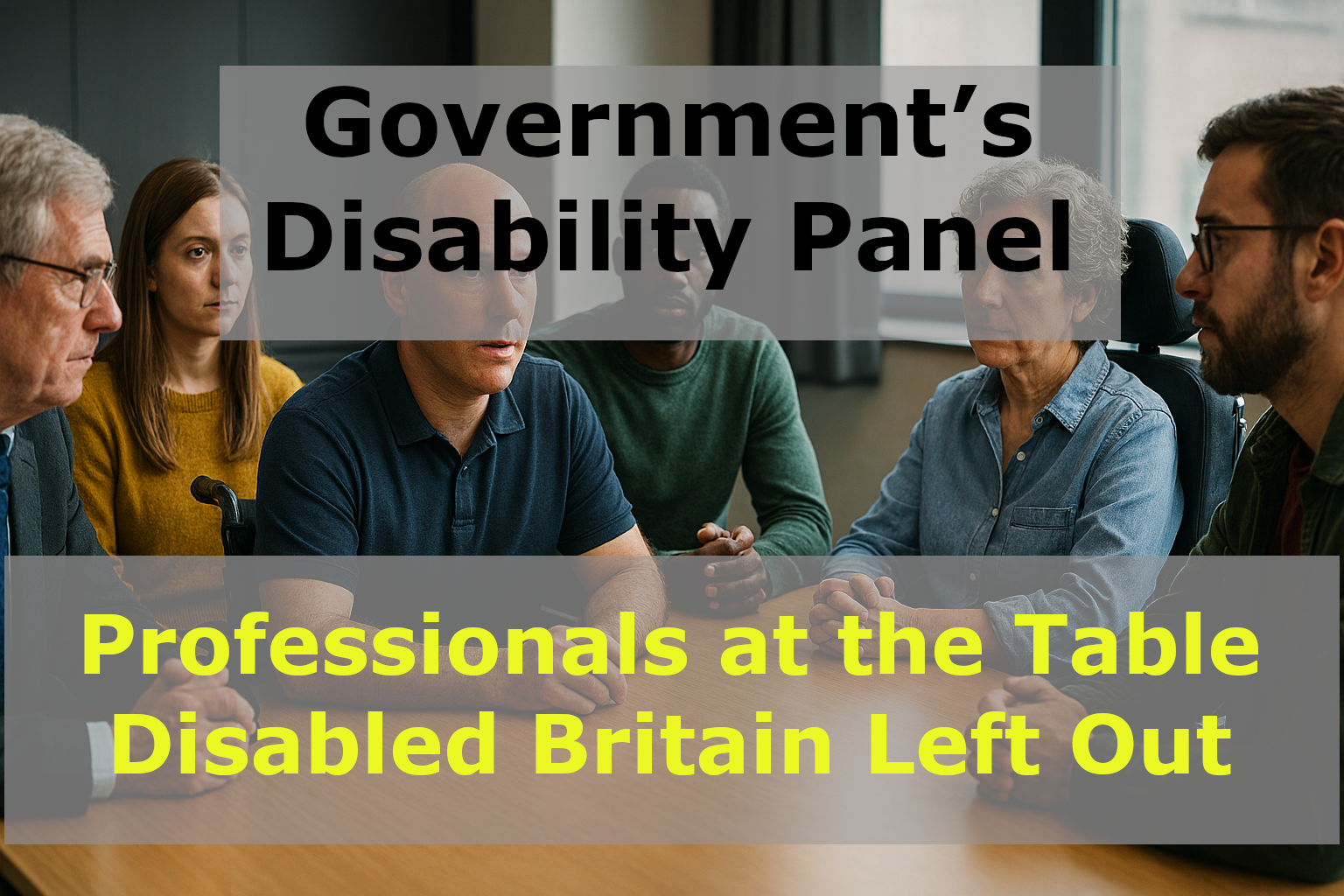
On 23 January 2026, the Government announced the launch of its new Independent Disability Advisory Panel, a group of ten people appointed to help shape health and disability policy. Ministers framed it as a landmark moment, a promise that disabled people would finally be "in the room where decisions are made".
The Panel, first trailed in the Get Britain Working White Paper, will advise on Access to Work, Disability Confident, and the Keep Britain Working Review. It will also share insight with the Timms Review of Personal Independence Payment. On paper, this looks like a meaningful shift: lived experience guiding policy design, delivery, and reform.
But when you look beyond the press release, a very different picture emerges.
🔍 Panel Composition Reality Check
- All 10 members hold senior professional roles (CEOs, Directors, Founders)
- Zero representation from disabled people unable to work
- No voices from those living in poverty or on basic benefits
- Missing perspectives from those most harmed by current policy
- Professional bias toward employment-focused solutions
🏢 A Panel of Professionals Not a Cross Section of Disabled Britain
The Government emphasises that all ten members have lived experience of disability or long term health conditions. That may be true. But every single member also holds a senior professional role:
💼 Leadership Positions
- CEOs: Leading major disability organizations
- Directors: Senior management in public and private sector
- Founders: Entrepreneurs who have built successful businesses
- Senior managers: High level operational and strategic roles
- Policy officers: Professional policy development expertise
🎯 Public Facing Roles
- Commissioners: Appointed roles in public bodies
- Public campaigners: Established advocacy and media presence
- Professional representatives: Sector spokespeople and thought leaders
- Network leaders: Well connected within policy and disability communities
- Conference speakers: Regular contributors to professional discourse
These are people who are already successful, influential, and professionally established. They are individuals who can work, who are well enough to hold demanding roles, and who have the networks, confidence, and stability to operate comfortably in government spaces.
This is not a criticism of the individuals themselves. Their expertise is real. Their contributions matter. But they represent a very narrow slice of disabled experience, one that looks nothing like the daily reality of most disabled people in the UK.
❓ Where Are the Voices of Those Living the Harshest Realities?
Most disabled people are not CEOs. Most disabled people are not directors. Most disabled people are not policy professionals. Most disabled people are not financially secure.
The majority are:
🏠 Daily Living Challenges
- Too ill to work: Conditions that prevent any form of employment
- Housebound or bedbound: Unable to leave home regularly or at all
- In chronic pain: Constant physical suffering affecting all activities
- Dealing with fluctuating conditions: Unpredictable symptoms and capabilities
- Managing degenerative conditions: Progressive health decline
💰 Financial Hardship
- Unable to heat homes: Choosing between energy and food
- Fighting for basic support: Constant battles with benefit systems
- Facing housing insecurity: Risk of eviction or homelessness
- Without access to aids: Cannot afford mobility equipment or adaptations
🏛️ System Navigation Struggles
- Traumatised by assessments: Psychological harm from benefit evaluations
- Exhausted by bureaucracy: Overwhelmed by complex application processes
- Cut off from social care: Inadequate or none existent support services
- Isolated and unheard: No voice in policy discussions affecting them
- Without dignity or security: Constant fear of losing essential support
These are the people whose lives are most shaped and often harmed by government policy. Yet none of them are represented on this panel.
The Missing Voices
A panel made up entirely of professionally successful disabled people cannot claim to reflect the lived experience of those who are:
- Unable to engage with formal consultations due to illness or lack of support
- Without the confidence or networks to navigate government processes
- Too exhausted by survival to engage in policy development
- Lacking the educational background to communicate in policy language
- Afraid of repercussions if they criticise systems they depend on
These voices are missing. And their absence matters.
💼 Financial Stability Changes Everything
The Government's framing treats all "lived experience" as equal. But it isn't.
A disabled CEO with a stable income, flexible working, supportive colleagues, and access to private therapy does not experience the same system as someone who:
📈 Professional Success Experience
- Financial security: Stable income, savings, private healthcare
- Workplace flexibility: Accommodating employers and colleagues
- Support networks: Professional connections and advocacy skills
- Confidence navigating systems: Experience with bureaucracy and formal processes
- Voice and platform: Ability to influence and be heard
📉 Struggling on Benefits Experience
- Financial insecurity: Below poverty line income, no savings, NHS waits
- Employment barriers: Cannot work due to severity of condition
- Social isolation: Limited support networks, advocacy skills, or formal connections
- System trauma: Humiliating assessments and constant fear of losing support
- Voicelessness: No platform, confidence, or energy to influence policy
Both are disabled. Both have lived experience. But their realities are worlds apart.
When government selects only the former, it creates a structural bias in the advice it receives. Policy becomes shaped by those who are already coping not those who are being failed.
⚖️ A Panel That Risks Reinforcing, Not Challenging, the Status Quo
Because of its composition, the Panel is likely to gravitate toward:
💼 Employment-Focused Solutions
- Work as solution: Emphasis on getting disabled people into employment
- Reasonable adjustments: Focus on workplace accommodations rather than income support
- Skills and training: Assumption that employment barriers are capability based
- Success narratives: Stories that reinforce "overcoming disability" through work
- Individual responsibility: Focus on personal adaptation rather than systemic change
🔧 System Tinkering
- Incremental improvements: Minor adjustments rather than fundamental reform
- Efficiency measures: Making current systems work better rather than replacing them
- Professional consensus: Solutions that professional networks find acceptable
- Evidence-based approaches: Privileging formal research over lived experience
- Collaboration frameworks: Working within existing structures rather than challenging them
Meanwhile, the people who are:
- Too ill to work and need adequate income support
- Living in poverty and require immediate financial relief
- Unsupported by social care and need comprehensive support services
- Traumatised by assessments and require dignity and respect in the system
- Unable to navigate bureaucracy and need accessible, simple processes
…are left out of the conversation entirely.
🎭 The Representation Problem
This is not co-production.
This is not representation.
This is not lived experience in its full, unfiltered form.
It is a curated, professionalised version of disability, one that aligns neatly with the Government's existing policy agenda.
📈 The Class Dimension: Professional Networks vs. Grassroots Reality
The panel's composition reveals a fundamental class bias in how government approaches "lived experience" consultation. Professional success has become the unofficial entry requirement for disabled people to influence policy.
Professional Networks vs. Community Voices
The selection process inevitably favors people who:
🎯 Visibility Factors
- Professional recognition: Known within disability sector and policy circles
- Media presence: Regular appearances in interviews, conferences, publications
- Formal qualifications: University degrees, professional certifications, established expertise
- Network connections: Links to government, charities, business leaders
- Communication skills: Ability to articulate complex policy positions confidently
🏛️ System Compatibility
- Institutional experience: Comfortable working within government structures
- Meeting culture familiarity: Experience with formal consultation processes
- Professional language: Fluent in policy terminology and frameworks
- Compromise ability: Willing to work within existing political constraints
- Time availability: Capacity to attend meetings and preparation sessions
This selection criteria systematically excludes disabled people who:
- Cannot work or hold demanding roles due to their conditions
- Lack formal education or professional experience but have deep lived experience
- Are suspicious of government based on their treatment by the system
- Cannot commit to regular meetings due to fluctuating conditions
- Communicate differently or need alternative engagement formats
The Innovation Gap
By excluding grassroots voices, the panel risks missing the most innovative and necessary policy insights:
- Survival strategies: How people actually navigate impossible systems
- Unintended consequences: Ways that well intentioned policies cause harm
- System workarounds: Informal solutions that could inform formal policy
- Dignity preservation: What disabled people need to maintain self-respect
- Community support: How peer networks fill gaps in formal services
🔄 Historical Pattern: When Consultation Becomes Co-option
This pattern of professional representation masquerading as authentic voice is not new. It reflects a broader tendency in government consultation to select the most palatable rather than the most necessary perspectives.
Previous Examples of Limited Representation
Other policy areas show similar patterns:
| Policy Area | Professional Voices Included | Grassroots Voices Missing |
|---|---|---|
| Housing Policy | Housing association CEOs, property developers, housing lawyers | People in temporary accommodation, those facing eviction |
| Education Reform | Head teachers, education consultants, academic researchers | Parents struggling with school systems, disadvantaged students |
| Mental Health Services | NHS trust managers, professional therapists, mental health charities | Service users in crisis, those rejected by services |
The Consultation Paradox
Government consultation often creates a paradox:
- Those most affected by policy are least likely to be included in its development
- Those most critical of current systems are least likely to be invited to improve them
- Those most innovative in their survival strategies are least likely to be heard
- Those most representative of the affected population are least likely to be selected
This creates policy development that is technically competent but experientially narrow, resulting in well designed systems that fail to address real world needs.
🎯 What Genuine Representation Would Look Like
If the Government is serious about embedding lived experience, it must move beyond symbolic inclusion toward authentic representation. This requires fundamental changes in how consultation is designed and delivered.
Inclusive Selection Criteria
Genuine representation would include people who:
🏠 Cannot Work Due to Health
- Severe conditions: People whose disabilities prevent any form of employment
- Fluctuating conditions: Those whose capabilities vary unpredictably
- Chronic pain sufferers: People managing constant physical discomfort
- Mental health conditions: Those whose conditions affect their ability to work
- Progressive conditions: People experiencing ongoing health decline
💰 Living in Poverty
- Benefits recipients: People surviving on ESA, Universal Credit, or PIP
- Social housing residents: Those in council housing or housing associations
- Food bank users: People relying on charitable food support
- Energy poverty: Those choosing between heating and eating
- Debt management: People struggling with essential bill payments
🏥 System Experience
- Assessment survivors: People who have been through PIP or ESA assessments
- Appeals experience: Those who have challenged benefit decisions
- Social care users: People relying on care packages or struggling without them
- NHS patients: Those experiencing long waits or inadequate care
- Housing adaptations: People needing or seeking home modifications
Alternative Engagement Methods
Including these voices requires different approaches to consultation:
- Home visits: Taking consultation to people who cannot travel
- Flexible timing: Working around medical appointments and bad days
- Multiple formats: Written, verbal, video, and creative expression options
- Supported participation: Advocates or interpreters to help people engage
- Anonymous input: Ways to contribute without fear of benefit implications
Structural Changes Required
Real inclusion requires systemic change:
- Compensation barriers: Payment that doesn't affect benefits
- Access provision: Transport, care cover, communication support
- Multiple touchpoints: Ongoing engagement rather than one off consultations
- Feedback loops: Showing how input has influenced policy
- Power sharing: Decision making roles, not just advisory positions
🔑 Key Takeaway: The Price of Admission Should Not Be Success
The Government's Independent Disability Advisory Panel represents a missed opportunity disguised as progress. By selecting only professionally successful disabled people, it creates the appearance of lived experience representation while systematically excluding the voices that matter most.
The panel's composition reveals uncomfortable truths about how power operates in disability policy. Professional success has become the unofficial entry requirement for disabled people to influence the policies that affect them. This creates a feedback loop where policy is shaped by those who have already found ways to thrive within existing systems, rather than those who are being failed by them.
💡 The Core Problem
- Professional disabled people experience different realities from those unable to work or living in poverty
- Panel composition creates structural bias toward employment focused and incremental solutions
- Most affected voices are those too ill to work, living on benefits, traumatized by assessments remain excluded
- Government consultation reproduces existing inequalities rather than challenging them
- Real lived experience is messier and more challenging than professional representation
This matters because disability policy affects real lives in profound ways. When someone loses PIP, they may lose their car, their independence, their ability to work. When ESA is cut, families choose between heating and eating. When social care is inadequate, people become prisoners in their own homes.
The people experiencing these realities understand systems in ways that professional success can obscure. They know where policies fail, what unintended consequences emerge, and what solutions might actually work. Their exclusion from the panel isn't just unfair, it's practically counterproductive.
If the Government were serious about lived experience, it would:
- Include people who cannot work and understand the reality of benefits dependency
- Include people living in poverty who know the daily impact of inadequate support
- Include people traumatized by the system who can explain how assessments actually feel
- Include people without professional networks who represent the majority of disabled experience
- Create accessible ways to participate that don't require professional skills or connections
Real lived experience is messy, complex, and often uncomfortable. It does not fit neatly into a press release. But it is essential if policy is to be fair, humane, and grounded in reality.
This panel could have been a turning point toward genuine co-production and authentic representation. Instead, it risks becoming another example of disabled people being spoken for, rather than listened to.
Disabled people deserve better than symbolic inclusion. They deserve policies developed with their full participation, not just the participation of those who have already succeeded despite systemic barriers. Until government understands this difference, disability policy will continue to fail the people it claims to serve.