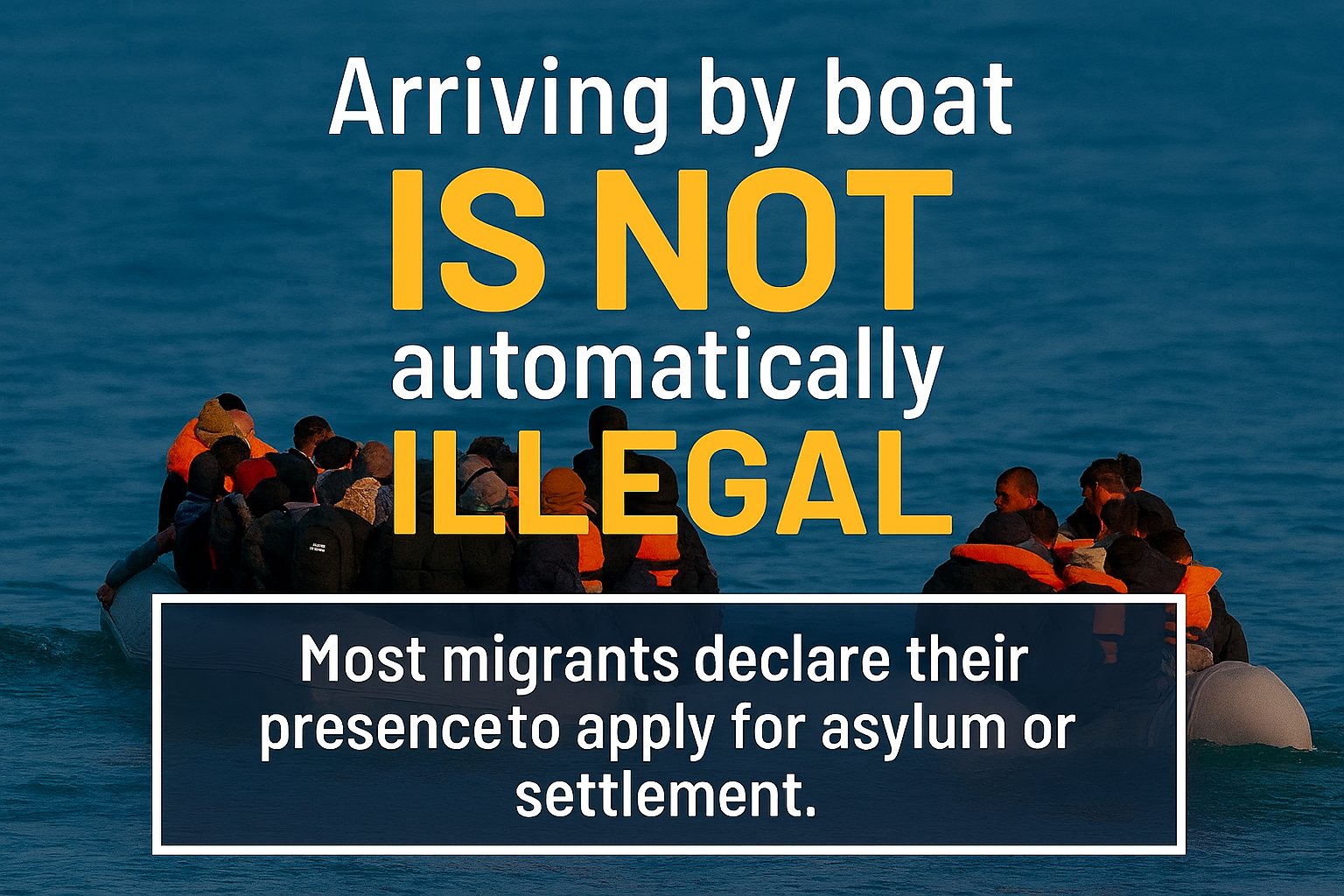
In recent months, political parties and media outlets have repeatedly described small boat crossings as "illegal." This framing is misleading and legally inaccurate. Crossing the Channel in a dinghy or other vessel is not, in itself, unlawful. What matters legally is whether someone enters the UK without valid documentation, destroys their papers, or fails to declare their arrival.
This distinction matters more than political rhetoric suggests. Misrepresenting the law risks fuelling fear, confusion, and hostility towards people who are exercising their right to seek asylum under international law that the UK helped create and has signed up to respect.
🗂️ The Legal Reality
- Crossing by boat is not automatically illegal - method of arrival does not determine legal status
- Most small boat arrivals declare their presence and enter the asylum process as law requires
- Right to claim asylum is protected regardless of how someone arrives in the UK
- Legal routes exist but have narrow eligibility and strict caps limiting access
- Political framing of "illegal boats" conflates danger with criminality
- International law distinguishes between "irregular entry" and "illegal presence"
The Legal Position: What Actually Matters
Understanding the law around Channel crossings requires distinguishing between the method of arrival and the legal process that follows. The key legal questions are not about boats, but about documentation and declaration.
Arrival by Boat is Not Automatically Illegal
Under UK law, anyone can charter or use a vessel to reach British shores. The method of transport does not determine legal status:
- Maritime Law: International waters allow free passage for vessels in distress or legitimate travel
- Entry Methods: Arrival by boat, plane, train, or on foot are all equally valid methods of reaching the UK
- Commercial vs Private: Whether someone pays for passage or uses their own vessel does not affect legality
- Rescue Obligations: UK and French authorities have legal duties to rescue vessels in distress
- Territorial Waters: Once in UK waters, vessels must follow UK maritime law but this doesn't criminalize arrival
Documentation is the Key Legal Issue
What matters legally is not how someone arrives, but what they do once they reach UK soil:
- Valid Documentation: Entry with proper visa or right of entry is completely legal
- Declaration Requirements: People must declare their arrival to immigration authorities
- Document Destruction: Deliberately destroying identity papers to conceal origin is unlawful
- False Information: Providing fake documents or false details constitutes an offense
- Overstaying: Remaining beyond permitted time becomes illegal presence
Asylum Rights Are Protected
The 1951 Refugee Convention, which the UK helped draft and signed, establishes clear protections:
- Right to Claim: People can seek asylum regardless of how they arrive
- Non-Refoulement: Cannot return people to face persecution
- No Penalties: Irregular arrival should not be penalized for genuine refugees
- Due Process: Right to fair consideration of asylum claims
- International Obligation: UK bound by treaties it has signed and ratified
Legal Routes: Limited but Available
Critics often ask why people don't use "legal routes," but understanding what these routes actually offer reveals their limitations.
Existing Legal Migration Pathways
The UK does provide several legal routes, but with significant restrictions:
- Family Reunion Visas: Only for immediate family of people with refugee status or protection
- UNHCR Resettlement: Globally, only 1% of refugees are resettled annually
- Community Sponsorship: Small-scale program dependent on local group support
- Humanitarian Visas: No general humanitarian visa scheme exists
- Work Visas: Require job offers and meet strict skills/income thresholds
- Student Visas: Require educational sponsorship and proof of funds
Crisis-Specific Schemes
Recent programs demonstrate both possibilities and limitations:
- Ukraine Schemes: Homes for Ukraine and Ukraine Family Scheme created rapid legal pathways
- Afghanistan (ARAP/ACRS): Limited to those who worked with UK forces or meet specific criteria
- Hong Kong BN(O): Specific to British National (Overseas) status holders
- Temporary Nature: Most schemes are time-limited responses to specific crises
- Geographic Restrictions: Apply only to specific countries or conflict zones
The Gap Between Need and Provision
Legal routes exist but don't match the scale of global displacement:
- Global Context: 100+ million forcibly displaced people worldwide
- UK Capacity: Legal routes accommodate thousands annually, not hundreds of thousands
- Eligibility Criteria: Strict requirements exclude many with genuine protection needs
- Geographic Limitations: Routes often don't exist from countries producing refugees
- Time Delays: Processing can take years, during which persecution continues
The Real Danger: Maritime Safety
While arrival by boat is not illegal, it is undeniably dangerous. The English Channel presents serious hazards that have resulted in tragic loss of life.
Channel Crossing Hazards
The Dover Strait is one of the world's busiest and most dangerous shipping lanes:
- Heavy Traffic: 500+ commercial vessels pass through daily
- Weather Conditions: Strong currents, sudden storms, and rough seas
- Cold Water: Hypothermia risk even in summer months
- Vessel Overcrowding: Small boats packed beyond safe capacity
- Poor Equipment: Inadequate life jackets, navigation, and communication devices
Smuggling Operations
The danger is exacerbated by criminal smuggling networks:
- Substandard Boats: Cheap, unseaworthy vessels to maximize profit
- Overloading: Packing more people than boats can safely carry
- No Safety Training: Passengers given no safety briefing or equipment instruction
- Weather Indifference: Crossings attempted in dangerous conditions
- Abandonment: Smugglers rarely accompany crossings, leaving passengers without experienced operators
Tragic Consequences
The human cost of dangerous crossings is mounting:
- Confirmed Deaths: At least 12 people died in Channel crossings in 2024
- Missing Persons: Unknown number presumed drowned, bodies never recovered
- Hypothermia Cases: Rescued passengers suffering severe cold exposure
- Trauma Impact: Survivors experiencing psychological trauma from dangerous crossings
- Family Separation: Deaths leaving families separated across countries
⚠️ The Danger vs Illegality Distinction
Channel crossings are:
- Dangerous: High risk of drowning, hypothermia, and maritime accidents
- Exploitative: Smugglers profit from desperation and provide unsafe passage
- Traumatic: Passengers face terrifying conditions and risk of death
But they are not:
- Automatically illegal: Asylum seekers have right to claim protection
- Criminal acts: Most arrivals declare themselves and follow legal process
- Immigration violations: Method of arrival does not determine legal status
Why Framing Matters: The Power of Language
How we describe Channel crossings shapes public understanding and policy responses. Political language choices have real consequences for both public opinion and government action.
"Illegal Boats" is Inaccurate
This phrase, repeated constantly by politicians and media, conflates several distinct issues:
- Method vs Status: Confuses how someone travels with their legal entitlement to be in the UK
- Means vs Purpose: Treats the boat itself as illegal rather than focusing on immigration status
- Arrival vs Presence: Suggests arriving by boat is inherently unlawful
- Transport vs Identity: Makes the vessel, not the person's circumstances, the legal issue
- Physical vs Legal: Conflates the dangerous physical journey with legal violations
Public Perception Impact
Repeated use of "illegal" language shapes how citizens understand the issue:
- Priming Effect: Frames all arrivals as criminal activity
- Asylum Prejudice: Undermines sympathy for people seeking protection
- Policy Support: Builds public backing for harsh enforcement measures
- Legal Misunderstanding: Creates false impression of what law actually says
- Dehumanization: Reduces complex human stories to simple "illegal" vs "legal" categories
Policy Consequences
Language choices justify specific policy approaches:
- Enforcement Focus: "Illegal" framing supports military style enforcement responses
- Route Restrictions: Justifies limiting rather than expanding legal migration pathways
- International Relations: Enables hostile rhetoric toward France and EU partners
- Budget Priorities: Supports spending on interdiction rather than safe routes or integration
- Legislative Changes: Provides political cover for restrictive immigration laws
International Comparisons: Better Practice Exists
Other countries demonstrate more accurate and nuanced approaches to describing irregular migration, showing that clearer language is both possible and beneficial.
European Union Terminology
EU institutions use more precise language:
- "Irregular Entry": Describes crossing without proper documentation
- "Unauthorized Presence": Refers to staying beyond permitted time
- "Mixed Migration": Acknowledges both economic migrants and asylum seekers
- "Search and Rescue": Emphasizes humanitarian obligations at sea
- "Protection Seekers": Neutral term for people claiming asylum
International Organization Standards
UN agencies and international bodies recommend specific terminology:
- UNHCR Guidelines: Avoid "illegal" when describing asylum seekers
- IOM Standards: Use "irregular" rather than "illegal" for unauthorized migration
- Council of Europe: Emphasizes human rights-compliant language
- Academic Consensus: Migration studies field rejects "illegal" terminology
- Legal Accuracy: International law distinguishes between administrative and criminal violations
Media Best Practice
Some news organizations have adopted clearer standards:
- BBC Guidelines: Use "people who crossed illegally" rather than "illegal migrants"
- Reuters Style: Avoid "illegal" as a noun describing people
- AP Standards: Distinguish between actions and people
- Guardian Policy: Use "undocumented" or "unauthorized" rather than "illegal"
- Migration Observatory: Academic body promoting accurate terminology
A More Accurate Narrative: Precision Matters
Clear, accurate language better serves both public understanding and policy development. Citizens deserve precise information about what is actually happening and what the law actually says.
Accurate Terminology
More precise language would describe:
- Irregular Arrival: Crossing without proper documentation or authorization
- Dangerous Crossing: Hazardous journey risking life and safety
- Asylum Claim: Legal application for protection under international law
- Maritime Rescue: Emergency response to vessels in distress
- Border Processing: Official procedures for handling arrivals
- Protection Assessment: Evaluation of asylum claims according to legal criteria
Key Distinctions to Make
Public discourse should clearly separate:
- Danger vs Illegality: Hazardous journeys are not automatically unlawful
- Method vs Status: How someone arrives vs their right to be here
- Administrative vs Criminal: Immigration violations vs criminal offenses
- Individual vs System: Personal circumstances vs policy framework
- Immediate vs Long-term: Emergency response vs integration planning
The Benefits of Accuracy
Precise language serves multiple purposes:
- Legal Understanding: Citizens better comprehend what law actually requires
- Policy Debate: More informed discussion of what works and what doesn't
- International Relations: Cooperation based on shared understanding of obligations
- Public Trust: Media and politicians seen as reliable sources of information
- Human Dignity: People's circumstances described with appropriate nuance
The Path Forward: Evidence Based Understanding
Moving beyond inflammatory rhetoric toward evidence based policy requires acknowledging both the reality of displacement and the limitations of current approaches.
Acknowledging Complex Realities
Honest policy discussion must recognize:
- Global Displacement: 100+ million forcibly displaced people worldwide will not disappear
- Limited Capacity: No single country can accommodate everyone needing protection
- Shared Responsibility: International cooperation essential for managing migration
- Mixed Motivations: People move for complex combinations of economic and protection reasons
- Integration Challenges: Successful settlement requires investment in services and communities
Policy Options for Consideration
Evidence based approaches might include:
- Expanded Legal Routes: Humanitarian visas and regional protection programs
- Faster Processing: Quick, fair decisions on asylum claims
- Regional Cooperation: EU-UK agreements on burden-sharing
- Integration Investment: Language training, skills programs, community support
- Return Arrangements: Fair, efficient processes for those not granted protection
- Root Causes: Development aid and conflict prevention in origin countries
The Role of Public Education
Citizens need accurate information to participate in democratic debate:
- Legal Literacy: Understanding what UK and international law actually requires
- Factual Accuracy: Numbers, trends, and outcomes based on evidence
- Historical Context: How current policies compare to past approaches
- International Perspective: How other countries handle similar challenges
- Local Impact: Real effects on communities of different policy choices
Conclusion: Truth in the Service of Democracy
Small boat crossings are dangerous, but they are not automatically illegal. Most people who arrive this way declare their presence and apply for asylum, as international and domestic law allows and often requires. The real challenge is the lack of safe, legal routes, which leaves many with no alternative but to risk their lives at sea.
The persistent framing of "illegal boats" serves political purposes but undermines public understanding of both the law and the policy choices available to the UK government. Citizens cannot make informed democratic choices based on misleading information about what is legal and what is not.
The distinction between danger and illegality matters profoundly. Channel crossings are undeniably hazardous they risk drowning, hypothermia, and exploitation by criminal smuggling networks. These dangers deserve serious policy attention focused on saving lives and providing safe alternatives.
But danger is not the same as criminality. People fleeing persecution, conflict, or violence have rights under international law that the UK helped create and has committed to uphold. Exercising these rights, even through dangerous journeys, is not unlawful.
Accurate language serves democracy better than inflammatory rhetoric. When politicians and media describe irregular arrivals as "illegal boats," they conflate the method of travel with immigration status, the physical journey with legal entitlements, and administrative processes with criminal violations.
This matters because language shapes policy. Framing arrivals as inherently criminal justifies enforcement-only responses while undermining support for safe routes, integration programs, or international cooperation. It primes public opinion against asylum seekers before their claims are even considered.
Other countries demonstrate that more precise terminology is possible. The EU distinguishes between "irregular entry" and "illegal presence." International organizations recommend avoiding "illegal" when describing asylum seekers. Academic consensus supports terminology that separates actions from people.
British democracy deserves the same precision. Citizens need to understand what the law actually says, what policy options exist, and what trade-offs different approaches involve. This understanding cannot develop through misleading frames that obscure rather than illuminate the choices we face as a society.
The challenge of managing migration in an interconnected world requires honest dialogue based on accurate information. Political point-scoring through linguistic manipulation may serve short-term electoral interests, but it undermines the quality of democratic debate and the effectiveness of policy responses.
Small boat crossings represent both human tragedy and policy failure tragedy because people die in preventable accidents, and failure because the lack of safe routes forces desperate people into dangerous journeys. Addressing both requires moving beyond myths toward evidence-based understanding of what works, what doesn't, and what our legal and moral obligations actually require.
Educating the public on legal reality is vital for democratic governance. Clear, evidence based reporting can cut through political spin and help citizens understand the difference between danger and illegality, between administrative violations and criminal offenses, and between the challenges we face and the solutions available to address them.
In the end, truth serves democracy better than spin. On small boats and big policy questions alike, citizens deserve accuracy, not myths.