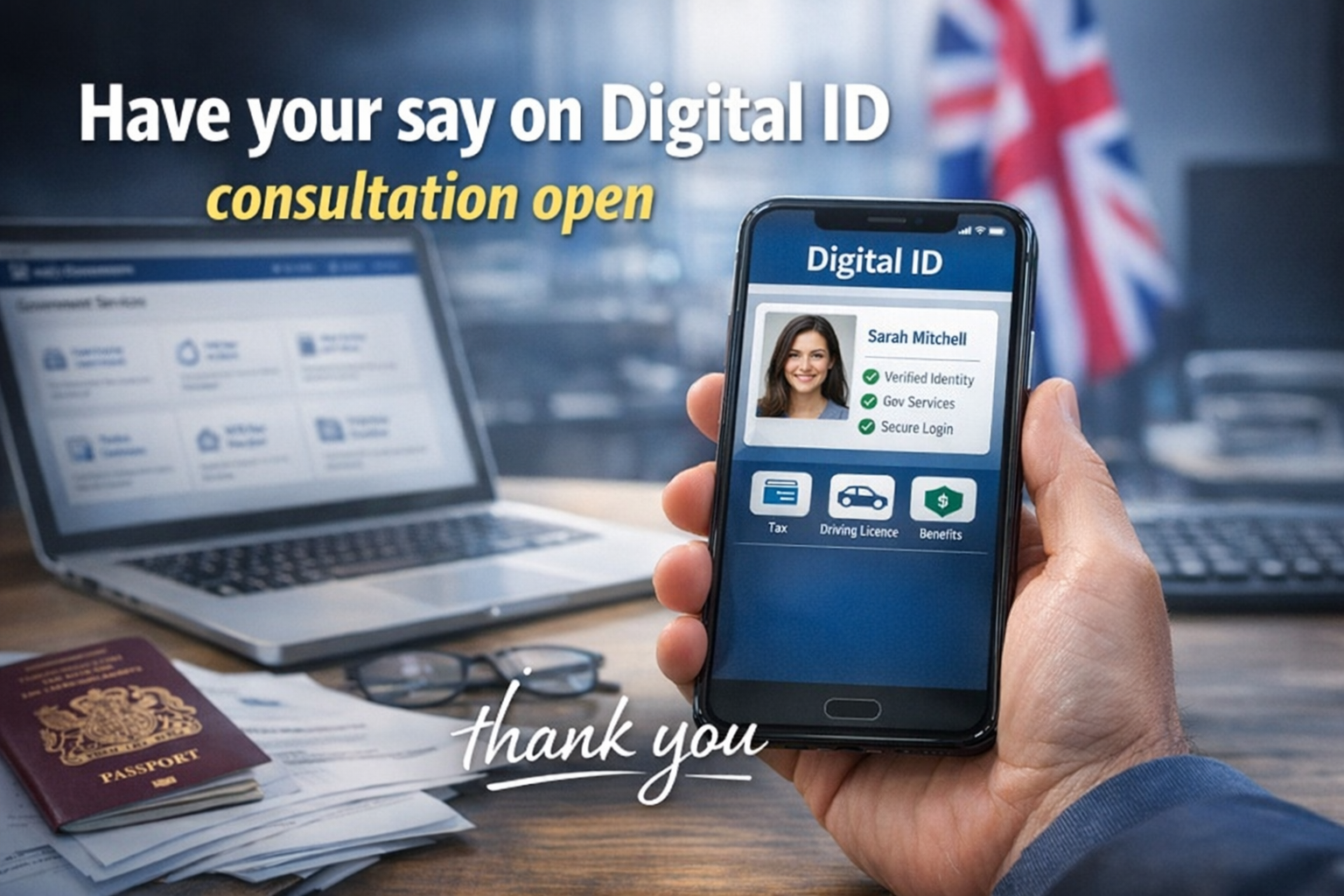
The government has opened a national consultation on plans to introduce a voluntary digital ID system that would allow people to prove their identity across public services using a single app. The announcement, published on 10 March 2026, forms part of a wider programme to modernise public sector technology and reduce reliance on legacy systems.
The consultation runs for eight weeks, closing on 5 May 2026. After that, a People's Panel will continue the process until 21 June, which the government describes as the formal end of the consultation period.
What the Government Is Proposing
Ministers have unveiled a working prototype of a single digital identity app that would allow people to log in once and prove who they are across multiple public services. The stated aim is to replace the current patchwork of logins, paper documents, and telephone based verification with a unified system comparable in ease of use to online banking.
The prototype demonstrates how the app could act as the "foundation" for a more joined up state, handling identity checks and data sharing between departments that people currently have to manage manually.
Three core principles are set out as guiding the design:
- Useful - reducing bureaucracy and making services more intuitive
- Inclusive - available and accessible to all, with non-digital routes preserved
- Trusted - built with data protection and security standards at the centre
Importantly, the government states that there will be no legal obligation to obtain or present a digital ID. Existing ways of accessing services by phone, post, and in person would remain available.
Why the Government Says Change Is Needed
Darren Jones, Chief Secretary to the Prime Minister, argues that the public sector has fallen behind private sector digital services such as banking and retail. He highlights the frustration many people experience when interacting with government: repeated identity checks across departments, lengthy phone queues, and complex paper forms.
The scale of the administrative challenge is illustrated by figures cited in the announcement:
- The DVLA currently processes 45,000 letters a day
- Defra uses 500 different paper forms
- HMRC handles 100,000 phone calls daily
Ministers say a digital ID system could reduce these pressures, cut costs over the long term, and significantly improve the user experience for people accessing public services.
What the Digital ID Could Be Used For
The consultation documents suggest a range of early use cases, including:
- Managing free childcare payments
- Filing tax returns
- Obtaining or renewing a driving licence
- Checking a tax code
- Completing digital right to work checks when starting a new job
The government has confirmed that anyone starting a new job will be able to use the digital ID for right to work checks, which will be required by the end of the Parliament. Alternatively, people will be able to carry out a digital check of other documents such as a passport or eVisa if they prefer.
The consultation also asks what information the digital ID should contain. Beyond basic proof of identity, one example given is the inclusion of proof of address, to reduce the need to produce a utility bill or bank statement.
Who the System Is For
The proposed national digital ID system would be available to British and Irish citizens, as well as foreign nationals with permission to be in the UK. The consultation seeks views on the minimum age at which people should be able to obtain a digital ID and what inclusion measures are needed for those who may struggle to access it digitally.
Public Involvement: Consultation and People's Panel
The online consultation will run for eight weeks. Alongside it, the government will convene a People's Panel made up of individuals from different backgrounds across the country, selected through a civic lottery process known as sortition. The panel will discuss the proposals in depth and help shape recommendations.
The government has been explicit that the final design of the system will depend on the consultation's findings. Key design decisions will only be taken after this process concludes.
Questions the consultation is seeking views on include:
- The minimum age for obtaining a digital ID
- What information it should include beyond basic proof of identity
- Which government services it should integrate with first
- How to ensure the system is accessible to everyone, including those who prefer non-digital routes
- How to make sure people can trust the system to protect their data
How This Fits Into Wider Digital Reform
The digital ID announcement follows the Roadmap for Modern Digital Government, which commits to replacing outdated technology across Whitehall, digitising major services including planning, making it easier for people to manage benefits and tax, and doubling the number of technology specialists across government departments.
The digital ID is positioned as the foundational component of this broader transformation, the element that makes "government by app" possible by providing a single, secure way to verify identity across different departments and services.
The government also cites international comparison as part of its justification, pointing to countries such as Estonia, which it says digitised public services fully years ago, and drawing parallels with the way supermarkets, banks, and shops have moved services online.
Questions Being Raised
The consultation has been welcomed by those who see significant potential in simplifying access to public services. It has also prompted questions from those concerned about the privacy, security, and civil liberties implications of a centralised digital identity infrastructure.
Some of the questions that have been raised include:
- What safeguards exist to prevent the system expanding in scope beyond its original purpose
- How data held within the system will be protected, given the UK government's track record on large scale IT projects
- Whether a voluntary system could in practice become a de facto requirement as more services integrate with it
- How the system interacts with existing digital identity and data collection provisions in other legislation, including the Children's Wellbeing and Schools Bill
- What the implications are for those who are unable or unwilling to participate
These are among the questions the consultation is intended to address. The government has emphasised that it wants to hear from a wide range of people and organisations, and that views shared will inform key design decisions that have not yet been taken.
The Cyber Security Context
One question that has received particular attention is how a centralised national digital ID database would be protected from cyber attack. This question arises against a backdrop of a documented and significant rise in serious cyber incidents affecting public sector systems in the UK.
The National Cyber Security Centre (NCSC), part of GCHQ, published its Annual Review covering the period from September 2024 to August 2025. It reported:
- The NCSC handled 204 nationally significant cyber incidents, up from 89 in the previous year (130% increase)
- In total, 429 incidents required NCSC support during the period
- 18 incidents were categorised as "highly significant", 50% more than the previous year
- This equates to an average of four nationally significant attacks every week
The NCSC highlighted increasing activity from advanced state linked and criminal threat actors, warning that the UK’s “collective exposure to serious impacts is growing at an alarming pace”.
The government’s Cyber Security Breaches Survey 2025 similarly found that 43% of businesses and 30% of charities experienced a cyber breach in the previous year, with ransomware incidents rising.
Critics argue that a centralised digital ID would create a high value target, concentrating identity data that cannot be easily changed if compromised. Supporters counter that strong security architecture and data protection by design principles can mitigate these risks.
The consultation explicitly seeks views on how the system should be secured and how public trust in data protection can be maintained.
What Happens Next
The consultation closes on 5 May 2026. Following that, the People's Panel will continue until 21 June 2026, which marks the formal end of the consultation process. A government response will be published once all stages have concluded and responses have been considered.
The survey is available to complete online and takes approximately 20 to 40 minutes, with respondents able to choose which topics they wish to answer questions on. The consultation is open to individuals, businesses, trade unions, civil society organisations, technologists, and public and private sector leaders.