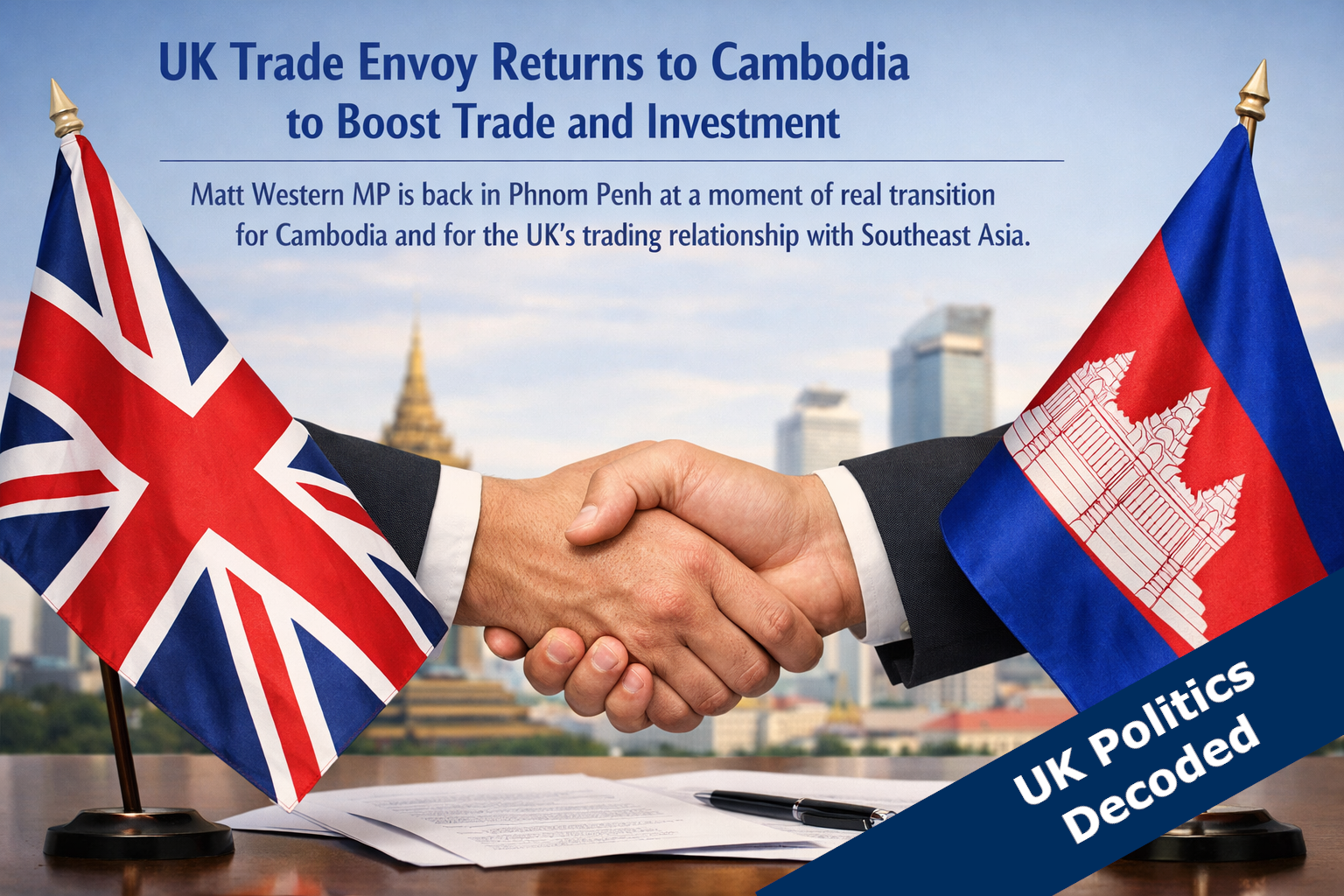
Matt Western MP, the UK Prime Minister's Trade Envoy to Cambodia, Vietnam, Thailand and Laos, arrived in Phnom Penh on 10 June 2026 for a visit aimed at deepening the bilateral trade and investment relationship. The timing is not accidental. Cambodia is approaching a significant economic milestone, and the UK's trade framework for developing countries has just been updated in ways that directly affect how Cambodian goods reach British markets.
The visit builds on earlier engagement and focuses on areas where both sides see the most scope for growth, green infrastructure, financial services and capital markets, and education. British businesses, including Reigate Grammar School Phnom Penh and Unilever, are already operating in the country and were part of the programme.
Key Points at a Glance
- Matt Western MP is visiting Cambodia on 10 June 2026 as UK Prime Minister's Trade Envoy
- Cambodia is preparing to graduate from Least Developed Country (LDC) status
- The UK's Developing Countries Trading Scheme (DCTS) gives Cambodia duty free access to over 99% of UK bound goods
- Improved rules of origin under the DCTS came into force on 1 January 2026
- Discussions cover energy, capital markets, and the ASEAN-UK Economic Integration Programme
- UK businesses including Unilever and Reigate Grammar School are already active in Cambodia
Cambodia is classified by the United Nations as a Least Developed Country, a status that carries preferential treatment in international trade including reduced tariffs and simplified rules for exporters. The country is on track to graduate from that category, which means those automatic advantages will eventually fall away.
That transition creates a practical challenge. Without careful preparation, Cambodian businesses could face higher barriers when exporting, even as their economy grows. Strengthening direct bilateral links with trading partners like the UK now is part of how countries manage that shift. Western's visit is framed around exactly that, building ties before the transition changes the terms.
The UK's Developing Countries Trading Scheme replaced the EU's Generalised System of Preferences after Brexit. Under the scheme, Cambodia currently benefits from duty free access on more than 99% of goods exported to the UK. It is one of the most comprehensive trade preference arrangements available.
In January 2026, the UK updated the rules of origin under the DCTS, the conditions that determine whether goods qualify for preferential tariffs based on where they are genuinely produced. The changes matter for Cambodia in several practical ways.
On garments, which are a core Cambodian export, the new rules give Enhanced Preference tier countries the same flexibility as the Least Developed Country tier. That means manufacturers can source up to 100% of inputs from other countries for certain garments, and fewer mandatory processing steps are required. Only one significant manufacturing process such as cutting and sewing needs to take place in Cambodia itself.
There are also new regional cumulation arrangements. For the first time, Africa has its own DCTS regional group, and the two Asia groups have been merged and expanded. Six countries including Afghanistan, Uzbekistan and Mongolia joined the Asia group in January 2026. Cambodian manufacturers can now source inputs from a wider range of countries in the region without losing access to UK tariff preferences.
Western is meeting senior Cambodian officials including Dr Sok Siphana and counterparts from the Ministry of Commerce and the Council for the Development of Cambodia. Talks are centred on trade and investment priorities, implementation of the Joint Trade and Investment Forum (JTIF), and how to increase use of the DCTS.
Energy is a significant strand. Western is meeting representatives from Electricité du Cambodge to discuss Cambodia's energy ambitions, how it plans to finance infrastructure development, and where UK expertise and capital might play a role in that transition.
Capital markets are another focus. Through a working group delivered with the British Chamber of Commerce in Cambodia, there are ongoing efforts to develop Cambodia's financial markets and explore where UK professional and financial services firms can contribute. Western is attending a networking reception with UK institutions, businesses and Cambodian counterparts as part of that strand.
This visit is part of a wider UK engagement strategy in the region. The ASEAN-UK Economic Integration Programme (EIP) is one of the government's main vehicles for this, providing technical and policy support across the bloc. Cambodia's participation in that programme sits alongside the bilateral work being done through the Trade Envoy role.
Western's remit covers four countries Cambodia, Vietnam, Thailand and Laos and his visits are intended to maintain momentum between formal government to government processes. The combination of ministerial engagement, business networking and programme work reflects an attempt to embed UK involvement at multiple levels rather than relying on top level diplomacy alone.
Speaking ahead of the visit, Western said Cambodia's "open and outward looking approach to trade and investment creates significant opportunities for deeper economic cooperation." He pointed to green infrastructure, financial services and education as sectors where the UK's strengths align with Cambodia's development priorities.
The government's stated aim is to support Cambodia's sustainable economic growth, create jobs, and attract investment with the UK positioned as a partner rather than a donor. Whether that framing translates into durable commercial relationships over time will depend partly on how the post LDC transition is managed and whether the DCTS changes genuinely make UK trade more accessible for Cambodian exporters.