AI Use: AI tools were used to support source discovery and to structure the article for clarity. All research, verification, drafting, and final editorial decisions are fully human led. Learn about our AI policy.
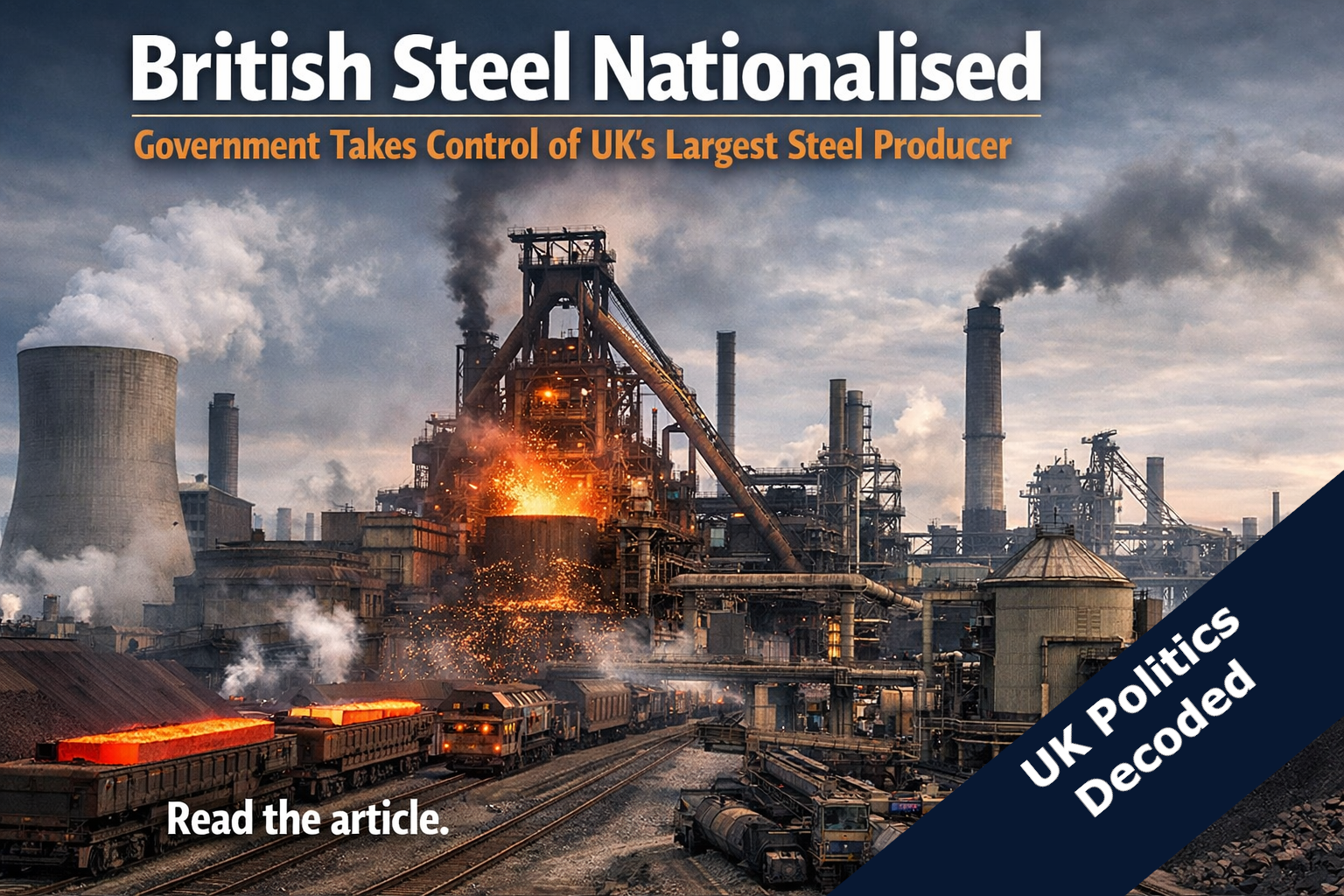
The UK Government has taken British Steel into public ownership on 16 July 2026, following Royal Assent of the Steel Industry (Nationalisation) Act the day before. Business Secretary Peter Kyle concluded that nationalisation was necessary to protect domestic steel production, particularly at the Scunthorpe site, and to secure supply chains critical to infrastructure, defence and energy projects.
The decision marks the first major nationalisation by the Labour government since it took office. Ministers say British Steel is essential to the country's economic security and that private ownership under Chinese company Jingye Group was no longer viable for protecting the UK's steelmaking capability.
What's Happening
- Public ownership confirmed: British Steel transferred to government control on 16 July 2026 after Steel Industry (Nationalisation) Act received Royal Assent
- Jobs protected: Steel sector supports 33,000 direct jobs and 36,000 supply chain roles across the UK
- Compensation process: Independent valuer to be appointed to assess whether compensation is payable to former owner Jingye Group
- New leadership: Non-executive directors appointed to stabilise operations, manage safety and develop low carbon future
- Part of broader strategy: Nationalisation builds on £2.5bn Steel Strategy launched in March 2026
The Government intervened in British Steel operations in April 2025 to keep blast furnaces running and prevent a disorderly closure that would have ended steel production at Scunthorpe and placed thousands of jobs at risk.
Ministers assessed that British Steel's continued operation was essential for:
- Critical infrastructure: Steel production supports major construction, transport networks and energy infrastructure projects
- Defence capability: Domestic steel supply is considered vital to national security and defence procurement
- Supply chain resilience: Maintaining UK based steelmaking reduces reliance on overseas suppliers for strategically important materials
- Employment: Steel industry supports around 69,000 jobs directly and across supply chains, concentrated in specific regional economies
- Industrial strategy: Steel production forms part of Government's plans to reindustrialise Britain and strengthen manufacturing base
Government says intensive discussions with former owner Jingye Group failed to deliver a viable long term solution:
Timeline of Events
- April 2025: Government intervened to keep blast furnaces operating and prevent closure
- April 2025-July 2026: Ministers and officials worked to find long term solution with Jingye Group
- March 2026: Government published Steel Strategy backed by up to £2.5bn investment
- 15 July 2026: Steel Industry (Nationalisation) Act received Royal Assent
- 16 July 2026: British Steel transferred to public ownership via ministerial regulations
The Steel Industry (Nationalisation) Act provides the legal framework for Government to take ownership of British Steel. Industry Minister Chris McDonald signed regulations on 15 July to effect the transfer once Royal Assent was achieved.
The Act grants Government authority to:
Core Provisions
- Transfer ownership: Move British Steel assets and operations from Jingye Group to public ownership
- Continue operations: Maintain steel production without interruption during ownership transfer
- Appoint leadership: Establish new board with non-executive directors to oversee company direction
- Manage compensation: Require independent valuation to determine if compensation is payable to former owner
- Set future direction: Develop commercially sustainable, low carbon business model for long term viability
The Act requires Government to appoint an independent valuer to assess whether any compensation is payable to Jingye Group for loss of ownership. A compensation scheme will be established through regulations expected in autumn 2026.
- Independent assessment: Valuer operates separately from Government to determine fair compensation
- Regulatory framework: Compensation scheme will be set out in regulations laid before Parliament
- Timeline: Regulations expected autumn 2026, though no specific date confirmed
- Public interest balance: Valuation must consider public interest test that justified nationalisation
- Taxpayer value: Government says solution must deliver value for taxpayers while securing steel production
British Steel now operates as a publicly owned company. A new leadership team of non-executive directors has been appointed to oversee immediate priorities and long term planning.
New leadership will focus on:
Short Term Actions
- Operational stability: Ensure continuous steel production at Scunthorpe site without disruption
- Health and safety: Manage workplace safety effectively during ownership transition
- Workforce engagement: Work closely with management, trade unions and staff on future plans
- Customer relationships: Maintain supply commitments to existing customers and contractors
Medium Term Goals
- Commercial sustainability: Develop business model that can operate viably without indefinite public subsidy
- Decarbonisation: Plan transition to low carbon steel production methods
- Investment options: Explore possible private sector investment or partnership arrangements
- Strategic direction: Determine long term future including potential return to private ownership
Government says public ownership provides a platform to stabilise the company and consider its future direction, including potential private sector involvement.
- Not permanent nationalisation: Public ownership described as providing "platform" rather than permanent state control
- Private investment sought: Government will explore opportunities for private sector investment in future
- Commercial viability required: Any long term solution must make British Steel commercially sustainable
- Low carbon transition: Future model must support shift to environmentally sustainable steel production
- Timeline unclear: No specific date given for potential return to private ownership or investment
The nationalisation is part of Government's broader strategy to revitalise the UK steel sector after years of global overcapacity, unfair competition and high operating costs.
Financial Support
- £2.5bn Steel Strategy: Published March 2026 with ambition for up to 50% of UK steel needs to be made domestically
- £500m for Tata Steel: Funding to support Port Talbot green steel transformation
- Energy cost relief: Support for steel firms energy costs worth hundreds of millions annually via Supercharger and British Industrial Competitiveness Scheme
- Trade protection: New measure limits tariff free steel imports by reducing overall quota volumes by 51%
Strategic Objectives
- Domestic production target: Aim for 50% of UK steel to be made in the UK
- Reindustrialisation: Steel production forms part of plans to strengthen UK manufacturing base
- Supply chain security: Reduce dependence on overseas steel suppliers for critical projects
- Green transition: Support development of low carbon steel production technology
Steel remains significant employer in specific regions, though sector has contracted in recent decades due to global competition and technological change.
- Direct employment: Around 33,000 people directly employed in UK steel sector (ONS Q1 2026 data)
- Supply chain jobs: Further 36,000 jobs across supply chains dependent on steel industry
- Regional concentration: Steel employment concentrated in specific areas including Scunthorpe, South Wales and Teesside
- Long term decline: Employment has fallen significantly from peak levels due to automation and global competition
- Skills and wages: Steel sector provides skilled manufacturing jobs with above average pay in affected regions
British Steel's nationalisation represents the first major industrial asset brought into public ownership by the Labour government elected in 2024. It forms part of a broader approach to economic policy emphasising state intervention in strategically important sectors.
Government's Approach
Ministers argue public ownership is justified when:
Criteria for State Intervention
- National security: Asset or capability deemed essential to defence, infrastructure or strategic resilience
- Market failure: Private sector unable or unwilling to maintain critical capability without unacceptable risk to economy
- Public interest: Benefits of state ownership outweigh costs to taxpayers and economic risks
- Employment protection: Intervention necessary to prevent large scale job losses in regionally concentrated industries
- Supply chain security: Domestic production required to reduce dependence on potentially unreliable overseas suppliers
Broader Industrial Policy
The nationalisation sits within Government's "Modern Industrial Strategy" announced earlier in 2026, which emphasises state support for manufacturing, infrastructure and green technology.
- Strategic sectors: Government identifying industries where state support or ownership may be appropriate
- Manufacturing focus: Policy aims to reverse decades of manufacturing decline and rebuild domestic capacity
- Green transition: Industrial strategy linked to decarbonisation goals and support for low carbon technology
- Regional development: Support concentrated in areas with legacy manufacturing employment and high unemployment
- Public procurement: Government considering requirements for UK made materials in public sector contracts
British Steel's nationalisation marks a significant intervention in a strategically important industry that Government considers essential to economic security and national resilience.
The move protects steel production capacity at a time when ministers believe domestic manufacturing and supply chain security are critical to economic and defence policy. Whether public ownership can deliver a commercially sustainable, low carbon steel business remains to be seen.
The compensation process, expected to begin in autumn 2026, will determine the final cost to taxpayers of securing British Steel's future under state control.
Key Takeaways
- British Steel transferred to public ownership on 16 July 2026 under Steel Industry (Nationalisation) Act
- Government concluded nationalisation was necessary to protect domestic steel production and critical supply chains
- New leadership team appointed to stabilise operations and develop commercially sustainable, low carbon business model
- Independent valuation will determine compensation payable to former owner Jingye Group
- Nationalisation forms part of broader £2.5bn Steel Strategy and Government's industrial policy approach