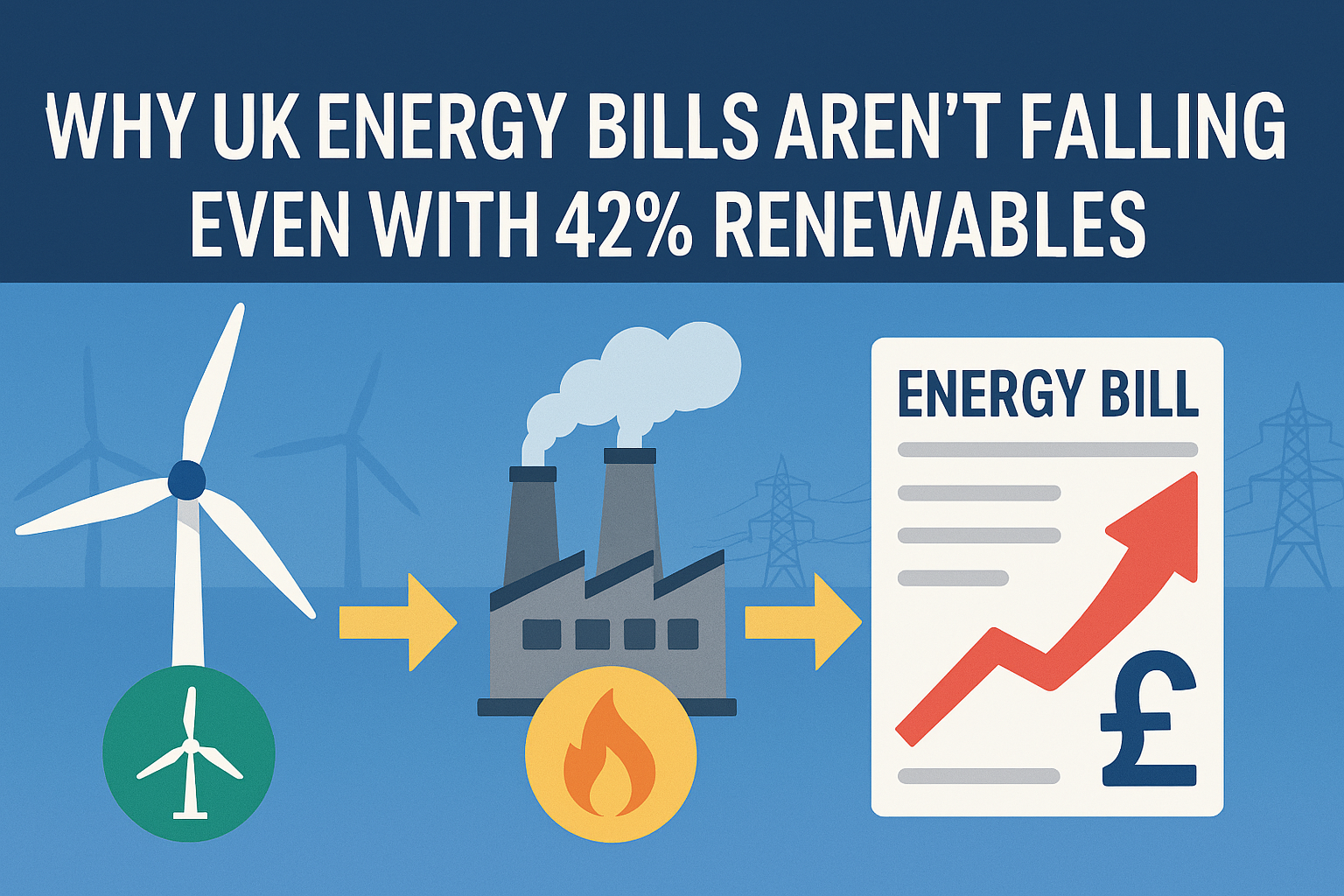
The UK's renewable energy revolution is undeniable: offshore wind turbines dot the horizon, solar panels cover rooftops across the country, and clean electricity now generates 42% of our power. Yet households opening their energy bills each quarter face a frustrating paradox, costs remain stubbornly high despite this green progress.
The disconnect lies in how electricity markets work. Even when renewables generate most of our power, bills are still set by the price of gas through a system called marginal pricing. Understanding this mechanism reveals why the renewable energy boom hasn't delivered the bill reductions many expected.
⚡ Energy Bill Reality Check
- 42.3% renewable electricity generation in 2025
- Marginal pricing system means gas plants set the price for all electricity
- Wind and solar receive the same high prices as expensive gas generation
- Household bills don't reflect the low cost of renewable electricity
- Market reform needed to pass clean energy savings to consumers
- Standing charges rising while renewable costs fall
🌱 The Renewable Foundation: Progress Without Reward
Renewables now generate just over 42% of UK electricity, a huge leap forward from just 15% a decade ago. Offshore wind leads the charge, supported by onshore wind, solar, hydro, and biomass. This represents remarkable progress, but it's not yet a majority share, and crucially, it hasn't delivered the household savings many expected.
The Scale of Renewable Growth
The transformation of UK electricity generation has been dramatic and swift:
🌊 Offshore Wind Dominance
- World leader: UK has the largest offshore wind capacity globally
- Rapid expansion: From almost zero to major electricity source in two decades
- Technology costs: Offshore wind now among cheapest forms of electricity generation
- Industrial success: Major job creation and export opportunities
- Future potential: Floating wind technology opens deeper water sites
☀️ Solar and Onshore Wind Growth
- Solar expansion: From niche technology to mainstream electricity source
- Cost reduction: Solar panel prices fallen by over 85% since 2010
- Onshore wind: Mature, reliable technology with strong public support
- Distributed generation: Households and businesses generating own electricity
- Grid integration: Smart systems managing variable renewable output
Why Progress Feels Invisible
Despite this remarkable transition, households see little benefit in their bills:
- Hidden savings: Renewable growth prevents bills from being even higher
- Counterfactual problem: Difficult to see what bills would be without renewables
- Gas price volatility: Fossil fuel price spikes mask renewable benefits
- System complexity: Multiple factors affect final household costs
- Political disconnect: Green energy success not translating to voter gratitude
🔍 The Current Energy Mix: Understanding What Powers Britain
To understand why bills remain high, we need to examine the complete picture of how Britain generates its electricity and how different sources contribute to the overall energy mix.
2025 Energy Generation Breakdown
The UK's electricity comes from a diverse portfolio of sources, each with different cost structures and market roles:
| Source | Share (%) | Notes |
|---|---|---|
| Renewables | 42.3% | Offshore wind dominates; solar and hydro growing rapidly |
| Fossil Fuels | 35.2% | Mainly natural gas; coal and oil minimal |
| Nuclear | 13.9% | Reliable baseload, but aging fleet |
| Imports & Storage | ~8.6% | Net imports from Europe + pumped storage losses |
The Critical Role of Gas
Despite representing only 35% of generation, gas plays a disproportionate role in setting electricity prices:
⚡ Marginal Generation
- Gas plants typically the "last generator" called upon to meet demand
- Can ramp up and down quickly to balance variable renewable output
- Sets the marginal price that all generators receive
- Higher fuel costs than renewables but provides essential flexibility
- Becomes price setter even when providing small share of total generation
💰 Price Volatility
- Gas prices subject to global commodity market fluctuations
- Geopolitical events significantly impact wholesale costs
- Seasonal demand patterns create price spikes
- Storage limitations increase vulnerability to supply disruptions
- Brexit and reduced Russian imports affect UK gas security
💡 The Pricing Reality Check: Why Renewables Don't Cut Bills
Here's the central paradox: even when renewables generate most of our electricity, bills are still tied to gas prices. This counterintuitive situation stems from how electricity markets determine prices through a system called marginal pricing.
Marginal Pricing Explained
The electricity market uses a "pay as cleared" system where all generators receive the same price, determined by the most expensive plant needed to meet demand:
1️⃣ Merit Order
Generators bid into the market in order of cost:
- Renewables: Wind, solar, hydro bid at near zero marginal cost
- Nuclear: Low marginal cost, runs continuously
- Coal/Gas: Higher costs due to fuel requirements
- Peak plants: Expensive but flexible generation for demand spikes
2️⃣ Demand Matching
The system calls up generators until demand is met:
- Low demand: Renewables and nuclear may meet most needs
- High demand: Gas plants required to fill the gap
- Calm weather: More gas needed when wind generation falls
- Peak periods: Evening demand requires most expensive generation
3️⃣ Price Setting
The last (most expensive) generator needed sets the price for everyone:
- Marginal generator: Usually gas plant determines market price
- All paid equally: Wind farms receive same price as expensive gas plants
- Consumer bills: Reflect this higher marginal price, not renewable costs
- Windfall profits: Cheap renewables earn excess revenues
Real World Example: A Windy Day
Consider a day when renewables generate 60% of electricity:
- Morning: Low demand met mostly by wind, nuclear, and solar
- Evening peak: Higher demand requires gas plants to start up
- Price setting: Gas plants set price at £80/MWh for the evening peak
- All generators: Wind farms also receive £80/MWh despite near-zero costs
- Consumer bills: Based on £80/MWh price, not the low cost of wind generation
- Market paradox: Households pay gas prices on a predominantly renewable day
🔄 The Bill Impact Paradox: When Green Doesn't Mean Cheap
The disconnect between renewable generation and consumer bills creates a frustrating paradox for households. On days when renewables supply most electricity, bills still reflect expensive gas prices, leading to growing public confusion and frustration.
Daily Market Dynamics
The paradox plays out differently across various market conditions:
🌬️ High Wind Day (Renewables 70%)
- Generation: Wind and solar meet most demand throughout day
- Gas role: Only needed for brief evening peak or backup
- Price setting: Gas plants still determine market price for all hours
- Consumer impact: Bills reflect gas costs despite minimal gas generation
- Public confusion: "Why are bills high when wind is free?"
🌅 Calm, Cloudy Day (Renewables 20%)
- Generation: Gas plants provide majority of electricity
- Price setting: Multiple gas plants set higher prices throughout day
- Consumer impact: Bills accurately reflect higher generation costs
- System stress: Reliance on expensive fossil fuel generation
- Price volatility: Higher and more variable electricity costs
Revenue Flows and Market Distortions
The current pricing system creates significant revenue flows and market distortions:
- Windfall revenues: Renewables earn high prices despite low costs
- CfD mechanisms: Some renewables pay back excess revenues to government
- Consumer frustration: Bills don't reflect renewable electricity consumption
- Investment signals: High prices incentivize all types of generation
- Political pressure: Voters don't see benefit from renewable investment
The "Free Wind" Misconception
Public frustration often centers on the misconception that renewable electricity should be free:
❓ Common Public Questions
- "Why aren't my bills falling if the wind is free?"
- "Don't solar panels mean cheaper electricity?"
- "Why do energy companies profit from free renewables?"
- "Shouldn't clean energy reduce my costs?"
- "What's the point of renewables if bills stay high?"
💰 Economic Reality
- Capital costs: Renewable infrastructure requires massive upfront investment
- System costs: Grid upgrades needed to handle variable generation
- Backup requirements: Conventional plants still needed for reliability
- Market design: Current system wasn't designed for high renewable shares
- Policy costs: Green subsidies and social programs funded through bills
🧾 Household Energy Bill Breakdown: Where Your Money Goes
Understanding why bills remain high requires examining all the components that make up household energy costs. Wholesale electricity represents only part of the final bill, with multiple other charges contributing to the total.
Bill Component Analysis
Household energy bills comprise multiple elements beyond just the cost of generating electricity:
| Component | What It Covers | Impact on Bills |
|---|---|---|
| Wholesale energy + gas markup | Marginal pricing: gas sets the wholesale rate for all electricity | High volatility |
| Supplier margin / company markup | Retail suppliers (EDF, Octopus, British Gas, etc.) add operating costs + profit | Varies by supplier |
| Standing charge | Grid upkeep, infrastructure upgrades, supplier obligations (regional variation) | Rising steadily |
| Policy & levies | Green schemes, social support programmes | Moderate, stable |
| VAT & admin | Tax and supplier overheads | Small but fixed |
The Key Detail: Compounding Markups
Households don't just pay wholesale energy costs, they pay wholesale + gas-linked markup + supplier margin. That's why bills remain stubbornly high even as renewables expand.
1️⃣ Wholesale Price Foundation
- Marginal pricing: Gas sets the base wholesale price
- Renewable discount lost: Low cost clean electricity priced at gas rates
- Volatility transmission: Gas price fluctuations affect all generation
- Market inefficiency: Price doesn't reflect generation mix
2️⃣ Supplier Margins
- Operating costs: Customer service, billing, marketing expenses
- Profit margins: Regulated but still significant component
- Risk premiums: Hedging against price volatility
- Competition effects: Market concentration limits price pressure
3️⃣ Fixed Charges
- Standing charges: Rising to fund grid upgrades for renewables
- Policy costs: Green schemes and social programs
- Network charges: Distribution and transmission infrastructure
- System costs: Balancing and ancillary services
🔀 How Energy Bill Costs Flow: Following the Money
Think of your household bill as a pipeline of costs flowing from generation to your final payment. Understanding this flow reveals why renewable savings get lost along the way and where potential reforms could make a difference.
The Energy Cost Pipeline
Energy costs flow through multiple stages before reaching household bills:
🌱 Stage 1: Generation
Where electricity is produced and priced
- Renewables produce cheap electricity with near-zero marginal costs
- Gas plants set the marginal price for all electricity
- All generators receive the same market price regardless of their costs
- Wind farms earn windfall profits when gas prices are high
- Price volatility created by fossil fuel market fluctuations
💷 Stage 2: CfD Mechanisms
How renewable revenue flows are managed
- Renewables under Contracts for Difference pay back excess revenues to Treasury
- When market prices exceed CfD strike price, generators return the difference
- Treasury receives billions in renewable energy paybacks during high price periods
- These funds offset system costs but aren't directly visible on bills
- CfD system protects consumers from some renewable cost increases
🏛️ Stage 3: Treasury and System Costs
How government manages energy policy costs
- CfD payback funds help offset other energy policy costs
- Government uses renewable revenues to fund grid upgrades
- System costs for balancing and backup generation
- Social programs like Warm Home Discount funded through bills
- Green levy costs partially offset by renewable paybacks
🏗️ Stage 4: Grid and Infrastructure
Network costs and infrastructure upgrades
- Standing charges fund transmission and distribution network upgrades
- Grid reinforcement needed to handle variable renewable generation
- Smart meter rollout and digital infrastructure investment
- Maintenance and replacement of aging network infrastructure
- Regional variations in network costs affect standing charges
🏢 Stage 5: Supplier Margins
Retail energy company costs and profits
- Energy companies add operating costs within Ofgem caps
- Customer service, billing, and marketing expenses
- Profit margins regulated but still significant
- Bad debt provisions and regulatory compliance costs
- Competition benefits limited by market concentration
🏠 Stage 6: Household Bills
Final cost breakdown reaching consumers
- Final bill = wholesale + markup + supplier margin + standing charges + levies + VAT
- Multiple layers of costs and markups compound the impact
- Renewable savings diluted through the cost flow pipeline
- Gas price volatility amplified by markup layers
- Consumers see total cost, not breakdown of individual components
Flow Summary: Where Renewable Savings Get Lost
The complete cost flow reveals why renewable electricity savings don't reach consumers:
Renewables → CfD Payback → Treasury → Grid Costs → Supplier Margin → Household Bills
- Marginal pricing: Renewable cost advantages lost at generation stage
- CfD complexity: Payback mechanisms not transparent to consumers
- Cost layers: Multiple markups compound the final price impact
- Policy costs: Green programs funded through bills rather than general taxation
- Market structure: System designed for fossil fuel generation, not renewable dominance
🔑 Key Takeaway: The Missing Link Between Green Progress and Consumer Benefit
The UK's renewable revolution is real and remarkable, 42% clean electricity generation represents a genuine achievement that has transformed Britain's energy landscape. Offshore wind farms dot the horizon, solar panels cover rooftops nationwide, and clean technologies now generate nearly half of our electricity.
Yet this green progress hasn't translated into cheaper household bills. The disconnect lies in the marginal pricing system that ties all electricity prices to the cost of gas, the most expensive generator needed to meet demand. Even on windy days when renewables provide 60% of electricity, consumers still pay prices set by gas plants filling the remaining gap.
This creates a frustrating paradox: households watch renewable energy expand while their bills remain stubbornly high. Wind farms earn windfall profits when gas prices spike, but consumers see none of the benefit from the low cost clean electricity they helped fund through green levies and taxes.
💡 Critical Market Dynamics
- Marginal pricing system designed for fossil fuel dominance now ill suited to renewable led electricity system
- Household bills reflect multiple cost layers beyond wholesale electricity prices
- Standing charges rising to fund grid upgrades needed for renewable energy integration
- CfD payback mechanisms provide some consumer protection but aren't visible in bills
- Market reform essential to pass renewable cost advantages to households
The solution requires fundamental electricity market reform that aligns pricing with the new reality of renewable dominated generation. Options include split pricing systems, green tariffs, long-term contracts, and smart demand response mechanisms that would allow consumers to access cheaper clean electricity directly.
Without reform, the political sustainability of renewable energy is at risk. Public support for clean technology depends partly on visible consumer benefits if households never see bill reductions despite massive renewable investment, political backing for continued expansion may weaken.
The current system also wastes economic efficiency. When renewable electricity costs pennies to generate but sells for pounds due to gas price setting, the market is sending wrong signals to investors, consumers, and policymakers about the true cost of clean energy.
Even without immediate bill relief, renewable expansion delivers crucial benefits: enhanced energy security through reduced fossil fuel imports, lower carbon emissions, job creation in clean technologies, and protection against future energy shocks. These advantages justify continued investment regardless of short-term bill impacts.
But the full potential of Britain's renewable revolution will only be realized when market rules change to reflect the reality of low cost clean electricity. Until then, households will continue paying gas prices for wind powered electricity, missing out on one of the primary promised benefits of the green transition.
Reforming pricing is the missing link between green progress and consumer benefit. The UK has successfully transformed its electricity generation, now it must transform how that electricity is priced and sold. Only then will households finally see cheaper bills as the reward for decades of renewable energy investment.