AI Use & Transparency: AI tools were used to support source discovery and to structure the article for clarity. All research, verification, drafting, and final editorial decisions are fully human led. Learn about our AI policy.
UKPoliticsDecoded is an IMPRESS regulated public interest publisher. Read our editorial standards.
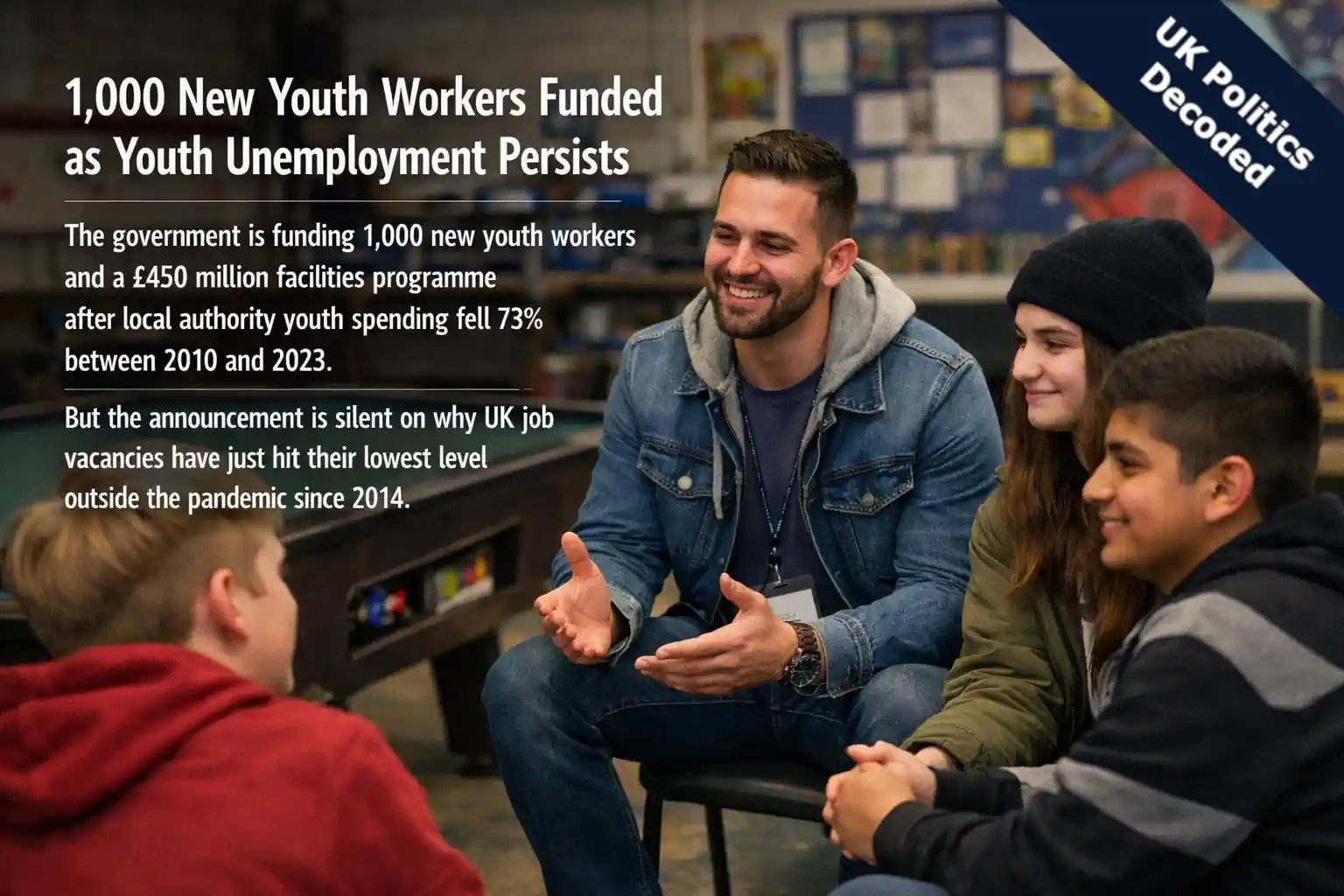
The government has launched a drive to train and employ 1,000 new youth workers across England, describing it as the largest investment into youth services in a generation. The Department for Digital, Culture, Media and Sport announced the programme on 26 September 2026, alongside a £450 million fund to build and improve youth facilities.
The push follows a steep decline in local authority spending on youth services, which fell by 73% between 2010 and 2023, according to a YMCA survey cited by the department. That drop, ministers say, stripped out youth worker roles and closed community spaces across England, leaving many young people without anywhere to turn outside school or home.
At a glance
- The government is funding 1,000 new youth workers, with the first in post by spring 2027.
- A £450 million Youth Matters Fund will help build and improve youth facilities and pay for enriching activities in England's most underserved areas.
- Local authority spending on youth services fell by 73% between 2010 and 2023, according to a YMCA survey.
- The new workers will support young people aged 11 and over, ahead of the social media ban for under 16s expected in spring 2027.
- Separate ONS figures show 981,000 young people aged 16 to 24 were NEET in April to June 2026, while UK job vacancies have fallen to their lowest level outside the pandemic since 2014.
Why Ministers Are Rebuilding the Youth Workforce Now
The 1,000 new youth workers are described by the department as the first step in rebuilding a workforce that has been hollowed out over more than a decade. The first workers are expected to be in position by spring 2027, timed to coincide with the rollout of the government's ban on social media for under 16s.
Youth workers recruited under the programme will work with young people aged 11 and above, both in community spaces and through outreach, with a particular focus on those judged most at risk of becoming NEET, meaning not in education, employment or training. The department says the workers will operate alongside multi agency teams spanning education, health and crime prevention, helping young people take part in sport, arts, mentoring and other youth work.
Officials have linked the recruitment drive to a longer term ambition for 500,000 more young people to have access to what the government calls a "trusted adult" by 2035.
What the £450 Million Youth Matters Fund Will Pay For
Alongside the workforce announcement, the government confirmed a £450 million programme called the Youth Matters Fund, which will open for applications "soon". The money is earmarked for building, improving and expanding youth facilities, alongside funding for youth work itself and enriching in person activities such as sport, music and volunteering, ahead of the social media restrictions taking effect.
What the Youth Matters Fund covers
- Construction and renovation of youth facilities, and purchase of capital equipment.
- Funding for youth work and enriching activities, aimed at halving the participation gap between disadvantaged young people and their peers.
- Central programme management and support for the wider rollout.
Both announcements sit under the government's National Youth Strategy, branded Youth Matters, which the Culture Secretary Lisa Nandy launched in December 2025. The strategy was co-produced with 14,000 young people aged 10 to 21, and up to 25 for those with special educational needs and disabilities, through a "State of the Nation" survey that the department says found many young people lacked access to safe, supportive spaces and had come to rely more heavily on online interaction in the absence of face to face opportunities.
Taken together, the strategy commits more than £500 million of government investment over the next decade, which ministers describe as an attempt to hand more control over youth provision back to local communities and let young people shape the services built around them.
Thursday's announcement is one part of a much larger cross government effort aimed at young people. The department points to 50 new Young Futures Hubs offering linked services on the main issues facing 10 to 18 year olds, £132 million for an "Every Child Can" programme, and £22.5 million for an Enrichment Expansion Programme funding activities in and around 400 schools.
There is also a £10 million partnership with the King's Trust to recruit and train trusted adults, and the £820 million Youth Guarantee, which is meant to ensure that everyone aged 18 to 24 has access to education, training, an apprenticeship or help finding a job. The government says fuller details of funding and delivery for the new youth worker programme will follow after further work with the youth services sector.
Why the Numbers Behind This Announcement Don't Add Up on Their Own
The government's youth worker announcement focuses entirely on supporting young people directly, through mentoring, facilities and trusted adults, but it says nothing about the economic conditions that determine whether there are jobs for those young people to move into once that support has done its work.
Separate labour market data illustrates the gap. The Office for National Statistics recorded 981,000 young people aged 16 to 24 as NEET in April to June 2026, or 13.0% of that age group, up 0.2 percentage points on the year. Of those, 393,000 were unemployed and the remaining 588,000 were economically inactive. Among 18 to 24 year olds specifically, 894,000 were NEET, a figure up 17,000 on the year.
At the same time, ONS estimates put UK job vacancies at 702,000 in June to August 2026, down 36,000 (4.9%) on the year and the lowest figure recorded outside the pandemic since 2014. Vacancies are now 86,000 below their pre-pandemic level, having fallen in 10 of 18 industry sectors over the quarter. The ONS has repeatedly noted that feedback from its Vacancy Survey points to smaller firms holding back on recruitment because of rising labour costs, a dynamic that tends to hit entry level and junior roles hardest, since employers facing higher costs and uncertain demand often prioritise retaining experienced staff over hiring and training newcomers.
That matters for a youth focused programme built around mentoring and trusted adults, because a trusted adult can help a young person build confidence, apply for jobs and stay engaged, but cannot manufacture a vacancy that does not exist. If fewer employers are creating entry level positions, more young people are likely to remain NEET for longer regardless of how much support they receive, and a growing share of that group risks ending up reliant on welfare support rather than moving into work.
Key Takeaways
- The government is funding 1,000 new youth workers and a £450 million Youth Matters Fund, part of a wider National Youth Strategy launched in December 2025.
- The push follows a 73% fall in local authority youth services spending between 2010 and 2023, according to a YMCA survey.
- The first new youth workers are due in post by spring 2027, timed alongside the rollout of the under 16s social media ban.
- ONS data shows 981,000 young people were NEET in April to June 2026, while UK job vacancies fell to 702,000, their lowest level outside the pandemic since 2014.
- The government has not yet set out how the announcement addresses the shrinking pool of entry level jobs that youth workers would ultimately be helping young people move into.
Sources & Further Reading
- GOV.UK - 1000 new youth workers to help reduce the risk of unemployment Archived copy (OGL): archived page
- ONS - Young people not in education, employment or training (NEET), UK: August 2026 Archived copy (OGL): archived page
- ONS - Vacancies and jobs in the UK: September 2026 Archived copy (OGL): archived page