AI Use: AI tools were used to support source discovery and to structure the article for clarity. All research, verification, drafting, and final editorial decisions are fully human led. Learn about our AI policy.
UKPoliticsDecoded is an IMPRESS regulated public interest publisher. Read our editorial standards.
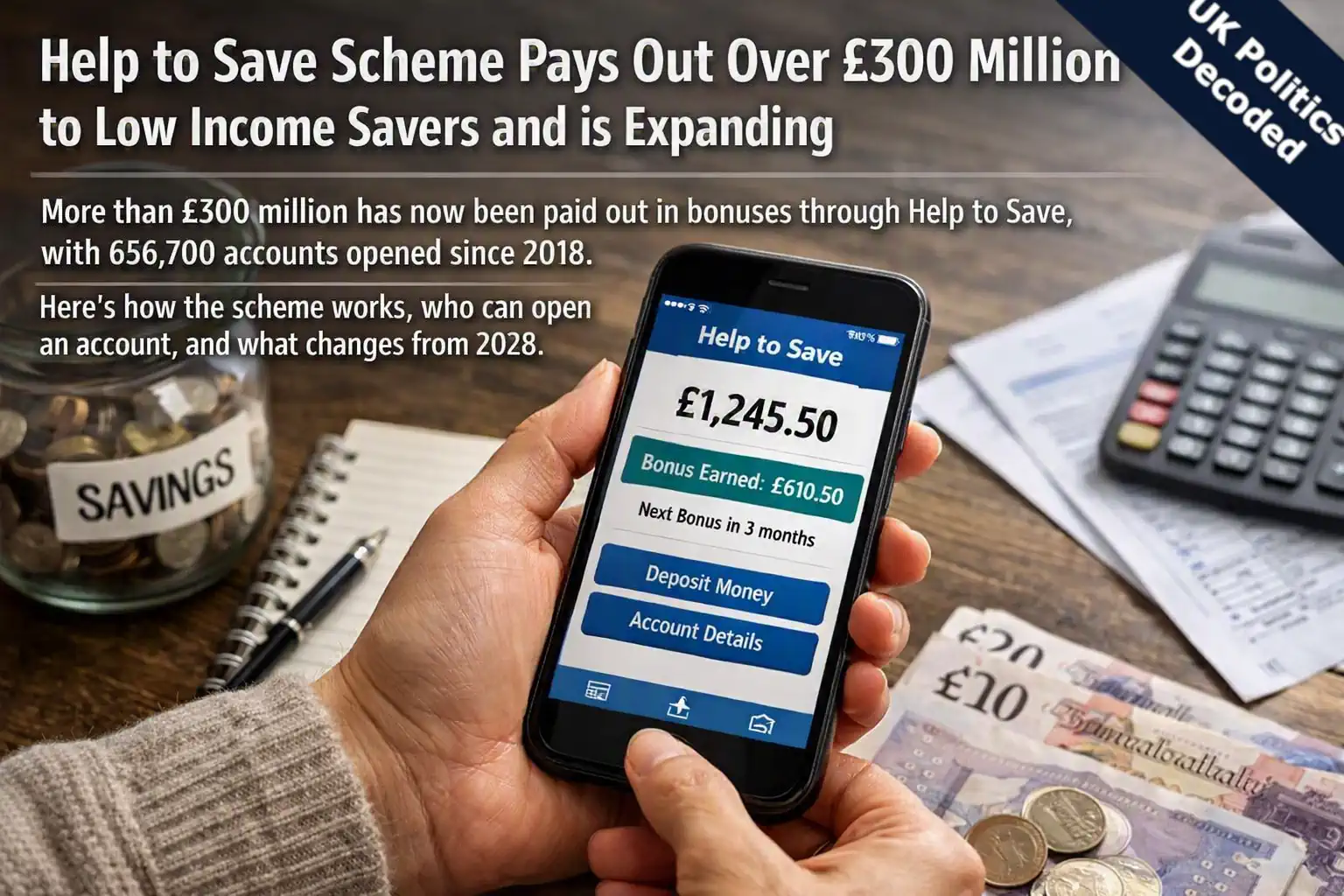
More than £300 million has now been paid out in government bonuses to people on low incomes through Help to Save, HM Revenue and Customs said on Monday. The announcement, timed to mark the start of UK Savings Week, comes alongside confirmation that eligibility for the scheme will widen substantially from 2028, opening it up to an estimated 1.5 million additional households.
Help to Save lets low income earners save between £1 and £50 a month and receive a 50% top up from the government on whatever they put in. Since launching in September 2018, 656,700 accounts have been opened, with savers depositing a combined £676.7 million.
At a glance
- More than £300 million has been paid out in Help to Save bonus payments since the scheme launched in September 2018.
- 656,700 Help to Save accounts have been opened, with savers depositing a total of £676.7 million.
- From 2028, the scheme will be opened to all Universal Credit claimants, regardless of earnings, adding an estimated 1.5 million eligible households.
- Help to Save, previously due to close, has now been made a permanent government savings scheme.
- 94% of people with a Help to Save account save the maximum £50 every month.
How the 50% Savings Bonus Actually Works
The mechanics of the scheme are straightforward. Savers can pay in anywhere between £1 and £50 a month, and for every £1 saved, the government adds an extra 50 pence. Accounts can stay open for up to four years, during which a saver can put aside a maximum of £2,400, unlocking a maximum government bonus of £1,200 on top.
Bonus payments land at two points, the end of year two and the end of year four. The first bonus is worked out as 50% of the highest balance a saver has held in that first two year period. The second, final bonus is calculated differently, and is based on how much a saver's highest balance has grown between the first two years and the last two.
If a saver's highest balance does not go up between those two periods, they do not receive a final bonus. Money can be withdrawn from the account at any time, though HMRC has been clear that doing so can reduce the size of the bonus a saver ultimately receives.
How the Two Bonus Payments Work
- After two years, savers receive a bonus equal to 50% of the highest balance held during those first two years.
- After four years, a second bonus is paid, equal to 50% of any increase between the highest balance held in years one and two, and the highest balance held in years three and four.
- No final bonus is paid if the highest balance has not increased over the four year period.
- Bonuses are paid directly into the saver's bank account, not into the Help to Save account itself.
Why 1.5 Million More Households Qualify From 2028
Help to Save has already been widened once. In April 2025, the earnings criteria were relaxed to include all working Universal Credit claimants, adding around 550,000 newly eligible people. The latest change goes further still. From 2028, HMRC says the earning threshold will be scrapped entirely for people with caring responsibilities, and the scheme will open to every Universal Credit claimant, working or not.
Combined, HMRC estimates that shift will make an additional 1.5 million households eligible to open an account. The scheme has had a longer than usual life span for what began as a time limited pilot. It was originally due to close in September 2023, was extended twice, first to April 2025 and then to April 2027, and has now been made permanent rather than facing another cliff edge deadline.
Economic Secretary to the Treasury Lucy Rigby said Help to Save was "a really beneficial scheme that offers a 50% government bonus on whatever you are able to save," adding that the government wanted "more eligible people to take advantage of it."
Your Bank Could Soon Offer Help to Save Directly
Alongside the eligibility changes, HMRC confirmed the scheme will move to a multi provider model. Until now, Help to Save has only been available through a single government administered route. In future, banks, building societies and credit unions will be able to offer the product directly to their own eligible customers.
Peter Tyler, Director of Personal Banking at UK Finance, welcomed the move, saying that "expanding Help to Save and enabling more financial services providers to offer the scheme directly is a positive step towards helping people build financial resilience." He added that the scheme gives eligible customers "a great opportunity and incentives to develop regular savings habits."
Money can currently be paid into an account by debit card, standing order or bank transfer, and HMRC data shows growing use of its app to manage accounts. Almost 24,000 people opened a Help to Save account through the HMRC app in the past year, using it to track deposits and monitor bonus payments.
What Changes for Savers
- All Universal Credit claimants become eligible from 2028, not just those in work.
- Earnings thresholds are dropped entirely for people with caring responsibilities.
- Accounts can eventually be opened directly through a saver's own bank, building society or credit union.
- The scheme's permanent status removes the risk of another closure deadline.
What Stays the Same
- The maximum monthly deposit remains £50, with a 50% government top up.
- Accounts still run for a maximum of four years, with two bonus payment points.
- Withdrawing savings early can still reduce the size of the bonus paid out.
- Applications can still be made online via GOV.UK or through the HMRC app.
Which Parts of the UK Are Saving the Most
HMRC's latest regional breakdown, covering account activity up to April 2026, shows England accounts for the bulk of activity, with 562,300 accounts open and £580.1 million deposited. The North West has the highest number of accounts of any English region outside London, with 83,750 open and £84.9 million saved.
Wales has 30,450 accounts holding £31.4 million in deposits, Scotland has 44,950 accounts holding £45.6 million, and Northern Ireland has 18,550 accounts holding £19.3 million. Across every region, the figures point to the same underlying pattern HMRC has highlighted nationally, the overwhelming majority of savers, 94%, are putting away the full £50 permitted each month, suggesting most people who sign up treat the scheme as a genuine savings habit rather than an occasional top up.
For a scheme aimed specifically at people on modest incomes, the scale of engagement is notable. Nearly two thirds of a million accounts have been opened over eight years, and the government's decision to make the scheme permanent, rather than extend it again on a fixed timetable, suggests officials see it as a long term fixture of the welfare and savings landscape rather than a temporary support measure.
The shift to a multi provider model is likely to be the more consequential change in practice. Removing HMRC's monopoly on delivering the scheme could make it easier for eligible savers to open an account through a bank they already use, rather than through a separate government service, potentially widening take up beyond the current 656,700 accounts.
Whether the 2028 eligibility expansion delivers the full 1.5 million additional accounts HMRC is forecasting will depend on awareness among Universal Credit claimants who do not currently work, a group that has historically been harder to reach with take up campaigns than working claimants already engaging with HMRC through payslips and tax codes.
Key Takeaways
- Help to Save has paid out more than £300 million in bonuses since launching in September 2018.
- 656,700 accounts have been opened, with savers depositing £676.7 million in total.
- From 2028, all Universal Credit claimants will become eligible, adding an estimated 1.5 million households.
- The scheme has been made permanent and will move to a multi provider model through banks, building societies and credit unions.
- 94% of current account holders save the maximum £50 allowed each month.