AI Use: AI tools were used to support source discovery and to structure the article for clarity. All research, verification, drafting, and final editorial decisions are fully human led. Learn about our AI policy.
UKPoliticsDecoded is an IMPRESS regulated public interest publisher. Read our editorial standards.
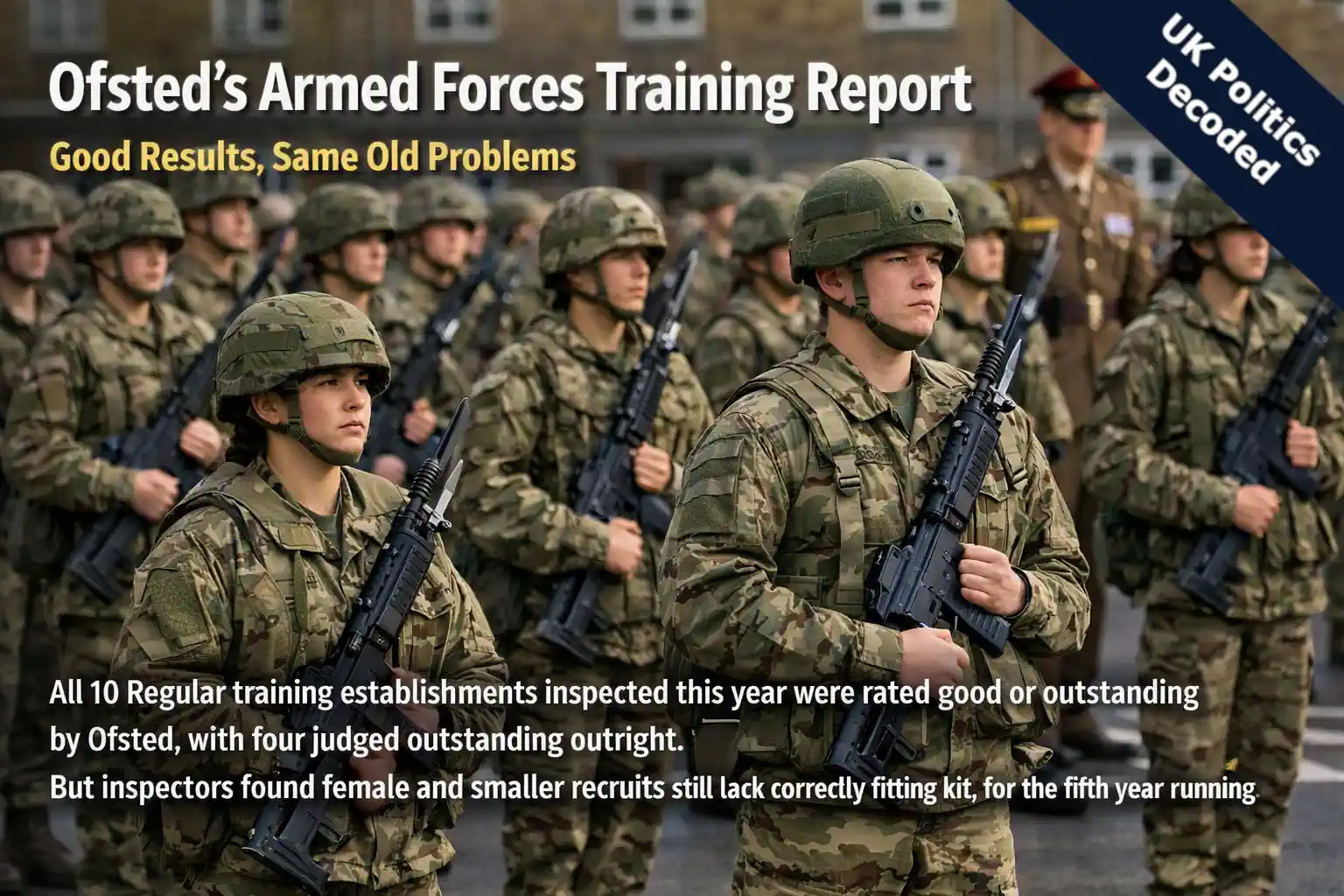
Ofsted published its 18th annual report on the welfare of Armed Forces recruits on 22 September, finding that every one of the 10 Regular training establishments inspected this year was rated good or outstanding. Four establishments, the Army Foundation College in Harrogate, the Defence Fire Training Unit, the Royal Marines and Royal Military Schools of Music, and Commando Training Centre Royal Marines, achieved the top grade.
Inspectors also carried out a combined inspection of the six University Royal Naval Units and their headquarters at Britannia Royal Naval College in Dartmouth, which was judged overall as requires improvement. No establishment was found inadequate. But alongside the positive headline grades, the report flags problems that have now persisted across several years of inspections, including recruits without kit that fits and accommodation that remains in poor condition.
At a glance
- All 10 Regular Armed Forces training establishments inspected this year were rated good or outstanding by Ofsted.
- Four establishments, including Army Foundation College Harrogate and Commando Training Centre Royal Marines, achieved the top outstanding grade.
- The combined inspection of six University Royal Naval Units was rated overall as requires improvement.
- For the fifth year in a row, inspectors found female and smaller trainees without correctly fitting kit or equipment.
- Poor infrastructure and accommodation remain unresolved despite Ministry of Defence improvement plans.
What Ofsted Inspected in the 2026 Armed Forces Training Report
The report covers the care, welfare and training arrangements for recruits, trainees and officer cadets across the Armed Forces' initial training system, known as phase 1 and phase 2 training. Phase 1 introduces new recruits to military life and basic skills, while phase 2 delivers the specialist technical and tactical training needed for a first professional role.
Inspectors visited 10 Regular establishments during 2025/26, spending between one and three days at each site depending on its size, with no more than two working days' notice given in advance. At the Ministry of Defence's request, no inspections of Reserve training took place this year, and the six University Royal Naval Units, at Birmingham, London, Manchester, Solent, Wales and Yorkshire, were assessed together as a single graded inspection under Britannia Royal Naval College.
Ofsted carries out this work under a memorandum of understanding between the Secretary of State for Defence and His Majesty's Chief Inspector, using an inspection handbook adapted from Ofsted's education inspection framework. Judgements are made on a four point scale running from outstanding down to inadequate, covering the quality of training and support, personal development, facilities and infrastructure, and leadership and management.
Six establishments were rated good, including the Defence Medical Academy, which the report notes had made "suitable improvements" since being rated requires improvement at its previous inspection. The academy trains personnel across the Army, RAF and Royal Navy, and operates across three sites, including Whittington Barracks and Stanford Hall.
Sir Martyn Oliver, His Majesty's Chief Inspector, described the results as showing "the clear commitment of staff to preparing trainees to be skilled members of the Armed Forces," pointing to strong pastoral support networks that link chains of command, trainers and civilian welfare staff. Calvin Bailey MBE, the Minister for Veterans and People, said in his foreword that the results demonstrate "the effort and dedication that goes into supporting our trainees' care and welfare," adding that most establishments had improved on their previous inspection outcomes.
How Ofsted grades establishments
- Inspectors judge each establishment on a four point scale, outstanding, good, requires improvement, or inadequate.
- Grading covers training quality, personal development, facilities and infrastructure, and leadership and management.
- Establishments receive no more than two working days' notice ahead of an inspection.
- Inspections run for one to three days depending on the size of the establishment.
Recruits Still Without Kit That Fits, Five Years Running
Despite the strong overall grades, Ofsted's report repeats a warning it has now made for five consecutive years, female and smaller trainees are still being issued with kit and equipment that does not fit them properly. Inspectors said recruits were "making do" with what was available, describing the situation as frustrating for trainees who want to represent their services professionally and perform at their best.
Sir Martyn Oliver called the persistence of the problem "disappointing," noting that it remains unresolved despite being raised in previous reports. Among Ofsted's formal recommendations this year is a direct call to "provide correctly fitting kit for all trainees, particularly for female trainees and those with a smaller frame."
What's working
- All 10 Regular establishments rated good or outstanding, with strong welfare support networks.
- The Defence Medical Academy improved from requires improvement to good since its last inspection.
- Staff maintain close oversight of trainee welfare, escalating concerns early where they arise.
What still needs fixing
- Female and smaller trainees still lack correctly fitting kit, for the fifth consecutive year.
- Poor infrastructure and accommodation continue to disrupt training at several sites.
- Some trainees face lengthy, unproductive holdover periods between training phases.
Why Barracks and Accommodation Keep Failing Ofsted's Standards
Infrastructure is the other recurring theme. Ofsted found that poor accommodation "remains a problem across too many of the establishments inspected this year," even where recent refurbishments had made a visible difference to trainees. The report says the Ministry of Defence has developed plans to improve training facilities, but that work is still needed to deliver consistently good accommodation and reliable facilities across the estate.
Calvin Bailey acknowledged the issue directly in his ministerial foreword, writing that improving the Defence Training Estate "is a priority for this government" and that ministers "will face these challenges head on." Sir Martyn Oliver went further, urging "senior colleagues in the MoD and across government to enable the swift improvements in infrastructure that are needed."
Inspectors also identified a separate issue affecting trainee morale, at a small number of establishments, recruits spent too long waiting in "holdover" between training phases or during pauses in courses, without productive activities to maintain the skills they had already learned. Ofsted's recommendations call for trainees in this position to be given meaningful development opportunities rather than idle time.
What Ministers Are Doing Now to Fix the Defence Training Estate
Ofsted's recommendations this year set out five areas for improvement, repairing accommodation defects and carrying out planned infrastructure work, giving trainees in holdover meaningful activities, providing correctly fitting kit for all recruits, strengthening how commanders use data to track trainees from different backgrounds, and using information from phase 1 training to better inform phase 2 starting points.
None of these recommendations are new in substance, several have appeared in previous years' reports, but the government has again committed to acting on them. The inspection framework itself is also due to be refreshed in September 2027, in line with changes to Ofsted's wider education inspection framework, which could affect how future reports are structured.
For now, the picture presented by Ofsted's 18th annual report is one of consistently good training and strong pastoral care, sitting alongside practical failures that have proven harder to fix. Whether next year's report shows the kit and accommodation problems finally resolved will be one of the clearest tests of whether this year's ministerial commitments translate into change on the ground.
Key Takeaways
- All 10 Regular Armed Forces training establishments inspected in 2025/26 were rated good or outstanding by Ofsted.
- Four establishments, Army Foundation College Harrogate, Defence Fire Training Unit, the Royal Marines and Royal Military Schools of Music, and Commando Training Centre Royal Marines, were judged outstanding.
- The combined inspection of six University Royal Naval Units under Britannia Royal Naval College was rated requires improvement.
- For the fifth year running, inspectors found female and smaller trainees without correctly fitting kit or equipment.
- Ministers have committed to improving the Defence Training Estate, but Ofsted's recommendations on kit and accommodation largely repeat previous years' findings.
Sources & Further Reading
- GOV.UK - Ofsted publishes annual report on Armed Forces initial training Archived copy (OGL): archived page
- GOV.UK - Welfare and duty of care in Armed Forces initial training 2025 to 2026 Archived copy (OGL): archived page