AI Use & Transparency: AI tools were used to support source discovery and to structure the article for clarity. All research, verification, drafting, and final editorial decisions are fully human led. Learn about our AI policy.
UKPoliticsDecoded is an IMPRESS regulated public interest publisher. Read our editorial standards.
The Department for Work and Pensions has published long run modelling showing what an adjusted Triple Lock, due to start in April 2030, would mean for public spending and pensioner poverty. The research paper, released on 29 September 2026, estimates the change would cut State Pension spending by £15 billion in 2039 to 2040 and £50 billion in 2049 to 2050, compared with keeping the current Triple Lock.
Those are nominal figures, and the department is careful to describe them as illustrative. They are not forecasts of government policy, and DWP says they should not be used to work out savings for any single year.
At a glance
- DWP published its State Pension uprating analysis on 29 September 2026, covering an adjusted Triple Lock that would begin in April 2030.
- Under the adjusted version, annual spending on State Pensions is estimated at £15 billion lower in 2039 to 2040 and £50 billion lower in 2049 to 2050 in nominal terms.
- In real terms, at 2025 to 2026 prices, the estimated savings are £11 billion in 2039 to 2040 and £30 billion in 2049 to 2050.
- Pensioner relative poverty after housing costs is projected to fall from around 14% in 2024 to 2025 to around 8% in 2049 to 2050.
- DWP stresses the results are conditional projections built on assumptions, not predictions of future poverty rates or government policy.
What Is Changing in the State Pension Triple Lock From April 2030?
The government has committed to uprating the State Pension using the Triple Lock throughout this parliament. Under that rule, the basic State Pension and the full rate of the new State Pension rise each year by the highest of average earnings growth, consumer price index inflation or 2.5%. DWP says this will take the pension to a record high relative to earnings over the coming three years.
From April 2030, the mechanism changes. The government will adjust the Triple Lock so that the pension still goes up every year by at least inflation or 2.5%, plus whatever extra is needed to keep it at that record high value relative to earnings. In practice, the paper says, this means the State Pension is set to rise in line with average earnings over time.
The distinction matters because the current Triple Lock can keep pushing the pension ahead of earnings whenever inflation or the 2.5% floor comes out on top. The adjusted version holds the pension's position against earnings steady once the record high has been reached, rather than letting it climb further.
How Much Would the Adjusted Triple Lock Save?
DWP compared projected State Pension spending under the adjusted mechanism with spending under the current Triple Lock. A negative figure in the paper represents a saving, and a positive one an additional cost. All the results published so far are savings.
In nominal terms, rounded to the nearest billion, the difference in annual spending is £15 billion in 2039 to 2040, rising to £50 billion in 2049 to 2050. Adjusted for inflation to 2025 to 2026 prices, those figures become £11 billion and £30 billion respectively. These are direct effects on Annually Managed Expenditure, the part of the public spending budget that covers demand led items such as pensions. They do not include tax or debt interest effects.
Nominal terms
- Estimated saving of £15 billion in 2039 to 2040.
- Estimated saving of £50 billion in 2049 to 2050.
- Rounded to the nearest billion.
Real terms (2025 to 2026 prices)
- Estimated saving of £11 billion in 2039 to 2040.
- Estimated saving of £30 billion in 2049 to 2050.
- Rounded to the nearest billion.
DWP adds a specific warning about how the numbers should be used. Because the two mechanisms respond differently to movements in earnings and inflation, and those differences compound over time, the savings are only reliable as long term estimates. The paper says they should not be used to derive point estimates for an individual year.
Would Pensioner Poverty Fall Under the Adjusted Triple Lock?
The paper also looks at who would be better or worse off. Its central finding is that pensioner relative poverty after housing costs is projected to fall under the adjusted Triple Lock, from around 14% in 2024 to 2025 to around 8% in 2049 to 2050.
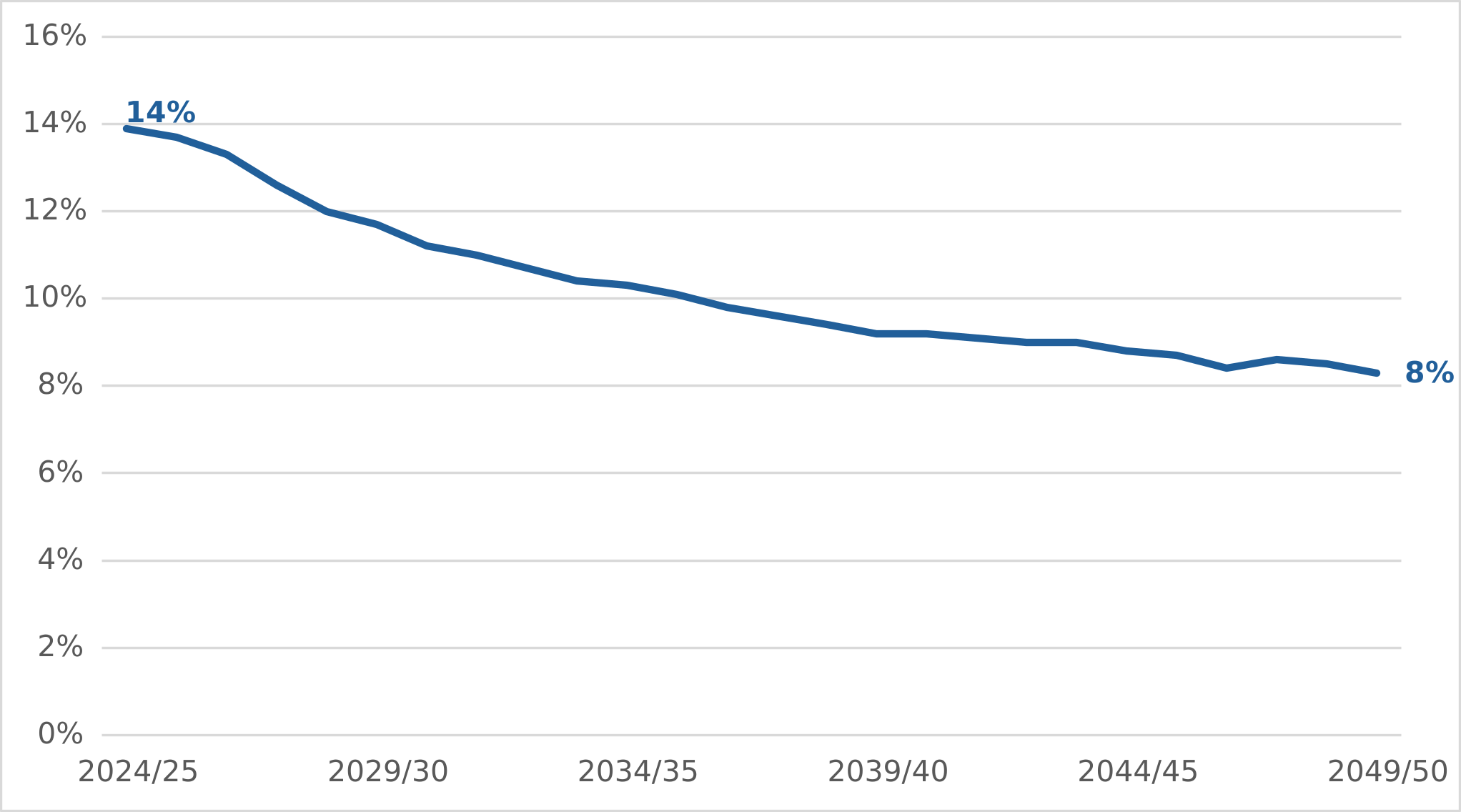
Relative low income here means household income below 60% of the contemporary median. DWP compared modelled incomes of people above State Pension age with a poverty threshold based on Households Below Average Income data for the financial year ending 2025, projected forward in line with average earnings growth. Housing costs were projected using tenure, age and income quintile.
Because the threshold moves with earnings, and the adjusted Triple Lock keeps the pension at a fixed record high value relative to earnings, the two rise together. The department describes the poverty results as projections conditional on its assumptions, rather than predictions of future poverty rates.
How DWP Modelled the Triple Lock Savings, and the Limits of the Numbers
The estimates come from Pensim3, DWP's dynamic microsimulation model, which draws on administrative and survey data including the Family Resources Survey to project the population and individual pension outcomes from 2018 to 2100. The analysis covers Great Britain and uses the Office for National Statistics 2024 based national population projections. Elements of the pre 2016 State Pension that fall outside the Triple Lock are assumed to continue rising with CPI.
How the comparison was built
- Pensim3 projects State Pension values for the basic and new State Pension under each uprating mechanism in future years.
- Long run spending under the adjusted Triple Lock is compared with spending under the current Triple Lock.
- Results are shown in nominal terms and in real terms at 2025 to 2026 prices.
- Modelled pensioner incomes are compared with a projected relative low income threshold after housing costs.
The department is open about the limits. Pensim3 relies on assumptions about demographic change, labour market behaviour, pension participation, benefit receipt and the wider economy, and outcomes become more uncertain further into the projection period. The analysis isolates the effect of uprating policy and does not capture behavioural responses or wider policy and macroeconomic changes.
Expenditure estimates also depend on future earnings growth, inflation, caseloads, mortality, migration and State Pension entitlements. DWP says the results should be read as broad indications of direction and scale.
The publication is described as ad hoc analysis intended to support public understanding of the change. In its statement of compliance with the Code of Practice for Statistics, DWP says releasing the figures serves the public interest and gives equal access to everyone interested in them. It also says publication reduces the administrative burden of answering parliamentary questions, Freedom of Information requests and other ad hoc enquiries.
Key Takeaways
- The government will adjust the Triple Lock from April 2030 so the State Pension keeps its record high value relative to earnings while still rising by at least inflation or 2.5% each year.
- DWP estimates the adjusted version would cost £15 billion less than the current Triple Lock in 2039 to 2040 and £50 billion less in 2049 to 2050, in nominal terms.
- In 2025 to 2026 prices, the estimated annual savings are £11 billion in 2039 to 2040 and £30 billion in 2049 to 2050.
- Pensioner relative poverty after housing costs is projected to fall from around 14% to around 8% between 2024 to 2025 and 2049 to 2050.
- The department says the figures are long run illustrations from the Pensim3 model, covering Great Britain, and should not be used to estimate savings in any single year.