AI Use: AI tools were used to support source discovery and to structure the article for clarity. All research, verification, drafting, and final editorial decisions are fully human led. Learn about our AI policy.
UKPoliticsDecoded is an IMPRESS regulated public interest publisher. Read our editorial standards.
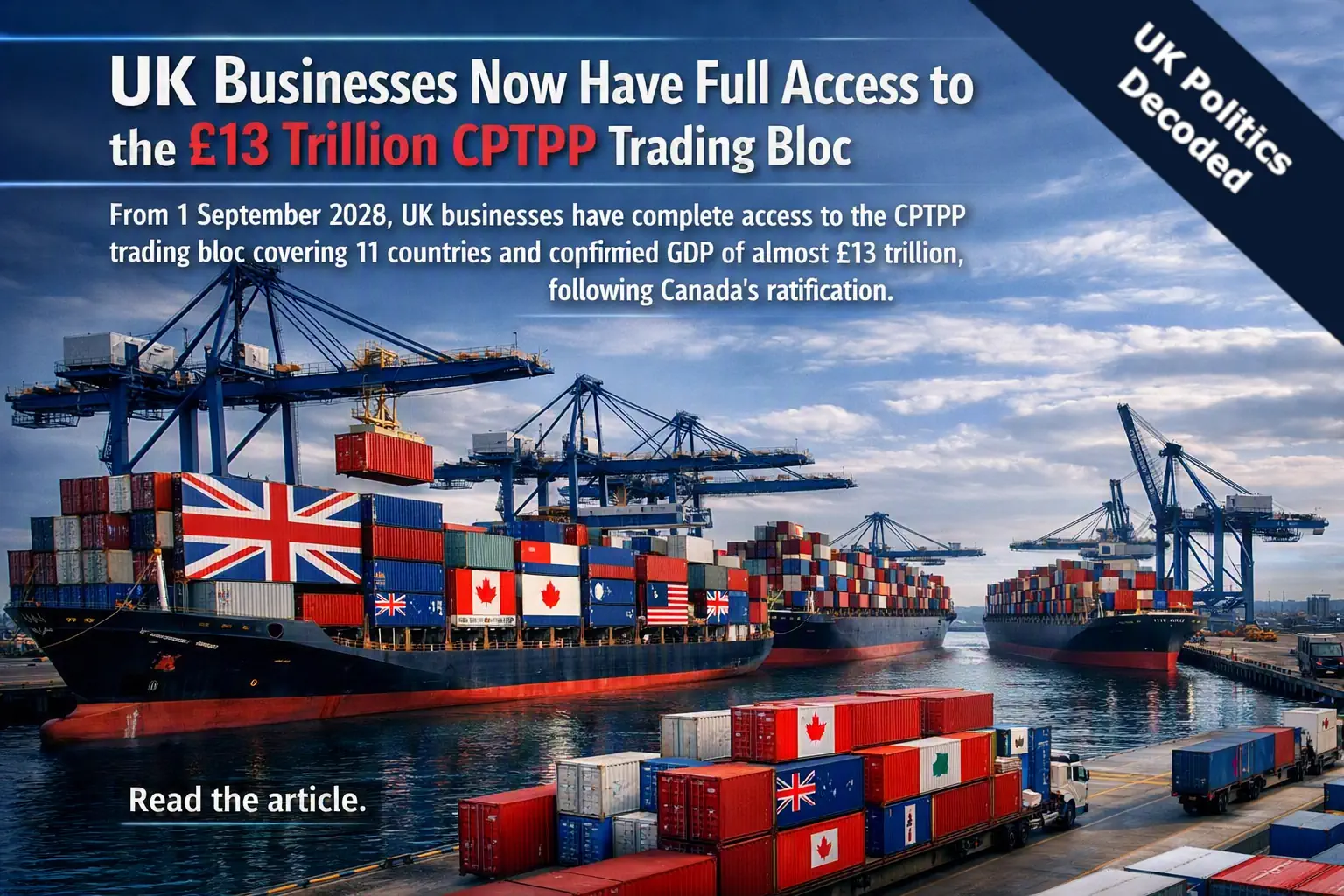
Canada was the final piece. When its parliament ratified the UK's accession to the Comprehensive and Progressive Agreement for Trans Pacific Partnership on 3 July 2026, the clock started on a 60 day countdown. From today, 1 September, British businesses have access to all 11 CPTPP member countries, a trading bloc that, with the UK included, covers economies worth almost £13 trillion in combined GDP, based on IMF World Economic Outlook data for 2025.
The UK signed the CPTPP in 2023 and the agreement entered into force with the first ratifying countries in 2024. Canada was the last of the existing members to complete its ratification process. With that done, over 99% of current UK goods exports to CPTPP countries are eligible for zero tariffs, and a specific set of business mobility and procurement provisions with Canada comes into force alongside.
At a glance
- From 1 September 2026, the UK has full access to all 11 CPTPP member countries, with Canada having been the final country to ratify on 3 July 2026.
- The combined GDP of all CPTPP members and the UK is worth almost £13 trillion in 2025, based on IMF World Economic Outlook figures.
- Over 99% of current UK goods exports to CPTPP member countries are eligible for zero tariffs.
- UK business visitors to Canada can now stay for up to six months under CPTPP business mobility rules, compared with the previous 90 day limit under the UK-Canada Trade Continuity Agreement.
- Full accession also opens new public procurement opportunities with Canada in sectors including air transport, accounting, and financial services.
- The government's central long run estimate is that CPTPP membership will add around £2 billion a year to UK GDP.
What Full Membership Means for UK Goods and Services Exporters
The practical benefit from full CPTPP membership comes in two main forms, tariff elimination and rules of origin flexibility. On tariffs, more than 99% of UK goods exports to CPTPP member countries will now qualify for zero rate treatment. Many UK goods already traded on preferential terms under bilateral agreements with countries such as Japan, Australia, and New Zealand. CPTPP extends those gains further, most significantly in Malaysia, where UK exports previously faced standard non preferential tariff rates and will now benefit from preferential access for the first time.
For UK importers, the agreement will gradually remove tariffs on goods arriving from CPTPP members. The official impact assessment pointed to products such as fruit juices from Chile and Peru, honey and chocolate from Mexico, and vacuum cleaners from Malaysia as examples where consumers and businesses can expect lower import prices, though the extent to which savings are passed through will depend on individual businesses.
Rules of origin provisions are also commercially significant. Under CPTPP, UK manufacturers can use inputs sourced from any member country in the production of their goods and still qualify for preferential tariff treatment across the whole bloc. That directly benefits businesses whose supply chains already span multiple CPTPP markets.
On services, the UK exported around £32 billion worth of services to CPTPP countries in 2022. The agreement sets rules that prevent CPTPP members from discriminating against UK service providers, ban requirements to establish a local office before supplying services, and restrict quantitative limits on cross border trade in services, giving UK professional and financial services firms a firmer legal footing in member markets.
New Business Mobility and Procurement Rules With Canada
Canada's ratification brings a distinct set of provisions into effect that were not covered by the UK-Canada Trade Continuity Agreement that predates CPTPP. On business mobility, eligible UK business visitors can now remain in Canada for up to six months. Previously, the Trade Continuity Agreement set a limit of 90 days in any six month period. The change has direct relevance for companies with operational staff, engineers, and technical specialists who need extended time at client sites in Canada.
Full accession also opens both countries' public procurement markets to each other in areas not previously covered. UK suppliers of goods and services gain new access to Canadian government contracts in sectors including air transport, accounting, and financial services, areas that were effectively off the table under existing bilateral arrangements.
Minister for Trade Anas Sarwar said the UK's full CPTPP access would bring new opportunities for British businesses across some of the world's fastest growing markets, whether selling food and drink or winning public contracts. Chancellor John Healey, who met with Canadian Finance Minister François-Philippe Champagne at the G20 Finance Ministers summit in North Carolina, described it as opening the door to new customers, contracts, and investment.
What the Government's £2 Billion GDP Projection Actually Represents
The headline economic figure, £2 billion added to UK GDP a year, in the long run, comes from the impact assessment published by the Department for Business and Trade. It is worth being precise about what it covers and what it does not.
The £2 billion is an estimate of the incremental gain from CPTPP membership above and beyond what the UK was already gaining from existing bilateral trade agreements with members such as Japan, Australia, and New Zealand. It measures the additional liberalisation, not the full value of the UK's trading relationship with the CPTPP group. The impact assessment puts the standalone value of that wider relationship compared with a scenario where no agreements existed with any member, at around £13.5 billion per year in long run GDP gains, though with acknowledged greater uncertainty.
Alongside the GDP estimate, the assessment projects that UK bilateral trade with CPTPP members could increase by £4.9 billion compared to 2040 projections, and that real take home pay for UK workers could rise by approximately 0.1%, equivalent to around £1 billion across the workforce. Nineteen of 23 modelled UK sectors are expected to expand as a result of accession, with four sectors projected to see slower growth relative to the baseline, primarily due to increased competition from CPTPP exporters. As with all trade modelling, these are long run central estimates based on data from before 2022, and carry inherent uncertainty.
Key Takeaways
- From 1 September 2026, the UK has full access to all 11 CPTPP member countries following Canada's ratification, completing a process that began when the UK signed the agreement in 2023.
- Over 99% of current UK goods exports to CPTPP member countries are now eligible for zero tariffs, with Malaysia representing a particularly significant gain where UK exports previously faced standard non preferential rates.
- Eligible UK business visitors can now stay in Canada for up to six months under CPTPP mobility rules, compared with the previous 90 day limit under the bilateral Trade Continuity Agreement.
- Full accession opens new public procurement access in Canada for UK suppliers, including in air transport, accounting, and financial services.
- The government's central long run estimate is that CPTPP will add around £2 billion a year to UK GDP, an incremental figure above existing bilateral agreements, not a measure of the full trading relationship.
- UK bilateral trade with CPTPP could increase by £4.9 billion against 2040 projections, with 19 out of 23 UK sectors expected to expand as a result of accession.
Sources & Further Reading
- GOV.UK - UK secures full access to £13 trillion CPTPP trading bloc (Department for Business, Innovation, Science and Trade, 1 September 2026) Archived copy (OGL): archived page
- GOV.UK - Impact Assessment of the UK's Accession to the CPTPP: Executive Summary (Department for Business and Trade, 2024) Archived copy (OGL): archived page