AI Use: AI tools were used to support source discovery and to structure the article for clarity. All research, verification, drafting, and final editorial decisions are fully human led. Learn about our AI policy.
UKPoliticsDecoded is an IMPRESS regulated public interest publisher. Read our editorial standards.
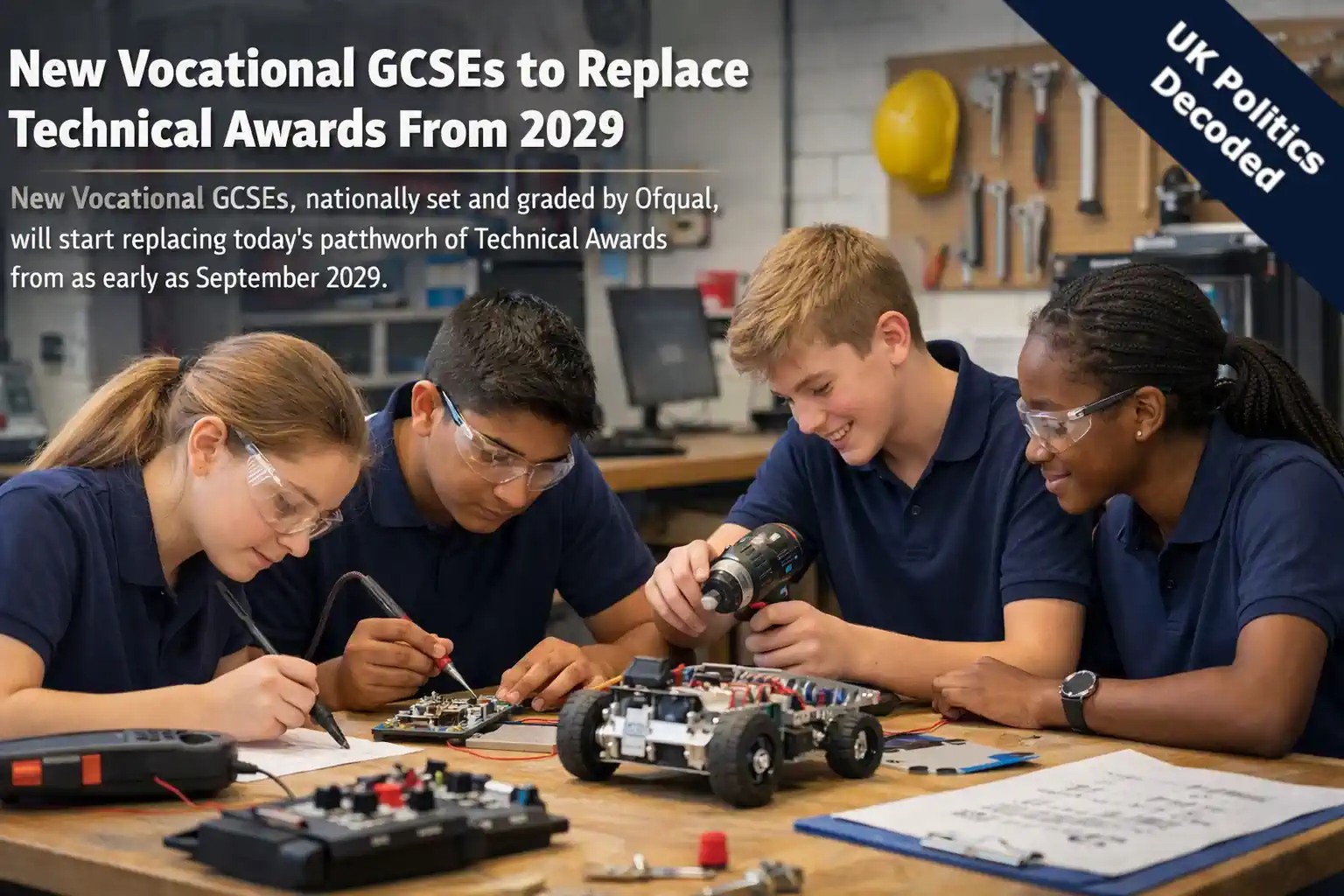
The Department for Education announced on 23 September that every secondary school pupil will be able to study new Vocational GCSEs, a nationally set qualification designed to sit alongside traditional GCSEs rather than replace them. The new qualifications will eventually take over from Technical Awards, which the department says currently vary by provider, lack nationally agreed content and do not consistently support progression into further study.
The announcement is billed by ministers as delivering on a commitment Prime Minister Andy Burnham made in his first week in the role, to put technical education "on an equal footing" with the traditional academic path. It comes alongside a separate push, the National Mission on Work Experience, calling on employers to create 200,000 additional placements for 14 to 16 year olds this academic year.
At a glance
- New Vocational GCSEs will be the same size as existing GCSEs, with nationally set content and grading regulated by Ofqual to ensure parity with academic subjects.
- They will eventually replace Technical Awards, which the Department for Education says currently vary by provider and lack consistent national content.
- The qualifications are expected in some subjects from as early as September 2029, building on new technical pathways due to start in September 2028.
- A National Mission on Work Experience is calling on employers to create 200,000 extra placements for pupils aged 14 to 16 this academic year.
- English, maths and science remain a common entitlement for every pupil alongside the new vocational options.
What Subjects the New Vocational GCSEs Will Cover, and When
The new qualifications will be the same size as a standard GCSE, with subject content developed on the advice of subject experts rather than set independently by individual awarding bodies. Assessment and grading will be regulated by Ofqual, the exams regulator, in a move the Department for Education says is intended to give the qualifications full parity with traditional GCSEs in the eyes of parents, colleges, universities and employers.
Possible subject areas floated by the department include Business Management and Finance, Creative Media Production, Digital Tech, Child Development, and Building and Construction. These are described as potential options rather than a confirmed list, with new subjects to be developed as part of a wider review of existing GCSEs alongside the vocational additions. The stated goal is to give pupils "greater choice" while avoiding duplication between the new qualifications and subjects already on offer.
English, maths and science will stay a common entitlement for all pupils regardless of the vocational options they choose. The department says the full suite of qualifications on offer at age 14, spanning GCSEs, the new Vocational GCSEs, T Levels and the forthcoming V Levels, will be aligned so pupils have a clear route through to A Levels, further study or an apprenticeship.
Timing is staged. New technical pathways are due to begin in September 2028, with Vocational GCSEs following in some subjects from as early as September 2029. Alongside this, 16 year olds will be able to take the first V Levels in Education, Finance and Digital from September 2027, and new T Levels in Sports, Fitness and Exercise Science, and Care Services are due to launch in 2028. A consultation is planned later this year, giving local leaders, employers, schools and colleges a say in which subjects the new qualifications should ultimately cover.
Confirmed So Far
- Vocational GCSEs will be nationally set, Ofqual regulated, and the same size as existing GCSEs.
- They will sit alongside, not replace, the academic core of English, maths and science.
- V Levels in Education, Finance and Digital start for 16 year olds from September 2027.
- New T Levels in Sports, Fitness and Exercise Science, and Care Services are due from 2028.
The qualification changes are being launched alongside the National Mission on Work Experience, a joint effort with the Good Growth Business Forum and other business groups to secure 200,000 additional work experience placements for pupils aged 14 to 16. The Department for Education describes it as "a call to arms" to employers, with mayors and local authorities asked to help connect schools with businesses in sectors such as accountancy, digital media and construction. Employers wanting to offer placements are directed to their local Careers Hub.
Downing Street's own operation, referred to by the department as No10 North, will set up work experience placements for 14 to 16 year olds during the current academic year, intended to give pupils direct exposure to government work. Business groups involved in the mission include the British Chambers of Commerce, the Confederation of British Industry, the Federation of Small Businesses, Make UK and the Trades Union Congress, among others sitting on the Good Growth Business Forum.
The Department for Education points to two independent reviews to justify the scale of the changes. An interim report on young people not in education, employment or training, commissioned from Alan Milburn, warned that Britain risks a "lost generation," with roughly 1 million young people currently NEET. Milburn's report found "strong evidence" that practical, hands on learning helps reduce the risk of young people falling into that group.
A separate White Working Class Inquiry concluded that the technical and vocational education system is currently "broken" for disadvantaged pupils, despite vocational routes being highly valued by white working class families. It recommended a significant structural overhaul of technical and vocational provision to help close gaps in opportunity between disadvantaged pupils and their peers.
What Happens Next, and When Pupils Will Actually See Change
Nothing changes for pupils sitting exams this year or next. The department has been clear that the new qualifications, and the technical pathways that precede them, are phased in gradually between 2027 and 2029, giving schools, awarding bodies and Ofqual time to develop content and assessment before any Vocational GCSE is actually sat. A consultation later this year is intended to shape exactly which subjects make the cut, with local leaders, employers and education providers all invited to contribute.
The government has also signalled it will adjust school performance measures and the Ofsted accountability framework so that schools are not penalised, and are instead incentivised, for offering the new qualifications. Whether that adjustment persuades schools already stretched by existing GCSE timetables to take up the new subjects at scale is likely to become clearer once the consultation responses and subject list are published.
Key Takeaways
- New Vocational GCSEs will be nationally set and Ofqual regulated, sitting alongside traditional GCSEs rather than replacing the academic core.
- They will eventually replace Technical Awards, which the Department for Education says lack consistent national content today.
- The first Vocational GCSEs are expected from as early as September 2029, following new technical pathways starting in September 2028.
- A National Mission on Work Experience is asking employers for 200,000 extra placements for 14 to 16 year olds this academic year.
- The reforms follow warnings from an Alan Milburn led review and the White Working Class Inquiry that roughly 1 million young people are currently not in education, employment or training.