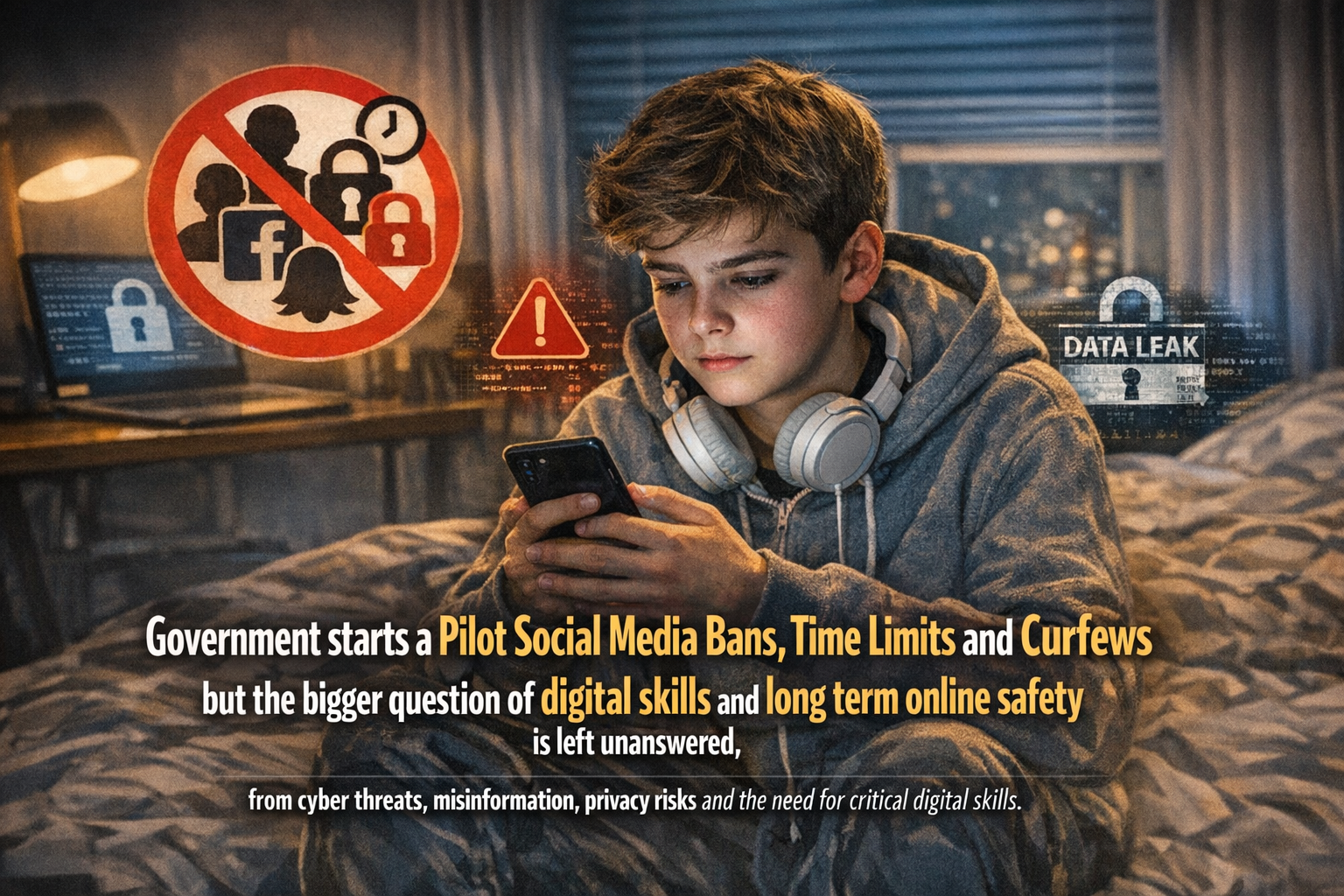
The UK Government has launched a six week pilot involving 300 families across all four nations of the UK, testing different types of social media restrictions for teenagers. The pilot is running at the same time as a national public consultation on children's digital wellbeing, which closes on 26 May 2026 and has already received nearly 30,000 responses from parents and children.
The aim is to gather real world evidence about what actually works before the government decides on its next steps. Technology Secretary Liz Kendall said the government wants to give young people "the childhood they deserve" and is "listening to parents, children and experts" to make sure any decisions are based on evidence from families themselves.
📋 At a Glance
- 300 families taking part across England, Scotland, Wales and Northern Ireland
- Six week pilot testing four different types of restriction
- Nearly 30,000 responses already submitted to the national consultation
- Consultation closes 26 May 2026, open to parents, children, educators and the public
- Government response expected in summer 2026
📱 What Is Actually Being Tested?
Families taking part in the pilot are randomly assigned to one of four groups. Each group tests a different approach to restricting social media access.
Group A: Full Social Media Ban
Parents in this group are shown how to use device controls to completely remove or disable selected social media apps. This group is effectively testing what a legally enforced social media ban at home might look like in practice.
Group B: One Hour Per Day Limit
A daily cap of one hour is applied to the most popular social media apps for teenagers, including Instagram, TikTok and Snapchat. Once the hour is used up, access is blocked for the rest of the day.
Group C: Digital Curfew
Social media is blocked between 9pm and 7am, leaving children free to use these apps before and after school hours. The aim is to test whether restricting evening and overnight access improves sleep and family time.
Group D: Control Group (No Change)
This group carries on as normal, with no changes to how children currently use social media. Their experiences are compared against the other three groups to measure the real difference each restriction makes.
What Will Be Measured?
Both parents and children will be interviewed at the start and end of the pilot. The government wants to understand the impact on:
- Sleep - are children sleeping better with restrictions in place?
- Schoolwork - does limiting social media improve focus and attainment?
- Family life - how does restriction affect relationships at home?
- Practical challenges - are parents able to set up controls, and are teenagers finding ways around them?
The results will be assessed by government officials and a panel of academics, alongside the responses submitted to the national consultation.
🔬 Related Research: The World's First Major Randomised Trial
Separate from the government pilot, the UK is also now home to the world's first major randomised controlled trial looking at the effects of reducing social media use among teenagers. This is an independent scientific study, funded by the Wellcome Trust.
The trial is co-led by the Bradford Institute for Health Research and Professor Amy Orben, a psychologist at the University of Cambridge. It is set to begin later in 2026 and will recruit from ten Bradford secondary schools, involving around 4,000 students aged 12 to 15 across school years 8, 9 and 10.
Professor Amy Orben said:
"We currently lack critical insights about how different types of social media policies might work in practice. Large randomised controlled trials, like the one in Bradford, will allow us to both better understand the impact of social media and select interventions that work for young people as well as their families."
The Bradford trial will look at changes in:
- Anxiety and mental health
- Sleep quality
- Overall wellbeing
- Body image and social comparison
- Bullying
- School absences
- Time spent with friends and family
👨👩👧 New Guidance and Campaigns for Parents
Later this week, the government will publish new practical advice on screen use for children under five. This guidance has been developed with parents, the Children's Commissioner Dame Rachel de Souza, and leading experts to offer advice that parents can trust.
The government has also launched a new campaign called "You Won't Know Until You Ask", which is designed to help parents start conversations with their children about what they see online. The campaign gives families:
- Guidance on how to use safety settings on apps and devices
- Conversation prompts to make it easier to talk about online risks
- Age appropriate advice on tackling misinformation, ragebait and misogynistic content
🔍 What the Pilot Doesn't Address
The government's pilot is focused on testing restrictions and their short term effects on wellbeing. However, there are several important areas that the pilot does not cover.
Restriction Is Not the Same as Preparation
The pilot tests bans, curfews and time limits but it does not test approaches to building digital skills. Children who grow up in a digital world need more than protection from it. They also need:
- Critical thinking skills to evaluate what they see online
- Risk management - knowing when something is unsafe and what to do
- Cyber hygiene habits - basic practices like strong passwords and recognising phishing
- Resilience to misinformation - being able to spot misleading content
- Confidence navigating online spaces safely and independently
These skills are generally built through guided experience, not through total restriction. The evidence base from organisations such as UNICEF suggests that age restrictions alone are not sufficient to keep children safe online, education and support must go alongside them.
Over Restriction and Long Term Digital Fragility
There is a risk that children who reach adolescence or adulthood without supervised online experience may be less equipped to navigate the internet safely, not more. Without opportunities to make mistakes in a supported environment, learn from them, and develop an understanding of how platforms work, young people may become more vulnerable to:
- Scams and phishing
- Online manipulation
- Harmful content
- Privacy risks
This is a long term safety issue that short term bans alone cannot resolve.
The Cyber Security Dimension
The UK already faces a well documented cyber skills shortage. Early digital exploration in childhood often sparks an interest in computing, coding, ethical hacking and digital forensics. Heavy restriction during the formative years may reduce the number of young people who develop the curiosity and confidence that lead to careers in technology and cyber security.
Beyond individual careers, a population with weak digital instincts is easier to exploit. Adults who are unfamiliar with how online platforms, algorithms or social engineering work are more vulnerable to the kinds of attacks the UK faces daily. This dimension is not addressed in the pilot.
Parents Need Education, Not Just Controls
The pilot is focused on enforcement tools, parental controls and app restrictions. But research consistently shows that many families benefit more from:
- Accessible, plain English guidance on online risks and how to talk about them
- Digital literacy education for parents as well as children
- Support in setting reasonable, age appropriate boundaries
- Resources to understand how social media platforms work
Education based approaches are often lower cost, more scalable and more effective over the long term than enforcement based ones, a point made by a range of child development and online safety experts.
📣 Have Your Say: National Consultation Open Now
The government is currently running a national consultation on children's digital wellbeing. Most people are unaware it exists.
🔗 Growing Up in the Online World: A National Consultation
It is open until 26 May 2026 and accepts responses from parents, children, educators, professionals and members of the public. You can raise concerns about digital literacy, cyber preparedness, parental support, and the balance between restriction and education. This is a genuine opportunity to influence the government's next steps.
📊 Summary: What This Pilot Is and Is Not
The government's pilot is an important step in gathering real world evidence about how different types of social media restrictions affect families. Testing these approaches before making national policy decisions is the right way to go about it.
However, the pilot is focused on short term impacts on wellbeing. It does not examine the broader challenge of preparing children for a digital world, one that includes social media but also cyber threats, misinformation, privacy risks and the need for critical digital skills.
A balanced approach to children's online safety would bring together:
- Education - teaching children how to navigate online spaces safely and critically
- Parental support - giving families the tools and knowledge to guide their children
- Digital literacy training - building skills that protect young people long term
- Guided exposure - allowing children to gain online experience in a supported way
- Evidence-based policy - restrictions where the evidence supports them, not as a default response
The national consultation is the place to raise these concerns. If you think digital literacy and cyber preparedness should be part of the government's response, now is the time to say so.
📚 Sources & Further Reading
-
Gov.UK — Children and parents to pilot social media bans, time limits and curfews at home (25 March 2026)
Archived copy (OGL): archived page -
Gov.UK — Growing up in the online world: a national consultation
Archived copy (OGL): archived page -
Gov.UK — A Safe, Informed Digital Nation: Government's Media Literacy Action Plan 2026–2029
Archived copy (OGL): archived page -
DISA — Researchers Investigate the Impact of Social Media Bans on Children
Archived internally for verification (25 March 2026) -
UNICEF — Age restrictions alone won't keep children safe online
Archived internally for verification (25 March 2026) -
The Lancet Public Health — Social media and adolescent health (2026)
Archived internally for verification (25 March 2026) -
ACAMH — Child and Adolescent Mental Health: Social media research (2026)
Archived internally for verification (25 March 2026)
AI Use: AI tools were used to support source discovery and to structure the article for clarity. All research, verification, drafting, and final editorial decisions are fully human led.