AI Use: AI tools were used to support source discovery and to structure the article for clarity. All research, verification, drafting, and final editorial decisions are fully human led. Learn about our AI policy.
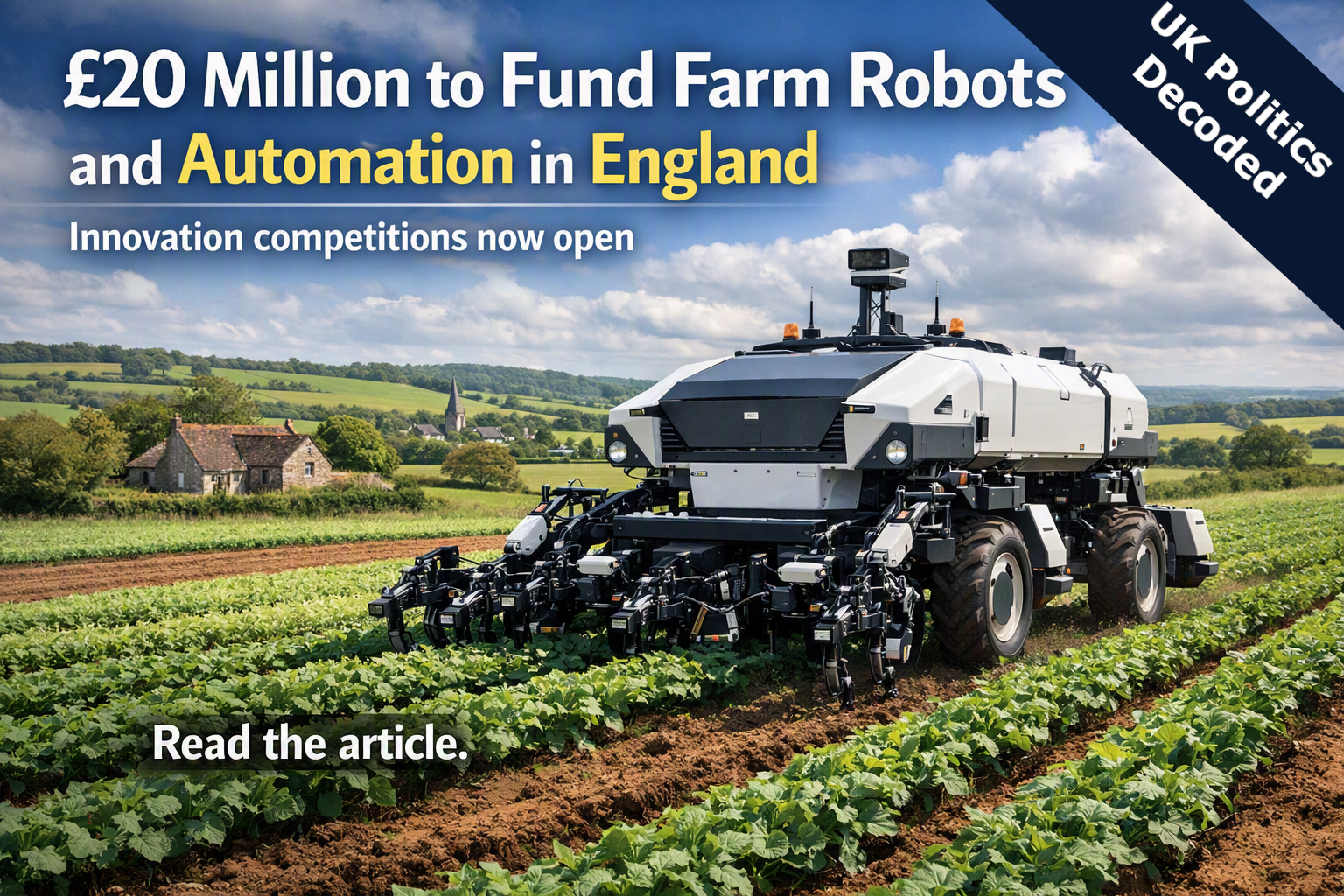
Agri-tech businesses can now apply for a share of £20 million in government funding to build the next generation of farm robots and automated systems. Farming Minister Stephen Morgan announced the new competition round on 3 August 2026, delivered in partnership with Innovate UK as part of the government's Farming Innovation Programme.
The funding is intended to help bridge a persistent labour gap at harvest time, when farms across England routinely struggle to source enough seasonal workers to pick and process crops.
Key Facts at a Glance
- Funding available: £20 million in this round
- Total 2026 pot: £123 million across the Farming Innovation Programme this year
- Who can apply: Agri-tech businesses collaborating with researchers and farmers
- Eligible sectors: Arable, horticulture, livestock, ornamental plant propagation, and forestry
- How to apply: Via the Innovate UK Innovation Funding Service applications are open now
This round is part of a recent £53 million boost to the Farming Innovation Programme, taking the total available in 2026 to £123 million. The new £20 million tranche is specifically targeted at automation and robotics technologies capable of planting, tending, and harvesting crops with minimal human intervention.
The competition is open to a broader range of applications than the previous automation round in 2023:
- Arable and horticulture: Automated systems for sowing, crop monitoring, weeding, and harvesting food producing plants
- Livestock: Technologies to detect illness in animals, such as breath analysis systems for dairy cattle
- Ornamental horticulture: Propagation, growing, and monitoring systems, including those transferable to food production
- Forestry: Robots for tree nursery operations, planting, woodland monitoring, and management
- Cross sector innovation: Projects must involve collaboration between businesses, researchers, and farmers
Projects Currently Using Programme Funding
- Fieldwork Robotics: Has developed a raspberry picking robot and is using government funding to make it more durable and reliable for commercial rollout
- Roboscientific DETECT: A breath analysis system designed to detect bovine respiratory disease in dairy cows before symptoms become visible, a condition that costs farmers significantly in animal losses, vet bills, and additional labour
- Scope: Both projects began under earlier Farming Innovation Programme rounds, the new £20 million extends and broadens the competition
- Commercialisation focus: The programme aims to accelerate innovations from concept to on farm application
The rationale behind this funding is directly tied to a structural challenge for English farming, finding enough workers during peak harvest periods. Post Brexit restrictions on the free movement of EU labour and the recent reduction in migration have squeezed the seasonal workforce, pushing up costs and leaving some crops unpicked in difficult years.
Drivers Behind the Funding Decision
- Labour shortages: Seasonal agricultural workers are harder to recruit and retain than before the end of free movement
- Productivity pressure: English farms face competition from lower cost producers abroad, automation can reduce unit costs
- Resilience: Automated systems are less vulnerable to labour market disruptions or adverse weather affecting picking windows
- Farming Roadmap: The investment forms part of the government's longer term Farming Roadmap for a modernised agricultural sector
- Innovation target: The government has pledged to invest at least £200 million in farming innovation by 2030, of which this forms part
The competition is run by Innovate UK, the government's innovation agency, working alongside the Department for Environment, Food & Rural Affairs (DEFRA). Chris Danks, Head of Agrifood at Innovate UK, described the programme as supporting "businesses, researchers and farmers to work together to develop technologies that address real world challenges across agriculture."
The Farming Innovation Programme was established as part of the government's post CAP (Common Agricultural Policy) transition funding framework. As direct payments to farmers under the old EU subsidy system have been phased down, the programme is one of several mechanisms intended to direct public money towards productivity, sustainability, and technology adoption on English farms.
Farming Innovation Programme. Context
- Programme origin: Established as part of England's post Brexit agricultural transition, replacing EU CAP subsidies
- Cumulative investment: The government has pledged at least £200 million in farming innovation by 2030
- 2026 total: £123 million available this year across all programme strands
- Delivery partner: Innovate UK administers competitions, DEFRA sets strategic priorities
- Application route: The Innovation Funding Service is open to businesses in collaboration with researchers and farmers
Previous Automation Rounds
An earlier automation competition ran in 2023, but was narrower in scope, it did not include ornamental horticulture, forestry, or livestock applications. The 2026 round deliberately expands eligibility, reflecting lessons from that earlier iteration and the government's aim to reach more of the agricultural sector.
- 2023 round: Focused on arable and food producing horticulture automation only
- 2026 expansion: Now includes livestock, ornamental horticulture, and forestry
- Rationale: Technologies developed for ornamental crops can often be adapted for food production
- Woodland inclusion: Forestry was added to support tree planting and woodland management targets
- Collaborative requirement: All applicants must partner with researchers and farmers, solo applications are not eligible
This is not a subsidy for farms it is a research and development competition for technology companies working with the agricultural sector. Farms themselves won't receive the money directly, the funding goes to agri-tech businesses and researchers who can demonstrate a credible path from prototype to commercial deployment on English farms.
The practical impact for farmers depends on what actually gets built and how quickly it reaches market. Technologies like Fieldwork Robotics raspberry picker have been in development for years, this funding is designed to accelerate that pipeline.
Applications are open now via the Innovate UK Innovation Funding Service.
Key Takeaways
- £20 million is available for agri-tech businesses developing farm robots and automation, applications are open now via Innovate UK
- The funding is part of a £123 million total for farming innovation in 2026, under the government's commitment to invest at least £200 million by 2030
- Eligible sectors include arable, horticulture, livestock, ornamental plant propagation, and forestry, broader than the 2023 round
- All applications must involve collaboration between businesses, researchers, and farmers, solo bids are not accepted
- The programme is delivered by Innovate UK in partnership with DEFRA and sits within England's post CAP agricultural transition funding framework
Sources & Further Reading
- GOV.UK – Robot revolution hits the fields as £20 million funding announced (DEFRA/Innovate UK, 3 August 2026) Archived copy (OGL): archived page
- Innovate UK – Farming Innovation competitions Archived copy (OGL): archived page
- GOV.UK – Farming Roadmap (PDF) Archived copy (OGL): archived page
- Fieldwork Robotics – website Archived internally for verification (5 August 2026)