AI Use: AI tools were used to support source discovery and to structure the article for clarity. All research, verification, drafting, and final editorial decisions are fully human led. Learn about our AI policy.
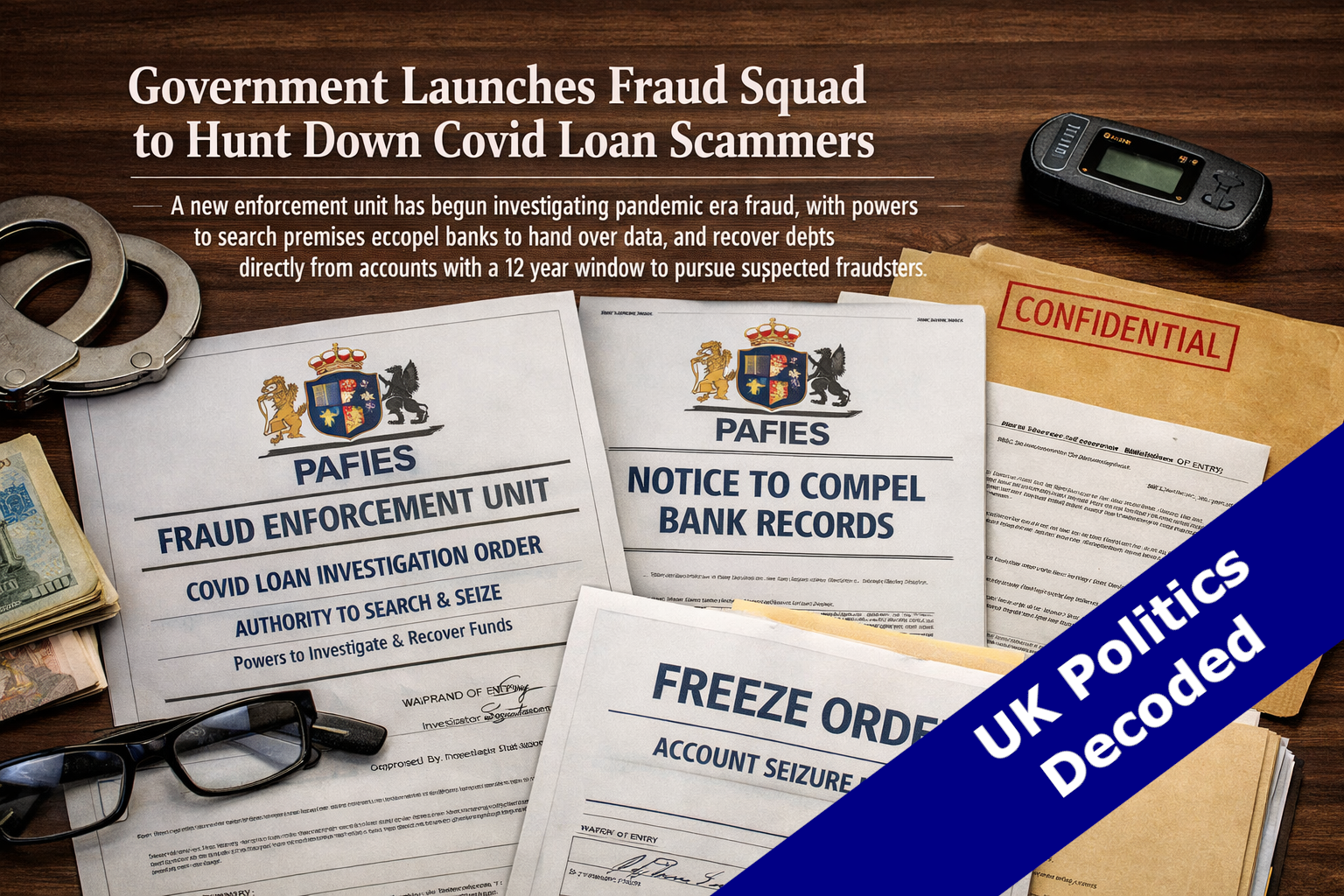
A new government enforcement unit has opened its first investigations into pandemic fraud, armed with what ministers describe as the strongest investigatory powers available to the state in a generation. The Public Authorities Fraud Investigation and Enforcement Service PAFIES began pursuing suspected fraudsters on 23 June 2026, focusing on individuals and companies that took public money through Covid emergency schemes they were not entitled to.
PAFIES operates under powers granted by the Public Authorities (Fraud, Error and Recovery) Act 2025. Its launch came alongside the government's formal response to the Covid Counter Fraud Commissioner's final report, which set out the full scale of losses from pandemic era public spending programmes.
At a glance
- Unit launched: 23 June 2026, PAFIES is actively investigating suspected Covid fraud
- New powers include: search and seizure of premises, third party data compulsion, direct debt recovery from bank accounts and wages
- Extended window: Limitation period doubled to 12 years, so suspected fraudsters can be pursued until 2032
- Scale of loss: £10.9 billion lost to pandemic fraud and error
- Prior enforcement: Nearly 2,000 company directors disqualified, 86 criminal prosecutions to date
- Full enforcement begins: Autumn 2026
Previous enforcement of pandemic fraud relied on existing mechanisms that were not designed for the pace or volume of cases created by the emergency schemes. The PAFER Act 2025 changes that, giving PAFIES a purpose built set of tools.
New enforcement powers under the PAFER Act 2025
- Search and seizure: Investigators can enter and search premises linked to suspected fraud and seize relevant material
- Third party compulsion: Banks and other organisations can be required to hand over data relevant to an investigation
- Direct debt recovery: Fraud related debts can be recovered from bank accounts and wages following a PAFIES investigation, without needing a prior court judgment
- Civil financial penalties: Faster enforcement action is available without full criminal proceedings, accelerating the pace of recovery
- 12 year limitation period: The window for civil Covid fraud claims has been doubled from six years, suspected fraudsters can be pursued until 2032
All of these powers become available to the unit from autumn 2026. That timing matters. The government ran a Voluntary Repayment Scheme last year, giving suspected fraudsters the chance to come forward and settle without facing the new enforcement tools. Those who did not respond have now missed that window and will face the full weight of PAFIES's toolkit from the autumn.
The Covid Counter Fraud Commissioner's final report put the overall loss figure at £10.9 billion. That figure covers fraud and error across pandemic era programmes including emergency loan schemes designed to keep businesses afloat during the 2020 and 2021 lockdowns. The government says that money should have funded the NHS and public services.
Enforcement has already produced results, even before PAFIES launched. Nearly 2,000 company directors have been disqualified as a result of fraud related investigations, and 86 people have faced criminal prosecution. A Covid fraud reporting website, opened to the public in September 2025, had already received more than 1,000 reports by the time of this announcement.
The government also credits measures from the 2024 and 2025 Budgets with protecting £7.5 billion of public money from fraud over two years. Chancellor Rachel Reeves framed that figure directly against what her administration inherited "In contrast to the last government, who left the door open to £10.9 billion of pandemic era fraud and error, we have taken action to protect £7.5 billion of public money. My message to those who owe the public purse money is clear, those who profited, will pay."
Satvir Kaur, Parliamentary Secretary in the Cabinet Office, added "Those who chose to exploit a national crisis to line their own pockets now have nowhere left to hide. Our decision to go after those who have cheated the system has already helped save £7.5 billion."
The Public Authorities (Fraud, Error and Recovery) Act 2025 is the same legislation that gave the Department for Work and Pensions its new benefit debt recovery powers, which came into force on 24 June 2026 the day after the PAFIES announcement. Those powers allow the DWP to recover benefit debts directly from bank accounts without a court order and, in serious cases, to ask courts to impose driving disqualifications on persistent non-payers.
The shared legislative base reflects a deliberate strategy. Rather than pursue different types of public money fraud through separate legal frameworks, the government has used one Act to close multiple enforcement gaps across different departments and agencies at once.
PAFIES sits alongside, not instead of the Public Sector Fraud Authority, which continues to manage broader cross government fraud prevention and detection. The PSFA's role in that wider picture remains unchanged; PAFIES handles active enforcement investigations specifically into pandemic era fraud.
Key takeaways
- PAFIES began operations on 23 June 2026, targeting suspected Covid era fraud under new powers from the PAFER Act 2025
- The unit can search premises, compel banks to share data, and recover debts directly from accounts and wages without a prior court judgment
- £10.9 billion was lost to pandemic fraud, enforcement so far has disqualified nearly 2,000 directors and prosecuted 86 individuals
- The limitation period for civil Covid fraud claims has been doubled to 12 years, pursuit can continue until 2032
- Full enforcement powers activate from autumn 2026, those who ignored last year's Voluntary Repayment Scheme now face the new toolkit in full
Sources & Further Reading
- GOV.UK - Government fraud squad hunts down Covid loan scams (HM Treasury and Cabinet Office, 23 June 2026) Archived copy (OGL): archived page
- Legislation.gov.uk - Public Authorities (Fraud, Error and Recovery) Act 2025 (full text) Archived copy (OGL): archived page
- GOV.UK - Public Sector Fraud Authority Archived copy (OGL): archived page