AI Use: AI tools were used to support source discovery and to structure the article for clarity. All research, verification, drafting, and final editorial decisions are fully human led. Learn about our AI policy.
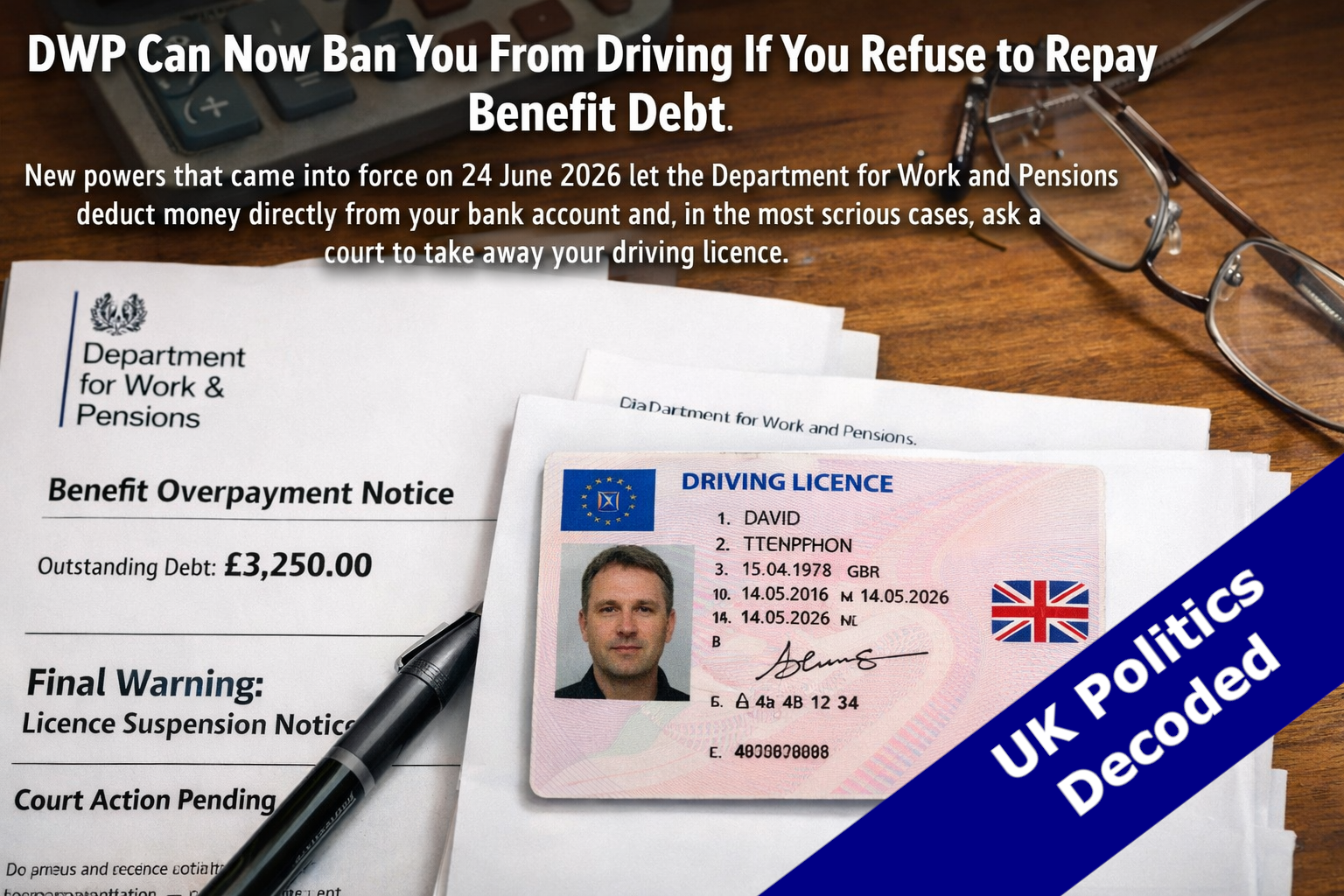
The Department for Work and Pensions has gained its most powerful debt recovery tools to date. From 24 June 2026, the DWP can go directly to a person's bank and claw back money owed without needing a court order first. And for those who continue to refuse, it can now apply to a court to have their driving licence suspended.
The powers come from the Public Authorities (Fraud, Error and Recovery) Act 2025, commonly referred to as the PAFER Act. The DWP began writing to thousands of people with outstanding debts on the same day, warning them to make contact and arrange repayment before enforcement begins in October 2026.
At a glance
- Powers in force from: 24 June 2026
- Enforcement begins: October 2026
- Who is affected: People who have stopped receiving benefits but still owe money to the DWP and are refusing to repay
- Direct deduction: DWP can recover debt directly from a bank account without a court order
- Driving ban: Courts can impose disqualification where debt is at least £1,000 and there is no essential need for the licence
- Savings target: £14.6 billion over five years from fraud, error and debt activity
The key distinction here is that these powers target people who are no longer claiming benefits but still owe money to the DWP. That population was previously very difficult for the department to pursue. If someone had left the benefits system and was not in PAYE employment, the DWP had few practical levers to recover what was owed.
According to the government's announcement, some people who could afford to repay were simply choosing not to. The PAFER Act closes that gap.
Anyone still in receipt of benefits can already have deductions made at source from their payments. These new powers are specifically designed for former claimants who have gone off benefits entirely.
Previously, recovering money from someone's bank account required the DWP to obtain a court order, a process that takes time and is not guaranteed. Under the PAFER Act, the department can now instruct a bank or financial institution to deduct the outstanding amount directly, bypassing that court stage altogether.
This does not mean the DWP has unrestricted access to accounts. The legislation sets out a Code of Practice governing how and when the power can be used, including safeguards that must be followed before any enforcement action is taken. Those safeguards are published on GOV.UK.
The driving disqualification power is a court based measure, the DWP applies to a court, and it is the court that decides whether to impose a ban. There are conditions attached.
Conditions for a driving ban to be sought
- The debt must be at least £1,000
- The person must have no essential need for their licence, for example, someone whose job depends on driving, such as a courier, would not be eligible for disqualification
- Any ban is initially suspended, provided the debtor keeps to agreed repayment terms
That suspended element is worth noting. The threat of losing a licence is intended to act as a lever to bring people to the table, not primarily as a punishment. If repayments are maintained, disqualification does not take effect.
Enforcement of the new powers will be gradually rolled out from October 2026. The DWP has said this is intended to give debtors a final window from now until October to contact the department, arrange repayment, or access free debt advice and support services.
Andrew Western, the Work and Pensions Minister for Transformation, said: "To anyone with an outstanding debt, our door is open and DWP will always work with you to find an affordable way to repay. But for those who can pay and won't we're going further than ever before to claw back cash and crack down on fraud."
Cabinet Office Minister Satvir Kaur added that "fraud against the public sector and unrecovered debt deny our vital frontline services of the funding they deserve."
The debt recovery powers that came into force on 24 June are not the only measures in the PAFER Act. A further provision, the Eligibility Verification Measure will allow the DWP to require banks and financial institutions to share limited data to help identify incorrect benefit payments. That element is not yet operational and will be introduced separately.
The government has framed the overall package as part of a commitment to recover £14.6 billion over five years through action on fraud, error and debt, including investment to deploy up to 3,000 additional DWP staff.
What the new powers allow
- Direct bank deductions: No court order required to recover owed money from accounts
- Driving disqualification: Courts can now impose bans at DWP's request for debts of £1,000 or more
- Wider reach: Former claimants no longer receiving benefits are now within scope of enforcement
What the powers do not do
- Not immediate: Enforcement does not begin until October 2026, giving debtors time to make contact
- Not automatic bans: Driving disqualification requires a court decision, not a DWP decision alone
- Not unconstrained: A Code of Practice governs use, and safeguards apply to all enforcement action
Key takeaways
- From 24 June 2026, the DWP can recover benefit debts directly from bank accounts without a court order under the PAFER Act 2025
- Courts can impose driving disqualifications at the DWP's request, but only where debt exceeds £1,000 and the person has no essential driving need
- Enforcement begins in October 2026 the DWP is urging anyone with an outstanding debt to get in touch now
- These powers target former claimants who have left the benefits system but still owe money, current claimants are already subject to deductions at source
- A suspended driving ban can be avoided entirely by keeping to agreed repayment terms
Sources & Further Reading
- GOV.UK - Driving bans for those who refuse to repay benefit debts as new DWP powers come into force (Department for Work and Pensions, 24 June 2026) Archived copy (OGL): archived page
- Legislation.gov.uk — Public Authorities (Fraud, Error and Recovery) Act 2025 (full text)
- GOV.UK — Repay and manage benefit money you owe