AI Use: AI tools were used to support source discovery and to structure the article for clarity. All research, verification, drafting, and final editorial decisions are fully human led. Learn about our AI policy.
If your energy supplier has ever treated you badly, overcharged you, or left you waiting weeks for a refund, you will know how frustrating it can be that nothing much seemed to happen as a result. Ofgem, Britain's energy regulator, has existed since 2000. But for much of that time, enforcing consumer rights meant taking companies to court, a lengthy, expensive process that let suppliers run out the clock. That is now set to change.
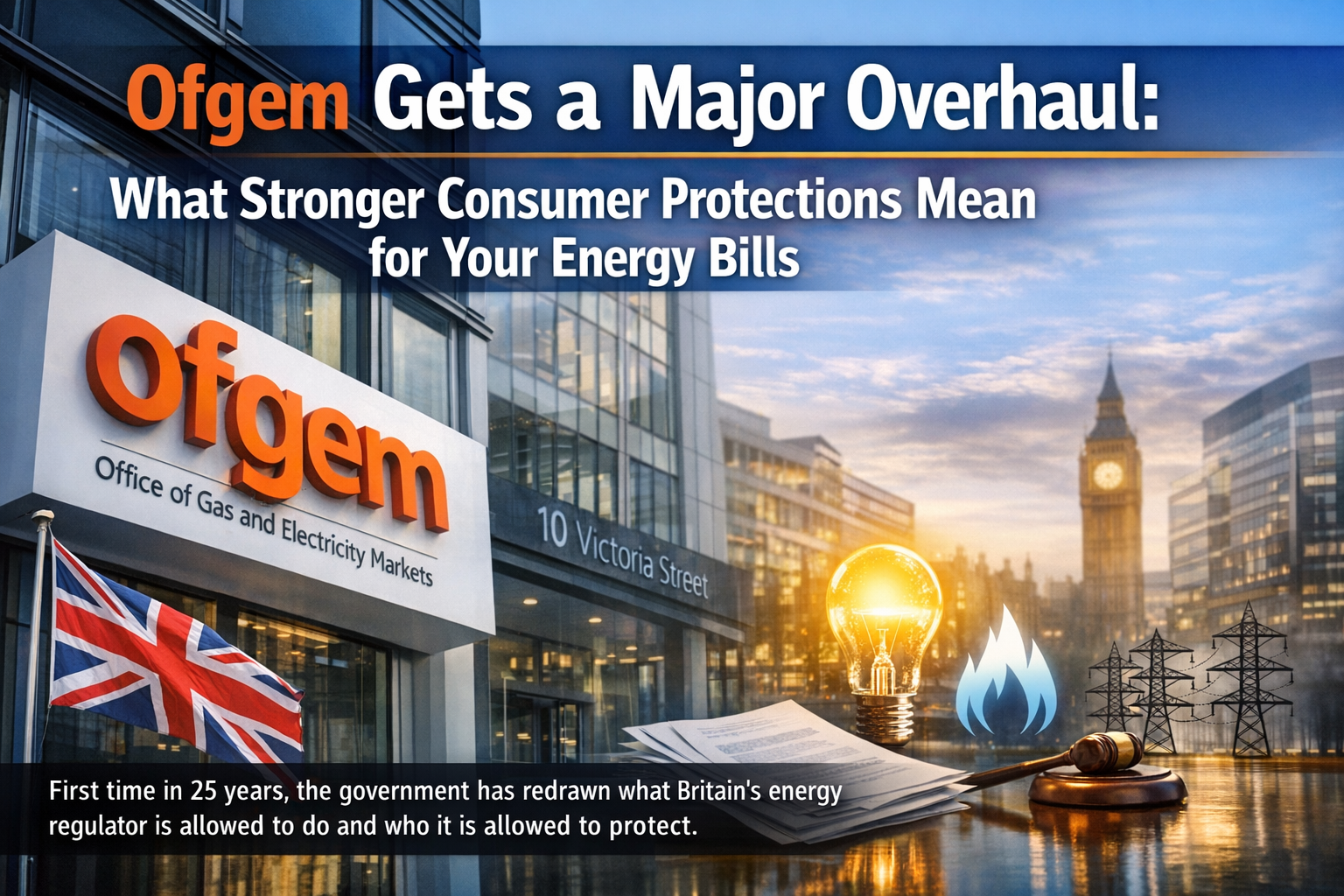
On 22 April 2026, Energy Secretary Ed Miliband and Consumer Minister Martin McCluskey announced the most significant overhaul of Ofgem's powers and remit since the regulator was founded. The reforms give Ofgem new tools to act faster, reach further into the energy market, and hold companies and their executives to account in ways it simply could not before.
Key Points at a Glance
- Direct enforcement powers: Ofgem will be able to enforce consumer law directly, without needing to go through the courts first, meaning faster action when things go wrong.
- Bonus bans for bad behaviour: Energy company executives can have their bonuses banned if their company breaks the rules, creating a personal financial incentive to treat customers well.
- Wider reach: Ofgem's remit is being expanded so it can regulate new and unregulated parts of the energy market, including the heating oil sector, where prices have spiked sharply.
- Streamlined focus: Ofgem is shedding responsibility for overseeing home upgrade schemes, which will move to the new Warm Homes Agency, so the regulator can concentrate on its core job.
- First major update since 2000: This is the first comprehensive reform of Ofgem's scope in 25 years, the government acknowledges the market has grown far more complex since then.
What Is Ofgem and What Did It Used to Do?
Ofgem stands for the Office of Gas and Electricity Markets. It is an independent government body that regulates the energy industry in Great Britain, setting rules for how suppliers and network companies must treat customers and operate within the market.
When Ofgem was set up in 2000, the energy market looked quite different. There were a handful of large suppliers, a relatively straightforward grid, and a limited range of products. A household basically chose between a fixed or variable tariff and got on with it.
Why the Old Model Was No Longer Fit for Purpose
Since 2000, the market has changed dramatically. There are now dozens of suppliers offering a wide variety of tariffs, smart home devices, electric vehicle charging packages, heat pump contracts, and more. Millions of customers use services that sit in grey areas, parts of the energy market that Ofgem had limited or no authority to regulate.
Where the Old System Was Falling Short
- Slow enforcement: To force a supplier to compensate customers or change its practices, Ofgem previously had to pursue action through the courts, a process that could take months or years.
- Unregulated corners: Growing numbers of customers were using products and services in parts of the market where Ofgem had little or no power to intervene, leaving them without the protections available to standard tariff customers.
- Heating oil excluded: Households that heat their homes with oil, a significant number particularly in rural areas, were largely outside Ofgem's remit even though their bills have surged alongside the wider energy crisis.
- No personal accountability: When a supplier failed its customers, the company might face a fine, but its senior executives had no direct personal financial consequence, reducing the incentive to prioritise customer outcomes.
The Three Core Changes: What Is Actually Happening
The government has announced three headline reforms to Ofgem's powers and remit. Each one addresses a specific weakness in how the regulator currently operates. It is worth understanding each one separately because they work in quite different ways.
Change 1: Direct Consumer Law Enforcement
This is arguably the most immediately practical change for everyday customers. At the moment, if Ofgem believes a supplier is breaking consumer protection law, for example by refusing to pay compensation it owes, applying unfair charges, or misleading customers, it has to refer the matter to the Competition and Markets Authority or take court action. That is slow and resource intensive.
- What changes: Ofgem will be given powers to enforce consumer law directly, without needing to go to court first. It will be able to order companies to pay redress, change their behaviour, or face penalties under its own authority.
- Why it matters: A regulator that can act quickly is a far more effective deterrent. If a supplier knows Ofgem can respond swiftly rather than entering a multi year court process, it has a much stronger incentive to get things right in the first place.
- What it means for you: If you are owed compensation from your energy supplier, the road from complaint to resolution should become shorter and more reliable.
Change 2: Executive Bonus Bans
This measure takes direct aim at senior leadership in energy companies. Under the reforms, Ofgem will have the power to ban bonuses for executives at companies that break the rules.
- What changes: If an energy company is found to have broken consumer protection rules, Ofgem can impose a ban on executive bonuses as part of the sanctions it applies.
- The logic: Corporate fines do not always change behaviour, especially at large companies where a fine is treated as a cost of doing business. Making it personal, directly affecting the pay of the individuals in charge, creates a different kind of incentive.
- Who is affected: Senior executives at regulated energy suppliers. The government is essentially saying that if your company lets customers down, you personally will feel it in your pocket.
- Why now: Public frustration with energy company profits while household bills remained high throughout the cost of living crisis made some form of executive accountability politically necessary as well as practically sensible.
Change 3: A Wider, More Flexible Remit
The third major change is about the boundaries of what Ofgem is allowed to do and who it is allowed to protect. Currently, those boundaries were drawn in 2000 and have not been significantly updated since.
What the Expanded Remit Means in Practice
- New areas of the market: Ofgem will gain the power to regulate in new parts of the energy market that have grown up since 2000, for example new types of flexible tariff, smart home energy products, and EV charging packages, if and when consumer protection requires it.
- Heating oil customers: The government specifically flagged heating oil as an area where new protections are needed. Heating oil customers, particularly those in rural areas, are not currently covered by Ofgem's standard protections, and their bills have been hit hard by Middle East price shocks. This reform will allow Ofgem to extend its remit there.
- Economic and consumer focus: Ofgem's remit is being streamlined to focus squarely on its core function as an economic and consumer protection regulator, removing some of the additional responsibilities that had accreted over the years and which can distract from that core mission.
- Home upgrade schemes moving out: Responsibility for overseeing home energy upgrade schemes will transfer to the new Warm Homes Agency, freeing Ofgem to focus on market regulation rather than scheme administration.
What This Means If You Are a Heating Oil Customer
One of the most significant practical expansions in these reforms is the explicit inclusion of heating oil customers within Ofgem's extended reach. This is worth dwelling on because it affects a large number of households, particularly in rural areas, who have had very little regulatory protection until now.
Why Heating Oil Customers Have Been Particularly Exposed
Unlike gas and electricity supplied through the national grid, heating oil is delivered to individual homes by tanker, often from a local or regional supplier operating outside the main regulated energy market. This means:
- No price cap protection: The Ofgem price cap that limits what gas and electricity suppliers can charge does not apply to heating oil. When global oil prices spike, heating oil customers face the full force of those increases with no regulatory ceiling.
- No guaranteed standards of service: Gas and electricity customers are covered by Ofgem's Guaranteed Standards of Performance, which set minimum service levels and automatic compensation if suppliers miss them. Heating oil customers have no equivalent protection.
- Middle East price impact: The ongoing Middle East conflict has pushed up global oil prices sharply. The government has already committed over £50 million in emergency support to low income heating oil households. But support payments are a sticking plaster; regulatory protection is a structural fix.
- Rural concentration: Heating oil is disproportionately concentrated in rural communities that often have fewer alternatives and less ability to switch quickly to other heating sources.
Extending Ofgem's powers to cover this market will allow the regulator to set minimum standards, investigate unfair pricing, and provide customers with a route to redress that simply did not exist before.
How Ofgem Itself Will Change
Beyond the new legal powers, the government has announced a series of changes to how Ofgem itself operates internally. These are less visible to the public but matter for how effectively the regulator uses its new tools.
Building a More Capable Regulator
Stronger Technical Expertise
- Technical capabilities: Ofgem will strengthen the specialist technical expertise within the organisation, so it is better equipped to understand and regulate a modern, complex energy system including smart grids, flexible demand, and new technologies.
- Better use of data: The regulator will improve how it collects and uses market data, enabling faster identification of problems and more evidence based decisions.
- Risk approach: Ofgem's approach to risk will be reassessed, moving from a cautious process led mindset to one more willing to take faster, decisive action when consumers need protection.
- Workforce plan: A new workforce plan will ensure staff have the skills to deliver the reforms, supported by stronger board level oversight of culture and capability.
Supporting Clean Energy Growth
- Investor confidence: A clearer, more focused remit is intended to give energy investors greater certainty about the regulatory environment, helping to attract the capital needed to build new clean energy infrastructure.
- Network investment: Ofgem plays a central role in approving the spending of electricity network companies, the ones that build and maintain the cables, substations, and pylons that carry power to homes. A more capable regulator can unlock investment faster.
- Modern energy system: As Britain transitions to a system powered largely by variable renewables, the grid needs to become far smarter and more flexible. Ofgem's reformed capabilities are intended to help manage and accelerate that transition.
- Growth mission: The government is framing the Ofgem reform as part of its broader economic growth agenda: effective regulation attracts investment; poor regulation deters it.
The Bigger Picture: Why Now?
It is worth asking why this reform is happening in April 2026 rather than at some other point. The answer involves a combination of long term regulatory drift and immediate crisis pressure.
Twenty Five Years of Market Change Without Regulatory Change
When Ofgem was created in 2000, it was designed to oversee a relatively simple privatised gas and electricity market with a small number of large players. Over the following quarter century, the market transformed almost beyond recognition:
- Dozens of suppliers: The "Big Six" era gave way to dozens of smaller suppliers, many of which collapsed during the 2021-22 energy crisis, leaving customers stranded and landing the industry with significant costs.
- New product types: Smart meters, time of use tariffs, heat pumps, electric vehicles, battery storage, and flexible demand services have created a far more varied consumer landscape than existed in 2000.
- Unregulated growth: Each new product or service type potentially created a new gap in Ofgem's regulatory coverage. The regulator's remit did not keep pace with the market it was supposed to oversee.
- Two energy crises: The Ukraine war gas price shock of 2022 and the ongoing Middle East driven price pressures of 2025-26 have demonstrated repeatedly that when things go wrong in energy markets, the consequences for households are severe and rapid.
What Interim CEO Tim Jarvis Said
- Scale of change: Jarvis described Britain's energy system as going through "the biggest changes in our lifetimes," acknowledging the regulator needs to keep pace.
- Systemic reform: He said the review "enables us to make changes at a more systemic level," going beyond the incremental reforms Ofgem has delivered in recent years.
- Consumer confidence: The goal is an energy system "that works for consumers" and in which people "can engage confidently in markets offering new products and services."
- Investor attractiveness: He also stressed the need for a market "that is attractive to investors," recognising that consumer protection and investment confidence go hand in hand.
What Citizens Advice and Other Groups Said
The announcement drew broadly positive responses from consumer organisations and industry groups, though with caveats:
- Citizens Advice (Gillian Cooper): Welcomed the reforms as "strengthening consumer protections" and giving Ofgem "the tools it needs to enforce the rules." But she also stressed that "effective regulation is one pillar" and that consumers also need "strong advocacy, trusted advice and the ability to get problems sorted quickly and fairly."
- Energy Network Innovation Taskforce (Laura Sandys CBE): Praised the focus on clarity of Ofgem's role and the shift from "a process, input regulator, to a dynamic opportunity and risk regulator." She highlighted recommendations for independent assessment of progress as particularly important.
- The caution: Both responses implicitly noted that having new powers on paper is not the same as using them effectively. Delivery will matter as much as the reform itself.
Conclusion: A Long Overdue Upgrade for Britain's Energy Watchdog
For anyone who has been let down by an energy supplier and felt like there was nowhere to turn, these reforms represent a genuine step forward. An Ofgem that can act without going to court, that can sanction executives personally, and that can reach into parts of the market previously beyond its authority, is materially more capable of protecting you than the one that existed yesterday.
The bonus ban power in particular sends a clear message. Energy company executives have sometimes been protected from the personal consequences of their organisations' failures by the corporate veil. That veil is now, at least partially, being lifted.
The expansion to cover heating oil customers is equally significant. For rural households who have been at the mercy of unregulated oil suppliers during a period of exceptional global price volatility, the promise of a regulatory framework that covers them is not a small thing. The detail of how that coverage will be implemented will need to be watched closely, but the direction of travel is right.
The internal reforms to Ofgem's capabilities, technical expertise, data use, and workforce planning, matter too, though they will take time to bear fruit. A regulator with new legal powers but the same old institutional culture and skill gaps will not deliver the improvements that households and businesses need. The government has acknowledged this, which is encouraging.
What these reforms do not do is fix the underlying economics of the energy market. Ofgem enforcing better consumer outcomes within a system where wholesale prices are still heavily influenced by global gas markets will not, on its own, bring bills down. That requires the structural work on market design and pricing that the government is pursuing in parallel. But a stronger, faster, more capable regulator is a necessary part of the picture and the fact that it has taken 25 years to get here is a reflection of how long regulatory reform tends to lag behind market reality.
Key Takeaways
- Ofgem has been given direct powers to enforce consumer law without going through the courts, meaning it can act faster when suppliers treat customers unfairly.
- Energy company executives can now have their bonuses banned if their company breaks the rules, creating personal accountability at the top.
- Ofgem's remit is being expanded to cover new and unregulated parts of the energy market, including heating oil, which has left rural households without protection during recent price spikes.
- Home upgrade scheme oversight moves to the new Warm Homes Agency, letting Ofgem focus on market regulation.
- Ofgem's internal capabilities in technical expertise, data, and risk assessment will be strengthened to match its expanded responsibilities.
- These are the first major changes to Ofgem's scope since it was founded in 2000, triggered by 25 years of market change and two consecutive energy price crises.
- The limit: Better enforcement does not fix the underlying price structure. These reforms make the regulator stronger within the existing market; the deeper work to reduce gas price exposure is happening separately.
Sources & Further Reading
- GOV.UK - Ofgem transformed to strengthen protections for energy consumers (22 April 2026) Archived copy: Wayback Machine archive
- Parliament.UK - Publication of the Ofgem Review Final Report (22 April 2026) Archived copy: UK Politics Decoded archive
- Ofgem.GOV.UK - Response to the Ofgem Review (22 April 2026) Archived copy: UK Politics Decoded archive
- Ofgem.GOV.UK - Enforcement documentation (22 April 2026) Archived copy: UK Politics Decoded archive