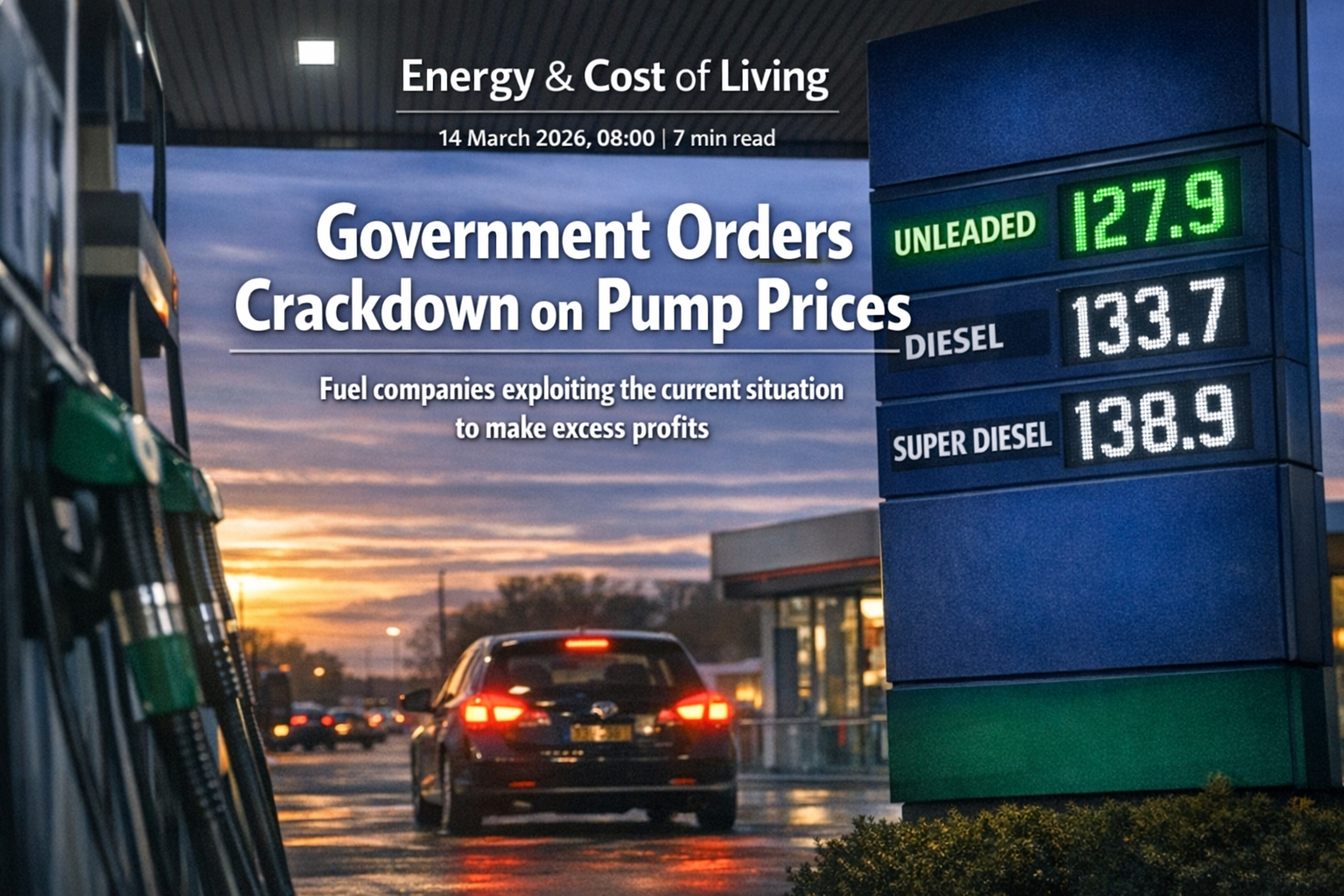
The government has ordered a crackdown on petrol, diesel, and heating oil prices, after concerns grew that some fuel retailers may be using global uncertainty to make excess profits at the expense of drivers and families. On 13 March 2026, Chancellor Rachel Reeves and Energy Secretary Ed Miliband met with petrol retailers and energy suppliers at Downing Street with a direct message: drivers must get a fair deal at the pump.
The Chancellor has written to the Competition and Markets Authority (CMA), the independent watchdog that enforces fair competition asking it to stay on high alert for any unjustifiable price rises. The government is also accelerating a price transparency tool called Fuel Finder, designed to help drivers quickly identify the cheapest forecourt in their area.
⛽ What's Happening
- The Chancellor has written to the CMA asking it to crack down on unjustifiable fuel price rises
- A Downing Street roundtable took place on 13 March with petrol retailers and energy suppliers
- Fuel Finder is being accelerated, a government tool to show drivers the cheapest local prices in real time
- Almost 90% of retailers have already signed up, with government taking action on the remaining 10%
- Households with a car could save an average of £40 a year once Fuel Finder is fully in place
⚠️ Why Is the Government Stepping In?
Tensions in the Middle East have added uncertainty to global oil markets, which can affect the price fuel companies pay for oil. However, the government is concerned that some retailers may be using that uncertainty as an excuse to push up prices and protect their own profit margins rather than passing on any savings to customers when costs ease.
The Chancellor noted earlier this week that petrol prices vary significantly between forecourts, ranging from £1.27 per litre to £1.80 per litre, a difference of 53p per litre depending on where you fill up. The government says that kind of variation is not acceptable and wants to understand why prices differ so widely and how quickly forecourts respond when wholesale costs fall.
💬 Chancellor of the Exchequer, Rachel Reeves
"I will not tolerate any company exploiting the current situation to make excess profits at consumers' expense. I'm backing drivers and families and I expect a fair deal at the pump."
💬 Energy Secretary, Ed Miliband
"Tackling the cost of living is our number one priority, all fuel retailers must sign up for Fuel Finder so drivers can find the cheapest price at the pump. We will not hesitate to act to protect consumers against any unfair practices."
🔍 What Is the CMA and What Has the Government Asked It to Do?
The Competition and Markets Authority is a government body that monitors markets to make sure businesses compete fairly and consumers are not being ripped off. It has the power to investigate markets, take enforcement action against companies, and recommend changes to rules and regulations.
The Chancellor has written to the CMA asking it to remain on high alert specifically for unjustifiable price rises on petrol, diesel, and heating oil. This comes after the Energy Secretary met with the CMA's Chief Executive on 10 March to discuss how consumers can be protected from any unfair price increases.
The CMA has previously looked at the fuel retail market. The government's intervention signals that it expects the watchdog to be ready to act quickly if evidence of price exploitation emerges.
📱 What Is Fuel Finder and How Does It Help Drivers?
Fuel Finder is a government backed scheme that requires fuel retailers to share their prices in real time. That data is then made publicly available through apps and online tools so that drivers can easily see which nearby forecourts are cheapest before they fill up.
The idea is straightforward: if people can easily see who is charging the most, they can take their business elsewhere. That pressure encourages retailers to keep prices competitive.
✅ Where Things Stand
- All major supermarkets are now sharing real time price data with Fuel Finder
- Almost 90% of retailers are already registered with the scheme
- £40 average annual saving estimated per household that owns a car, once Fuel Finder is fully operational
🎯 What Comes Next
- Government is taking action on the remaining 10% of retailers not yet signed up
- Retailers who refuse transparency will be "called out" publicly, according to the government
- Greater competition is expected to drive prices down as more consumers use the data
💷 What Does This Mean for Drivers and Families?
If you drive a car or use heating oil to warm your home, the government's actions are aimed at making sure you are not overpaying due to unfair practices by retailers.
In the short term, the Fuel Finder tool once fully rolled out will make it easier to identify the cheapest forecourt near you. The government estimates this could save households that own at least one car around £40 a year on average at the pump.
The CMA being put on high alert means there is a watchdog actively monitoring for any unjustifiable price rises. If evidence of price exploitation is found, the CMA has the tools to investigate and take action. The government has been clear it expects firms to pass on any reduction in costs to consumers not absorb those savings as profit.
🎯 Key Takeaways
- The government has ordered a crackdown on fuel prices amid concerns some retailers are exploiting global uncertainty to protect margins at consumers' expense
- The Chancellor has written to the CMA asking it to stay on high alert for unjustifiable price rises on petrol, diesel, and heating oil
- Fuel Finder, a real time price transparency scheme is being accelerated, with almost 90% of retailers already signed up
- Prices currently vary from £1.27 to £1.80 per litre between forecourts, a gap the government says is unacceptable
- Households that own a car could save an average of £40 a year once full price transparency is in place
📚 Sources & Further Reading
AI Use: AI tools were used to support source discovery and to structure the article for clarity. All research, verification, drafting, and final editorial decisions are fully human led.