AI Use: AI tools were used to support source discovery and to structure the article for clarity. All research, verification, drafting, and final editorial decisions are fully human led. Learn about our AI policy.
The government has announced at least six new warships for the Royal Navy and a major overhaul of the UK Commando Force, in two separate Ministry of Defence announcements made on 28 and 29 June 2026. Both sit within the forthcoming Defence Investment Plan, which is expected to be published ahead of the NATO Summit.
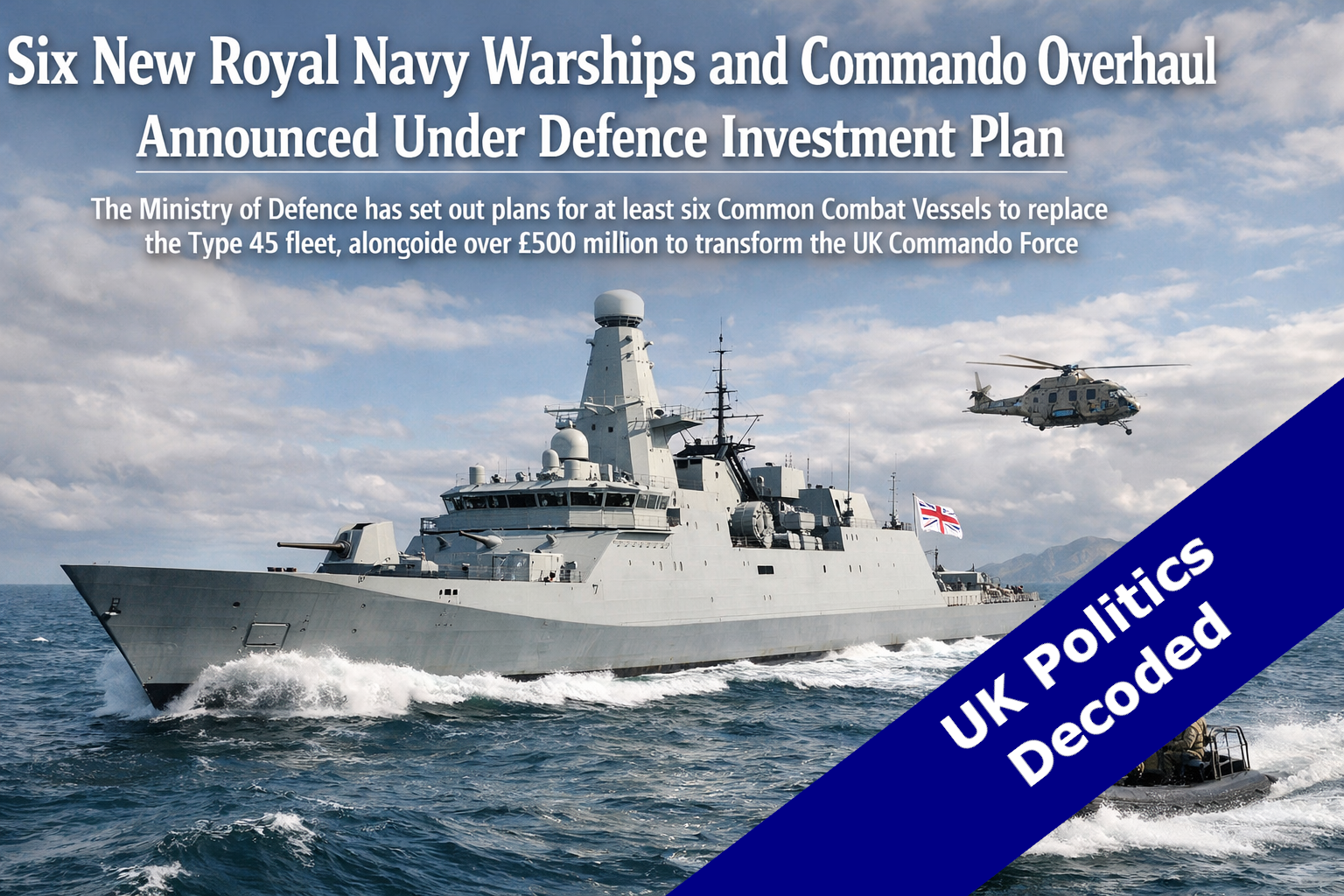
The new vessels called Common Combat Vessels (CCVs) will replace the six Type 45 destroyers currently in service. They mark a significant change in design philosophy. Rather than concentrating firepower in a small number of large, expensive ships, the CCVs are designed as hybrid platforms, crewed warships that also coordinate uncrewed systems operating in the air, on the surface, and underwater. Delivery is expected from the early 2030s.
At a glance
- New warships: At least six Common Combat Vessels to replace the six Type 45 destroyers, with delivery expected from the early 2030s
- Hybrid design: Each CCV will act as a control hub for uncrewed air, surface and underwater systems, the Royal Navy's first hybrid warship class
- Commando Force: Over £500 million committed to transforming the UK Commando Force into the Future Commando Force, with a focus on the High North
- Technology investment: Nearly £100 million for drones, uncrewed vessels, next generation communications and networked targeting and strike systems
- Jobs: Programmes funded through the Defence Investment Plan are expected to back tens of thousands of new UK jobs
The CCV replaces earlier plans for a Type 83 destroyer. According to the Ministry of Defence, the shift reflects a deliberate move away from concentrating capability in a small number of high cost platforms. The new design is intended to be more adaptable and better suited to the pace of modern warfare.
When in service, the CCVs will operate alongside eight Type 26 frigates, five Type 31 frigates, and a series of uncrewed platforms including Type 91 missile platforms, Type 92 underwater sensing platforms, Type 93 extra large uncrewed underwater vehicles, and Type 94 sensor platforms. The Ministry of Defence described the combination as "a once in a generation investment in new maritime capability."
The ships will also anchor three new Atlantic programmes, Atlantic Bastion, Atlantic Shield, and Atlantic Strike. These are designed to counter Russian activity in the North Atlantic and High North, protect critical underwater infrastructure, and strengthen NATO deterrence.
Defence Secretary Dan Jarvis MBE MP said the vessels would provide "a capability built for modern warfare," adding that they would be British built and support jobs across the nation.
Announced a day earlier, on 28 June, the Future Commando Force transformation will receive over £500 million. The UK Commando Force is described by the Ministry of Defence as the UK's elite frontline, rapid reaction force, capable of deploying anywhere in the world at short notice. It currently leads NATO's rapid reaction forces and operates in environments ranging from the Arctic to the Middle East.
The investment will fund new high speed Joint Commando Craft (JCCs), developed in collaboration with Norway. The government said these boats could be used for operations including seizing Russian shadow fleet tankers and other maritime security tasks. The Norway partnership builds on the existing Type 26 frigate deal.
Future Commando Force, what is included
- Joint Commando Craft: New high speed boats developed with Norway, suitable for maritime security and rapid intervention operations
- Technology package: Nearly £100 million for uncrewed vessels, next generation communications, networked targeting, and strike drones
- Amphibious ships: Investment in new, larger amphibious ships aimed at creating a combined fleet with the Netherlands
- High North focus: The transformation is specifically oriented towards the High North, reflecting its growing importance to UK and NATO security
Jarvis said he had spent two weeks refocusing the Defence Investment Plan towards immediate front line priorities, stating "We're investing in new lethal strike drones, high speed boats and amphibious transport ships to give our Commandos the equipment they need to stay ahead of adversaries and defend us."
Both announcements emphasise the domestic industrial dimension. The CCV's adaptable design is flagged as creating opportunities across the UK defence industry and positioning the platform for export. The Type 26 frigate already selected by Australia, Canada, and Norway is cited as evidence of the international appetite for British built warships.
Programmes funded through the Defence Investment Plan are expected to back tens of thousands of new UK jobs, though no breakdown by shipyard or region was provided in the announcements.
The two announcements together represent one of the most significant statements of Royal Navy procurement intent in recent years. The shift from the Type 83 to the CCV concept, fewer large ships, more hybrid and uncrewed capability reflects a broader strategic direction that the government has been signalling since taking office.
The full Defence Investment Plan has not yet been published. The government has said it will be released ahead of the NATO Summit. Until then, some details including the total programme cost for the CCVs and the full scope of the DIP remain to be confirmed.
Key Takeaways
- At least six Common Combat Vessels will replace the Type 45 destroyer fleet, with delivery expected from the early 2030s replacing earlier plans for a Type 83
- The CCVs are the Royal Navy's first hybrid warship class, designed to coordinate crewed and uncrewed systems in air, surface and underwater environments
- Over £500 million will fund the Future Commando Force transformation, including new high speed boats with Norway and nearly £100 million in drone and technology investment
- Three new Atlantic programmes, Bastion, Shield, and Strike will be anchored by the CCV programme to counter Russian activity and protect underwater infrastructure
- The full Defence Investment Plan has not yet been published and is expected ahead of the NATO Summit
Sources & Further Reading
- GOV.UK - At least six new air defence warships to defend UK waters and boost shipbuilding (Ministry of Defence, 29 June 2026) Archived copy (OGL): archived page
- GOV.UK - High speed boats and new drones for elite Commando Force under Defence Investment Plan (Ministry of Defence, 28 June 2026) Archived copy (OGL): archived page