AI Use: AI tools were used to support source discovery and to structure the article for clarity. All research, verification, drafting, and final editorial decisions are fully human led. Learn about our AI policy.
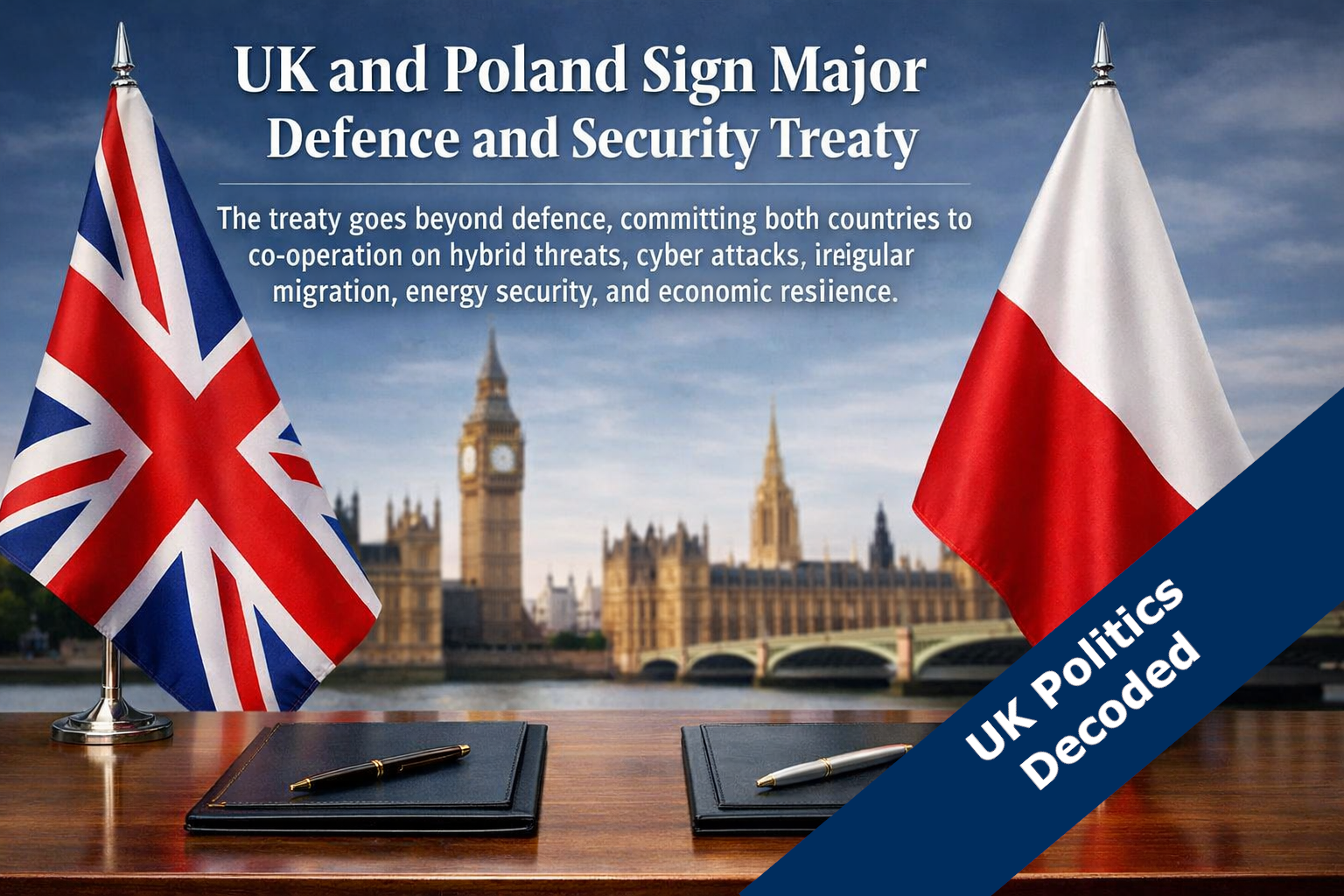
The UK and Poland have signed a new Treaty on a Security and Defence Partnership, replacing and significantly expanding a 2017 agreement between the two countries. The signing took place in London on 26 May 2026 during a visit by Polish Prime Minister Donald Tusk, hosted by Prime Minister Keir Starmer. The treaty was formally published by the UK government on 27 May 2026.
Both governments described it as the most significant step forward in the bilateral relationship in a generation. It follows similar bilateral treaties the UK has struck with France and Germany, and comes as Starmer's government has sought to deepen engagement with European partners on security and defence following Russia's continued military presence in Ukraine.
What the Treaty Covers at a Glance
- Defence cooperation: Joint weapons development, air defence systems, uncrewed land capabilities, and co-production of a next generation medium range air defence missile.
- Hybrid threats: Coordinated responses to Russian linked sabotage, arson attacks, cyber incidents, and foreign information manipulation.
- Migration: A Joint Action Plan targeting migrant smuggling networks and boosting intelligence sharing on organised crime groups.
- Energy security: Reducing Russian sourced nuclear fuel dependency and strengthening civil nuclear and renewable energy cooperation.
- Governance: Biennial prime ministerial consultations and a senior official coordination mechanism to track implementation.
The Context: Why Now, and Why Poland?
Poland is NATO's most significant eastern flank state. It shares a border with Ukraine, Belarus, and the Russian exclave of Kaliningrad, and in 2023 it spent 3.9% of GDP on defence, more than any other NATO ally. It has also taken in more Ukrainian refugees than any other country. Its strategic position within the alliance means it holds direct relevance to any credible European deterrence posture.
The announcement in London cited a specific pattern of hybrid attacks both countries said they attributed to Russian direction, arson attacks in East London warehouses, cargo fires in Birmingham, and similar incidents across Europe. The treaty acknowledges these as part of a pattern of "malign actions" by the Russian Federation requiring a joint, coordinated response.
The UK-EU Security and Defence Partnership, signed on 19 May 2025, is also explicitly referenced in the treaty text. With Poland an EU member, the two governments framed this bilateral agreement as complementary to that broader EU-UK arrangement.
What the Treaty Text Actually Commits To
The full treaty, published under the Open Government Licence by 10 Downing Street on 27 May 2026, runs to twelve articles. It covers foreign and security policy co-operation, defence, national security, economic security, energy and climate security, and governance. The following is a breakdown of the main substantive commitments.
Defence and Armed Forces
Under Article 2, both governments commit to deepen military cooperation across all domains, including training, education, exercising, and special operations. The treaty specifically calls for:
- The design and development of new air defence effectors described as sophisticated munitions to strengthen air and missile defence systems.
- The co-production of a next generation medium range air defence missile.
- The use of uncrewed land systems to reinforce NATO's eastern flank, supported by large scale joint exercises in counter drone warfare, electronic warfare, and engineering.
- Greater alignment of defence industrial and export strategies, including joint procurement and supply chain risk reduction.
- Enhanced liaison officer networks and negotiations on the mobility of military personnel between the two countries.
The treaty also explicitly states that in the event of an armed attack on either party, both "shall assist one another, including by military means in accordance with Article 5 of the North Atlantic Treaty." This is a reaffirmation of NATO obligations rather than a new legal commitment, but it is written directly into the bilateral treaty text.
Cyber and Hybrid Threats
Article 3 deals with national security cooperation, and it is notably detailed on the threat from hybrid operations. Both governments commit to strengthening resilience against sabotage, cyber attacks, and what the treaty calls Foreign Information Manipulation and Interference (FIMI) a term covering disinformation and influence operations by hostile state actors.
What the Hybrid Threat Commitments Include
- FIMI: Both countries will deepen exchanges of risk analysis and develop joint capability to tackle disinformation and influence campaigns from malign actors.
- Cyber: Increased collaboration in cyber security capabilities, including dual use technologies, artificial intelligence, and space.
- Critical infrastructure: Sharing best practice on resilience, preparedness, and incident response, particularly in the energy sector and maritime infrastructure.
- Counter terrorism: Strengthened coordination through continued intelligence cooperation and increased data sharing where appropriate.
Migration and Organised Crime
A Joint Action Plan on Irregular Migration is included as part of the treaty framework. As a major EU border state and migration partner for the UK, Poland plays a role in upstream prevention of irregular crossings into Britain. The plan commits both governments to:
- Target smuggling networks and their use of social media to recruit vulnerable people.
- Maximise intelligence sharing to disrupt gangs and their tactics.
- Harness advanced targeting and surveillance technologies to strengthen border security.
- Cooperate on advance cargo information sharing and pre arrival risk analysis to tackle drug trafficking, firearms, and illicit finance.
The treaty also commits both countries to opening negotiations on a new prisoner transfer agreement, building on a memorandum of understanding signed between the two justice ministries in November 2024. Criminal records exchange including for employment vetting, migration procedures, and safeguarding checks is also specifically listed.
Energy Security and Russia's Nuclear Supply Chain
Article 5 of the treaty addresses energy and climate security. One notable passage is a commitment by both governments to counter Russia's involvement in their respective civil nuclear supply chains, including technology and raw materials. Poland, which has historically relied on Russian nuclear fuel technology, has been working to diversify. The treaty formalises the UK's support for that effort.
Both sides also commit to joint actions to support zero or low emission energy sources, protect maritime energy infrastructure, and uphold the goals of the 2015 Paris Agreement. Transmission system operators and market regulators are specifically mentioned as key partners in delivering energy security.
How the Treaty Will Be Governed
Article 6 sets out the governance structure. A senior official coordination mechanism will review implementation and identify new areas of cooperation. Prime ministers will hold biennial consultations. Further ministerial level dialogues on specific policy themes can be held as needed.
The treaty can be amended in writing by agreement between both parties and can be terminated with six months' written notice. It enters into force 30 days after both governments notify each other that their internal ratification procedures are complete. The signed copy has blank spaces for the date and location, which is standard practice for a treaty text released ahead of formal deposit with the relevant constitutional authorities.
The agreement builds directly on the 2017 Treaty between the Republic of Poland and the United Kingdom on Defence and Security Cooperation, and the Poland-UK 2030 Strategic Partnership Joint Declaration on Foreign Policy, Security and Defence, signed in July 2023.
Key Takeaways
- The UK and Poland signed a new bilateral Security and Defence Partnership treaty in London on 26 May 2026, replacing the 2017 treaty and significantly expanding its scope.
- The treaty covers defence industrial cooperation, next generation weapons co-production, cyber and hybrid threat response, migration, energy security, and organised crime.
- Both sides explicitly named the Russian Federation as the most significant long term threat to Euro-Atlantic security and committed to countering its influence across all domains.
- A Joint Action Plan on Irregular Migration is included, targeting smuggling networks and border security intelligence sharing.
- Both governments committed to reducing Russia's role in their civil nuclear supply chains and to cooperating on clean energy transition.
- The treaty is governed by biennial prime ministerial consultations and a senior official implementation mechanism.
Sources & Further Reading
- GOV.UK – Prime Minister's Office: UK and Poland set to sign major defence and security treaty (26 May 2026) Archived copy: UK Politics Decoded archive
- GOV.UK – 10 Downing Street: Full text of the Treaty on a Security and Defence Partnership (published 27 May 2026) Archived copy: UK Politics Decoded archive