AI Use: AI tools were used to support source discovery and to structure the article for clarity. All research, verification, drafting, and final editorial decisions are fully human led. Learn about our AI policy.
On 15 June 2026, Prime Minister Keir Starmer and Technology Secretary Liz Kendall announced that social media platforms will be legally barred from offering services to children under 16 in the UK. The plans, described by the government as going "further than any other country in the world", follow Australia's legislative model and are expected to be brought to Parliament before Christmas, with protections potentially in force by spring 2027.
More than 116,000 responses were submitted to the national consultation that preceded today's announcement. Nine in ten parents said they backed a ban. Two thirds of young people agreed that under 16s should not be allowed to use at least some social media platforms. Politically, the ground was well prepared.
What the Government Has Announced
- Social media ban: Platforms whose purpose is to enable social interaction and which allow users to post content including Snapchat, TikTok, YouTube, Instagram, Facebook and X, will be prohibited from offering services to under 16s.
- Messaging excluded: Services like WhatsApp and Signal are not included in the social media ban.
- Wider restrictions: Harmful functions including livestreaming and stranger communication with children will be blocked on a broader range of online services, including gaming platforms.
- AI chatbots: AI "romantic companion" chatbots must enforce a minimum age of 18. Intimate AI chatbot functions will be restricted for under 18s more broadly.
- Age assurance: Ofcom will conduct a rapid study on highly effective age assurance (HEAA) measures. The Secretary of State has written to Ofcom's new Chair requesting an urgent review of enforcement capabilities.
- Timetable: Secondary legislation under powers already taken via the Children's Wellbeing and Schools Act. First regulations could be in effect spring 2027.
The harm the government is responding to is real. Algorithmic feeds on social media platforms can intensify children's exposure to dangerous or distressing material. Real time content is harder to moderate. The government's own data and the responses it received from families make clear that many parents feel they have lost control of what their children access online, and when.
But the scale of the announcement does not make the mechanism sound. And there are two significant problems with this policy that are not being addressed in today's press release.
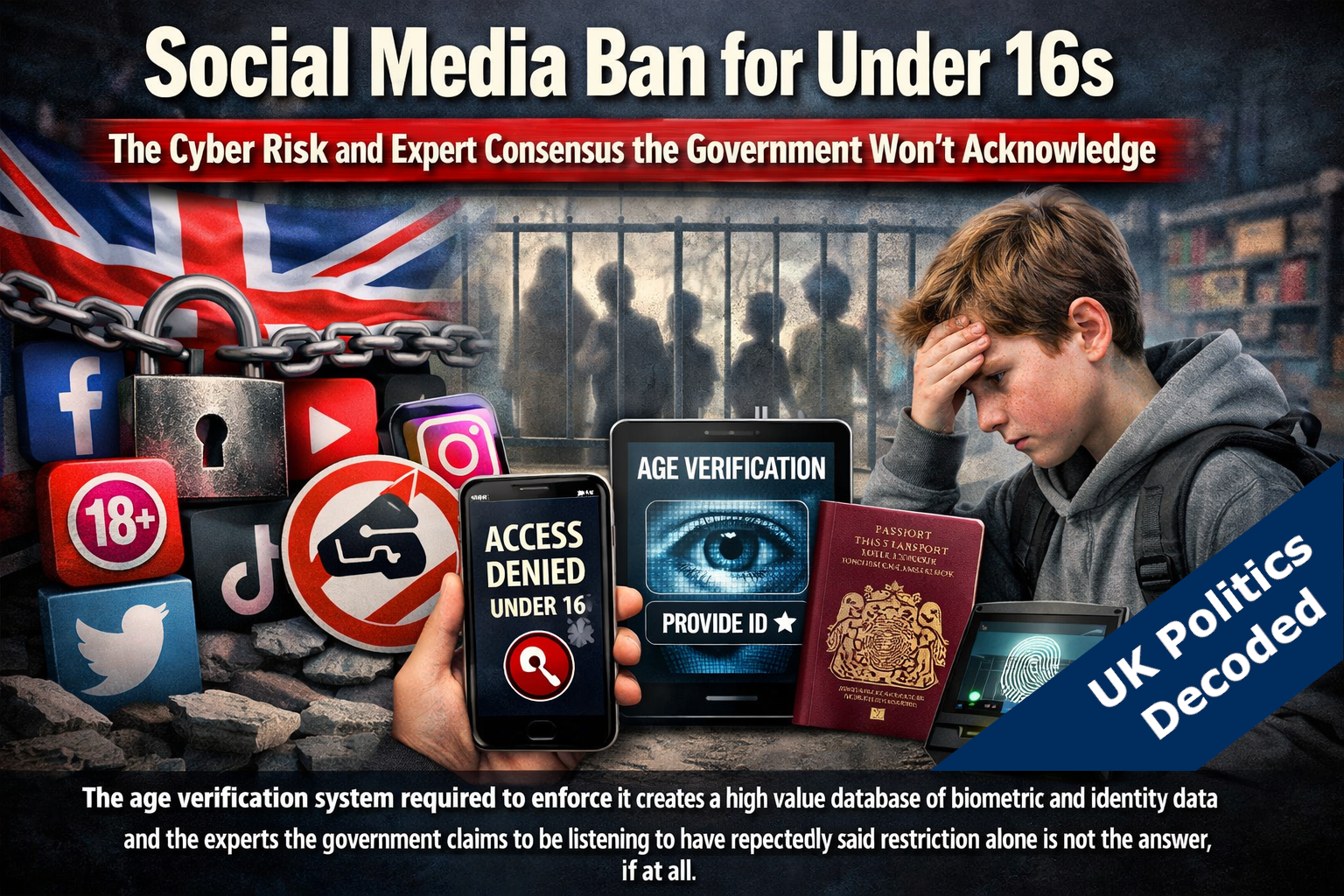
A ban on under 16s using social media is only as effective as the system used to verify ages. The government has acknowledged this, tasking Ofcom with studying what constitutes "highly effective age assurance." What it has not done is explain honestly what effective age assurance actually requires, or what it costs in terms of privacy and security.
Age verification at scale means collecting identity signals. In practice, that means some combination of official documentation, passports, driving licences, biometric data such as facial analysis or age estimation, or linked financial records. None of those data types are trivial. They are among the most sensitive categories of personal information that exists. And under this policy, they would need to be processed, held, or transmitted by private companies operating under government mandate.
What Effective Age Assurance Requires in Practice
- Identity documentation: Official ID such as a passport or driving licence to confirm age with reasonable certainty.
- Biometric processing: Many age assurance systems use facial analysis to estimate age or verify identity against a document scan.
- Data storage: Verification status must be held somewhere, on the device, in a cloud system, or with a third party provider to function across multiple services.
- Third party infrastructure: Platforms are unlikely to build their own verification systems. The market is dominated by a small number of specialist private firms whose security standards are not publicly audited.
A High Value Target for Hackers and Foreign States
The UK's cyber attack surface is not a theoretical concept. It is made up of every database, every system, every contractor holding information that people have been required to provide in order to access services. The government is proposing to create a new one, a mandatory identity and age verification infrastructure covering every child and adult in the country who wishes to use social media or other in scope platforms.
That is an extraordinarily high value dataset. A database linking the identities, biometric records, and online behaviour of millions of UK residents is precisely the kind of asset that hostile states and criminal organisations target. We know this from experience, not theory. The NHS has been hit by multiple ransomware attacks in recent years. The Electoral Commission disclosed in 2023 that a breach had exposed data relating to approximately 40 million people. The Police Service of Northern Ireland accidentally published the personal details of every serving officer. These are not edge cases, they reflect a structural problem in how large centralised datasets are managed and protected in this country.
The risk is not confined to large public institutions. In October 2025, Discord disclosed that official ID photos belonging to approximately 70,000 users had potentially been leaked following a cyber attack not on Discord itself, but on the third party company it had contracted to verify user ages. The hackers obtained passport scans and other identity documents that people had submitted for the sole purpose of proving their age on a platform. Information like official ID numbers is, as the BBC reported at the time, "especially valuable because, unlike credit card details, it typically remains unchanged over time." Discord is a single platform. The government is proposing mandatory age verification across an entire category of the internet.
The government has already signalled it is aware of the tension. Its announcement explicitly states that age assurance measures must work "without threatening privacy." But that instruction is in direct conflict with what effective age verification actually requires. You cannot verify identity at scale without processing identity data. The government has not resolved this contradiction, it has simply stated that it expects both things to be true simultaneously.
The Government's Position
- Privacy assurances: Age assurance measures must work "without threatening privacy."
- Ofcom oversight: The regulator will conduct a rapid study on highly effective age assurance and publish an enforcement strategy.
- Existing law: The Online Safety Act and UK GDPR place obligations on companies handling personal data.
- Funding: The government has confirmed Ofcom will receive funding to carry out its expanded responsibilities.
The Security Reality
- Data concentration risk: Centralising identity and biometric data creates a single point of failure that is a prime target for state sponsored attackers.
- Private sector custody: Verification infrastructure will be held by private companies, not regulated public bodies, with variable security standards.
- UK breach history: NHS Trusts, the Electoral Commission, and government contractors have all been successfully compromised in recent years.
- No liability framework: The announcement does not address what happens when a verification provider is breached or who bears responsibility.
What Experts Have Actually Been Saying
The government says it has listened to parents, children, and experts. It held one of the largest national consultations in recent memory. But there is a persistent gap between the evidence from child safety research and the policy response that has been chosen.
UNICEF has stated plainly that "age restrictions alone won't keep children safe online," warning that bans without accompanying education and parental support risk pushing children toward less regulated spaces. The Lancet's Public Health journal published research this year examining the relationship between social media restrictions and adolescent wellbeing, noting that the evidence base for blanket bans remains limited and that the effectiveness of restrictions depends heavily on whether they are accompanied by wider digital literacy investment. Academic research published in the journal Child and Adolescent Mental Health similarly found that parental engagement and education consistently outperform technical controls as protective factors.
The DISA research network, reviewing the emerging literature on social media bans, identified a recurring concern, that restrictions without education can reduce children's exposure to a known platform while driving them toward less monitored alternatives. The argument is not that children should have unrestricted access to social media. It is that restriction alone, without the tools to understand why and to navigate risk, leaves the underlying vulnerability intact.
What the Research Consistently Finds
- UNICEF (2026): Age restrictions alone are insufficient. Children need digital literacy skills and parental support to navigate online harm, not just platform restrictions.
- The Lancet Public Health (2026): The evidence base for blanket social media bans on adolescent wellbeing is limited. Effectiveness depends significantly on whether restrictions are paired with broader education investment.
- Child and Adolescent Mental Health journal: Parental engagement and education are consistently stronger protective factors than technical controls, which are routinely circumvented.
- Displacement risk: Restrictions without education do not eliminate demand, they redirect it, often toward less regulated platforms where oversight is weaker or absent entirely.
The Dark Web Displacement Effect
There is a pattern that has emerged wherever heavy handed internet regulation has been introduced without addressing the underlying demand. People, children and adults do not simply stop accessing content when a platform is blocked. They find another route.
For privacy conscious users, or those who simply refuse to hand over official documentation and biometric data to private companies, that route increasingly runs through VPNs, Tor, and the wider anonymised web. The irony of the government's approach is that it creates exactly the conditions that push cautious, privacy aware users deeper into unregulated spaces. Someone who declines to submit a passport scan to an age verification provider, a perfectly reasonable position, given the UK's recent record on data security, may find themselves unable to access mainstream platforms and instead navigating services with no moderation, no safety infrastructure, and no accountability.
For children specifically, this displacement risk is not hypothetical. Research has repeatedly shown that determined young people can and do circumvent platform level restrictions. The technical barrier to accessing content via a VPN or an unverified secondary account is low. What regulation does, in those cases, is not block access, it removes the regulated safety infrastructure from around the access that continues anyway.
Parental Responsibility and the Missing Conversation
One of the most striking absences from today's announcement is any substantive discussion of parental education. The government frames this as giving "power back to parents" but the policy it has chosen does the opposite. It transfers responsibility for managing children's online lives to platforms, regulators, and private verification companies, while leaving parents with no better understanding of how to talk to their children about the online world than they had before.
Child safety specialists have consistently argued that the most durable protection for children online is a parent who understands the risks and can discuss them. That requires investment in education for parents as much as children. It requires school curricula that treat digital literacy as seriously as reading and maths. It requires accessible guidance for families, not press releases about banning platforms.
None of that is incompatible with proportionate technical safeguards. But the balance of today's announcement is heavily weighted toward restriction and enforcement, with very little acknowledgement that the same outcome might be better achieved and more durably through a different approach.
The government plans to use secondary legislation under powers already acquired through the Children's Wellbeing and Schools Act, which means the first regulations could, in theory, come into force as early as spring 2027. The bill itself is expected to be brought to Parliament before Christmas.
Ofcom has been asked to conduct a rapid study on highly effective age assurance and to produce an enforcement strategy. The Technology Secretary has also written to Ofcom's new Chair requesting an urgent review of the regulator's enforcement capabilities. Funding, the announcement confirms, will follow.
The government has also said it will look further at overnight curfews and breaks in infinite scrolling for under 18s, with more detail expected in July.
What is not yet clear is how age verification will work in practice, what data will be required, who will hold it, under what security standards, and what liability framework will apply when things go wrong. Those are not minor implementation details. They are the questions on which the safety of this policy, for children and adults alike, actually depends.
Key Takeaways
- Social media platforms including TikTok, Instagram, Snapchat, YouTube, Facebook and X will be banned from offering services to under 16s, with legislation expected before Christmas 2026 and first regulations potentially in force by spring 2027.
- Age verification at the scale required will involve private companies processing official identity documents and biometric data on millions of UK residents, creating a high value target for hostile states and criminal hackers.
- The UK has a recent and documented track record of large scale data breaches in public and quasi public institutions. The government has not published a liability framework for when age verification providers are compromised.
- UNICEF, The Lancet, and academic child safety researchers have consistently found that parental education and digital literacy outperform technical restrictions as protective factors, and that bans without education risk displacing children to less regulated platforms.
- Privacy conscious users who decline to submit biometric or identity data to private verification companies may find themselves unable to access mainstream regulated platforms and pushed toward unmonitored, unmoderated alternatives.
Sources & Further Reading
- GOV.UK – Social media to be banned for 16s in landmark government move (15 June 2026) Archived copy: UK Politics Decoded archive
- UNICEF – Age restrictions alone won't keep children safe online
- DISA – Researchers Investigate the Impact of Social Media Bans on Children
- The Lancet Public Health – Social media restrictions and adolescent wellbeing (2026)
- Child and Adolescent Mental Health – Parental engagement and online safety outcomes
- BBC News – ID photos of 70,000 users may have been leaked, Discord says (9 October 2025)