AI Use: AI tools were used to support source discovery and to structure the article for clarity. All research, verification, drafting, and final editorial decisions are fully human led. Learn about our AI policy.
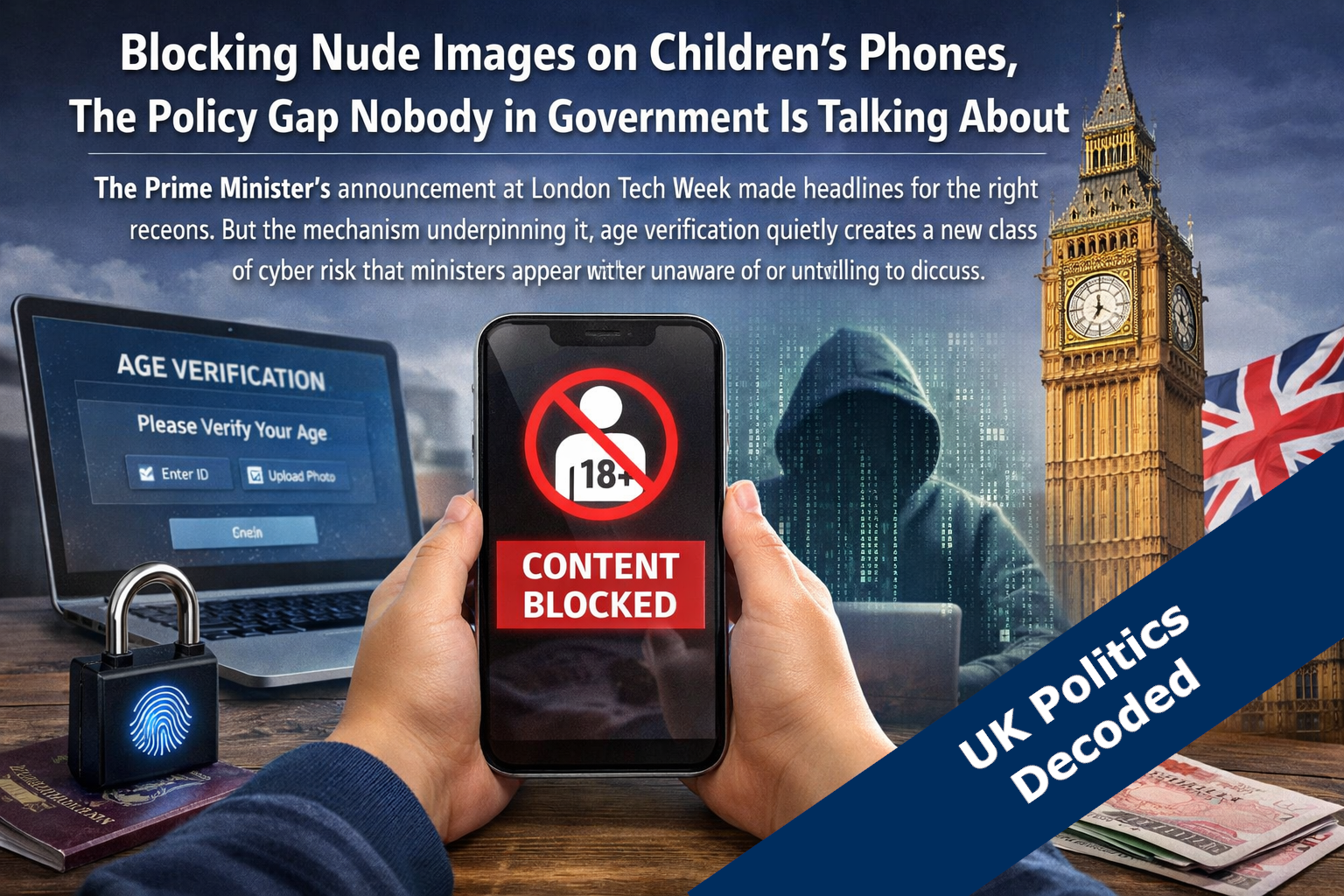
Speaking at London Tech Week on 8 June 2026, Prime Minister Keir Starmer announced that Britain would become the first country in the world where it is impossible for children to take, share or view nude images on their devices. Apple and Google have been given three months to activate device level nudity blocking by default for under 18s. If they fail to act, the government will legislate. Criminal liability for tech executives is, the announcement noted, "on the table".
The statistics cited are stark. According to government figures, 91% of online child sexual abuse reports recorded in 2024 contained self generated content from children. The average child now views pornography by age 13. More than half of all child sexual abuse and exploitation cases involve children aged 10 to 17 offending against other children. Those numbers represent real harm and the policy response, at least in intention, is serious.
What the Government Announced
- Target: Apple and Google must block nude images across the full device by default for children, not just blur them and not just in some apps.
- Scope: Covers cameras, messaging apps, third party services and search functions on smartphones and tablets, both existing and newly sold.
- Deadline: Three months for voluntary compliance before legislation is introduced.
- Adults: Can unlock adult content through an age verification process.
- Precedent: Apple has already introduced age checks in the UK, making it the first company to activate safety features by default for unverified users.
Nobody is seriously arguing that children should have unrestricted access to sexually explicit material. The intent behind this policy is defensible and the scale of harm that prompted it is not in dispute. The problem is what happens when you lift the bonnet and look at how the system is actually supposed to work.
The policy hinges on age verification. Adults who want to access nude content must prove they are over 18. That sounds reasonable until you ask prove it how? In practice, age assurance systems rely on private companies holding one or more of the following, biometric data, a facial age estimate or a scan, official identity documents such as a passport or driving licence, or linked financial data. These are not abstract categories of information. They are some of the most sensitive personal data in existence.
The government's own announcement states that companies must introduce these measures "without threatening privacy or collecting any data." That instruction is what experts question whether this is technically feasible as written. Effective age verification, at device level, across every app and service, requires some form of identity signal. The government has not explained how that signal is generated without any data being held, processed or transmitted.
What Age Verification Actually Requires
- Identity proof: Passport, driving licence or equivalent official document to confirm age.
- Biometric processing: Many systems use facial analysis to estimate or confirm age against a document.
- Data holding: Verification status must be stored somewhere on the device, in the cloud, or with a third party provider.
- Third party providers: Most major platforms are not building their own verification infrastructure. They are procuring it from specialist firms.
Who holds the keys and what happens when they're stolen?
Age verification data is a high value target. A database containing the identity documents and biometric records of millions of UK adults is not a mundane operational asset. It is exactly the kind of dataset that hostile state actors, criminal organisations and opportunistic hackers routinely pursue.
The UK's recent track record on protecting sensitive data held by government and public service bodies does not inspire confidence. The NHS has been subject to repeated ransomware attacks. The Electoral Commission disclosed in 2023 that it had been breached and that the data of approximately 40 million people had potentially been accessed. The Police Service of Northern Ireland accidentally published the personal details of all serving officers. These are not isolated incidents, they reflect a systemic vulnerability in how large public and quasi public datasets are managed.
Now consider what the government is proposing to normalise, every adult in the UK who wants access to legal content on their own device must pass their identity through a verification layer controlled by private companies operating under government mandate. Each of those companies becomes a target. Each database a single point of failure. The attack surface for the UK's cyber infrastructure does not shrink under this policy. It grows, substantially, and it does so in ways that directly affect individual citizens.
What the government says about data protection
- No data collection: The announcement states companies must block content "without threatening privacy or collecting any data".
- On device processing: British firm SafeToNet claims its HarmBlock technology works in real time with no data entering or leaving the application.
- Existing frameworks: The Online Safety Act and UK GDPR place obligations on companies handling personal data.
- Oversight: Ofcom has regulatory responsibility for enforcement under the Online Safety Act.
What the technical reality looks like
- Identity signal required: Device wide age assurance requires some form of verified identity link, either on the device, in a token, or with a third party.
- Verification industry: The UK age verification market is dominated by a small number of private companies. Their security standards vary and are not publicly audited.
- Breach history: Major UK public institutions have been successfully breached in recent years, including NHS Trusts, the Electoral Commission and government contractors.
- Criminal liability: The announcement floats criminal liability for tech executives but does not address liability for verification providers whose systems fail.
What the experts actually recommend
There is a persistent gap between how politicians frame online child safety and what those who work in the field consistently recommend. Digital rights researchers, child psychologists, and internet safety specialists have repeatedly pointed to education as the most effective long term tool, not as a replacement for technical safeguards, but as the foundation without which any technical measure is incomplete.
The argument is practical, not ideological. Technical restrictions are circumventable. Any child with a VPN, a secondary device, or a friend's login can navigate around device level blocking. What cannot be circumvented is a child who understands what they are looking at, why it may be harmful, and who to talk to if they are pressured. That understanding comes from parents and educators, not from app settings.
Critics of the government's approach also point to an unintended consequence that has emerged consistently wherever similar restrictions have been introduced, platform level restrictions and age gating do not eliminate demand. They redirect it. Services that comply with UK regulations lose users to services that do not, often smaller, less moderated platforms operating outside UK jurisdiction, or darker corners of the internet where there is no effective oversight at all. The government's approach, as currently framed, risks pushing both children and adults toward less safe environments, not safer ones.
Rights that are not being mentioned
The legal framework underpinning this policy is more complicated than the press release suggests. Three provisions of the European Convention on Human Rights, which remains part of UK law via the Human Rights Act, are directly relevant.
Article 8 - the right to private and family life, establishes that public authorities may not interfere with a person's private life without lawful basis and proportionate justification. Compelling adults to submit biometric or documentary proof to access legal content on their own devices is a significant intervention into private life. Whether it meets the proportionality test is not a settled question.
Article 2 of Protocol 1 protects the right of parents to ensure their children's education conforms to their own convictions. The legal text states that "the State shall respect the right of parents to ensure such education and teaching in conformity with their own religious and philosophical convictions." Parents who believe that educating their children about sexuality and online risk is their responsibility rather than the state's, have a plausible argument that blanket device level controls interfere with that right.
Article 10 protects freedom of expression, including the right "to receive and impart information and ideas without interference by public authority." Restricting the ability of adults to receive legal information or content without passing through a state mandated verification process engages Article 10. The government will argue that the restriction is justified and proportionate. That argument will almost certainly be tested in court.
ECHR Provisions in Play
- Article 8 – Private and Family Life: Compulsory age verification using biometric or identity data constitutes an interference with private life requiring proportionate justification.
- Article 2, Protocol 1 – Right to Education: Parents have the right to direct their children's education, including on matters of sexuality and online safety, in line with their own convictions.
- Article 10 – Freedom of Expression: The right to receive information without public authority interference is engaged wherever adults must verify identity to access legal content.
Good intentions, unanswered questions
None of this is an argument against protecting children online. The harm the government is responding to is real and the organisations quoted in the announcement, from the NSPCC to Barnardo's to the Internet Watch Foundation are not wrong to welcome action. The data on self generated child sexual abuse material is alarming. Something needs to change.
But "something needs to change" is not the same as "this specific mechanism is well designed and safe to implement at scale." The announcement at London Tech Week was heavy on political intent and light on technical detail. The instruction that age verification must happen "without any data being collected" is either a misunderstanding of how the technology works, or an aspiration that the government has not yet figured out how to deliver.
The UK's cyber attack surface is not abstract. It is made up of every dataset, every verification system, every third party contractor holding information that people have been required to hand over to access services they use every day. Government and NHS systems have been compromised in the recent past. The question of whether the state can keep this kind of data safe is not hypothetical. And it is a question that, as yet, nobody in a ministerial role is being asked to answer.
Key Takeaways
- The government has given Apple and Google three months to block nude images by default on children's devices, with legislation threatened if they do not comply.
- The policy relies on age verification systems that, in practice, require private companies to hold sensitive identity or biometric data on millions of UK adults.
- Recent high profile breaches of NHS, government and public sector systems raise legitimate questions about whether this data can be kept secure at scale.
- Digital safety experts consistently argue that education of both children and parents — is more effective than technical restrictions alone, which are routinely circumvented and can push users toward less regulated platforms.
- Articles 8 and 10 of the ECHR, and Article 2 of Protocol 1, are all engaged by this policy and are likely to face legal challenge as legislation is developed.
Sources & Further Reading
- GOV.UK – New plans to stop children taking, sharing or viewing nude images (8 June 2026) Archived copy: UK Politics Decoded archive
- Online Safety Act 2023 – legislation.gov.uk Archived copy: UK Politics Decoded archive
- Human Rights Act 1998 – incorporating ECHR Articles 8 and 10, and Protocol 1 Article 2 Archived copy: UK Politics Decoded archive