AI Use: AI tools were used to support source discovery and to structure the article for clarity. All research, verification, drafting, and final editorial decisions are fully human led. Learn about our AI policy.
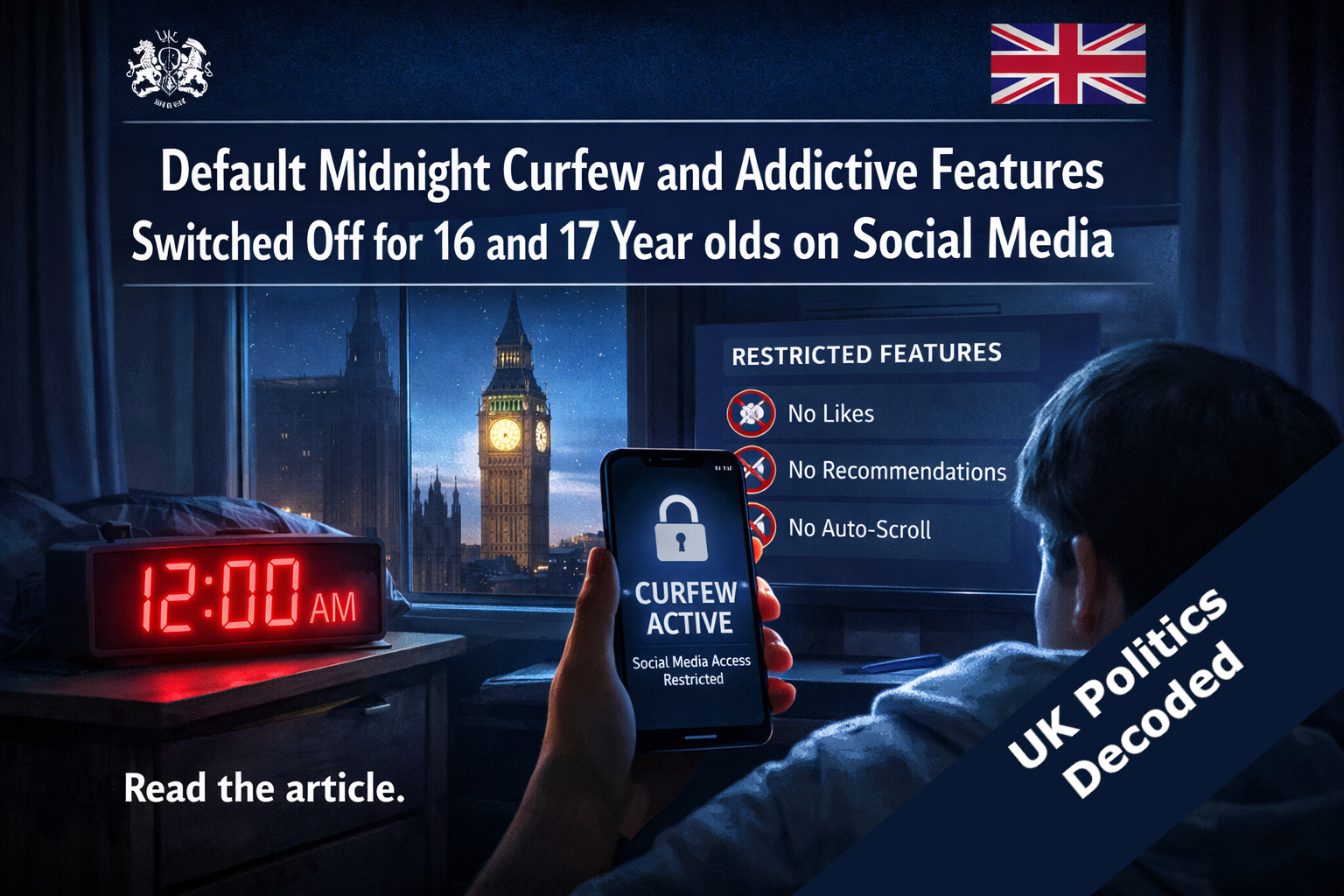
Social media platforms will be required to apply a default overnight curfew for users aged 16 and 17, blocking access from midnight to 6am. Alongside the curfew, features that drive extended use, autoplay videos and continuously refreshed personalised feeds will be switched off by default for that age group. Both measures were announced by Technology Secretary Liz Kendall on 15 July 2026.
Teenagers aged 16 and 17 will be able to turn these defaults off themselves if they choose to. The government describes that as striking a balance between greater protection and the increased autonomy that comes with age ensuring, as Kendall put it, that "when kids turn 16, they don't face a cliff edge of being exposed to the most addictive features online."
At a glance
- Default curfew: Midnight to 6am on social media apps for all users aged 16 and 17
- Addictive features: Autoplay videos and personalised feeds switched off by default for 16 and 17 year olds
- User override: Teenagers aged 16-17 can change their own settings, under 16s cannot
- Timeline: Regulations to be laid before Parliament by end of 2026, measures expected in force spring 2027
- Broader context: Follows the government's June 2026 announcement of a social media ban for under 16s, also due spring 2027
The announcement follows a government commissioned qualitative study run by Savanta for the Department for Science, Innovation and Technology (DSIT), involving more than 300 teenagers and parents across the UK. The research tested three types of restriction during a one month trial period in May 2026, a 15 minute daily limit on each app, a 9pm to 7am overnight curfew, and full removal of social media apps.
The overnight curfew proved the easiest to enforce. Families were most likely to say they would continue it voluntarily after the study ended, and it produced the most consistently reported improvements in sleep. Participants described going to bed earlier, feeling more rested, and concentrating better in lessons. However, it left daytime use largely unchanged, researchers noted that many young people simply shifted their scrolling earlier, front loading their evening use before the cut off took effect.
Full app removal produced the sharpest improvements in focus and family time, but also caused the most social disruption. Several young people described feelings of isolation from peer group chats and weekend plans, particularly given their friends were not subject to the same restrictions. The 15 minute daily limit had the lowest compliance rate of the three, with many families encountering workarounds, switching to tablets, laptops, or older phones. Across all three interventions, teenagers reported an initial period of irritability that typically eased after the first week.
Alongside the social media measures, Kendall announced a separate package of protections for children using AI chatbots. This includes mandatory breaks for under 18s, and work with regulators to address services that provide dangerous or unverified mental health advice with ministers keeping open the option of banning chatbots that pose a serious threat to children.
The government also said it will expand the Kids Online Safety Hub to provide new guidance for children, parents, and guardians on how to use AI safely. From September 2026, RSHE (Relationships, Sex, and Health Education) classes in England will cover critical thinking about AI, identification of misinformation and misogynistic content, and an understanding that online content can present a distorted picture of the world. From September 2028, the National Curriculum will embed media literacy across subjects, with an enhanced computing curriculum covering AI, data science, and algorithmic bias.
A companion report published on 14 July 2026, commissioned by DSIT and conducted by BMG Research, surveyed 2,299 young people aged 11 to 17. It found that 39% have successfully bypassed an online age check at least once. Around a quarter (26%) had used a VPN in their lifetime, and around a fifth (22%) of VPN users said they use one specifically to access age restricted content equating to roughly 7% of all children surveyed.
The report also found that 51% of children who had bypassed age checks subsequently encountered at least one type of harmful content. Explicit sexual content was the category most likely to be seen only after bypassing, 35% of those who had bypassed and seen such content said they encountered it exclusively following a successful workaround. The findings are intended to inform future policy on enforcement and circumvention, as the government prepares its under 16s ban regulations.
The Online Safety Act 2023 required platforms to introduce highly effective age assurance for children's harmful content from July 2025, covering methods such as facial age estimation and government ID verification. In June 2026, the Prime Minister announced the government's intention to prevent social media platforms from offering services to under 16s altogether. Regulations giving effect to that ban are expected to be laid before Parliament by the end of 2026 and to come into force in spring 2027, alongside today's measures for 16 and 17 year olds.
The new default curfew and feature restrictions sit within the same legislative framework. Ofcom is responsible for enforcement under the Online Safety Act, and the government has said it will have robust implementation powers to back the new rules.
Key Takeaways
- From spring 2027, social media platforms must apply a default midnight to 6am curfew for users aged 16 and 17, and switch off autoplay and personalised feed features by default
- Teenagers aged 16 and 17 can override their own settings, the curfew and feature restrictions cannot be turned off for under 16s
- Government commissioned research found the overnight curfew was the intervention families most consistently adopted and were most likely to continue voluntarily
- A DSIT survey of 2,299 young people aged 11 to 17 found 39% had successfully bypassed an online age check at least once, 51% of those subsequently encountered harmful content
- AI chatbot safety measures for under 18s, including mandatory breaks and potential bans on chatbots offering dangerous mental health advice, are also planned
Sources & Further Reading
- GOV.UK - New social media curfews and crackdown on addictive features to better protect 16 and 17 year olds online (DSIT, 15 July 2026) Archived copy (OGL): archived page
- GOV.UK - Children's circumvention behaviours online (DSIT/BMG Research, 14 July 2026) Archived copy (OGL): archived page
- GOV.UK - Social Media Intervention Research 2026, Qualitative research with 13 to 17 year olds in the UK (DSIT/Savanta, 14 July 2026) Archived copy (OGL): archived page
- Kids Online Safety Hub (HM Government) Archived copy (OGL): archived page