AI Use: AI tools were used to support source discovery and to structure the article for clarity. All research, verification, drafting, and final editorial decisions are fully human led. Learn about our AI policy.
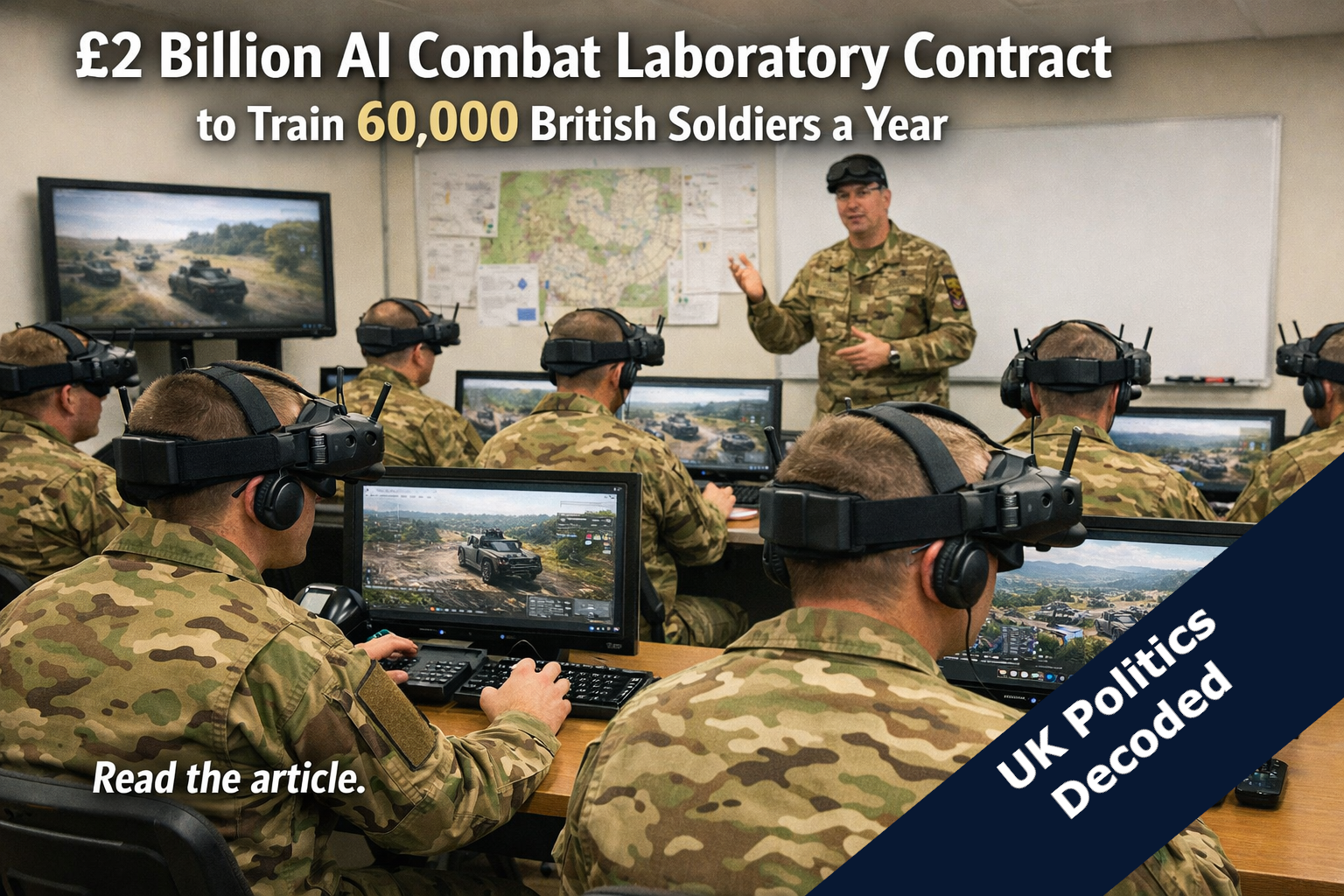
A £2 billion defence contract signed on 10 July 2026 will bring AI powered training to the British Army, with up to 60,000 soldiers trained each year through a new digital platform called the Combat Laboratory. The Ministry of Defence awarded the 15 year contract to Omnia Training, a consortium led by Raytheon UK and made up of five UK based companies, to deliver the Army's Collective Training Service (ACTS) under the wider Army Collective Training Transformation Programme (CTTP).
The contract sits within the £298 billion Defence Investment Plan published on 30 June 2026, which set out the government's ambition to make the British Army ten times more lethal by 2035. It also supports around 400 jobs across the UK, with 270 new skilled roles being created over the contract's lifetime.
At a glance
- Contract: £2 billion over 15 years, awarded to Omnia Training, a Raytheon UK led consortium of five UK based companies
- Platform: The Combat Laboratory uses AI, simulation, and advanced analytics to replicate modern warfare conditions
- Scale: Up to 60,000 soldiers trained per year, across exercises ranging from 100 to 50,000 personnel
- Jobs: Around 400 supported, 270 new skilled roles created, 100 apprenticeships developed
- Sovereign tech: Two platforms within the system are UK developed, backed by over £2 million in government innovation funding
At the centre of the contract is the Combat Laboratory, a digital platform that integrates simulation, live systems, and AI driven analytics to replicate the complexity of modern warfare. It is designed to assess operations, spot patterns, and monitor performance using data, helping commanders at all levels make better decisions under pressure.
Soldiers and commanders will be able to train anywhere, at any time, without needing fixed infrastructure. The system can scale from small unit operations involving 100 personnel all the way up to exercises simulating 50,000 strong forces, covering everything from section level tactics to large scale NATO contingency planning.
The Ministry of Defence says it is intended to draw on lessons from modern conflict specifically from Ukraine to keep training relevant to the threats British forces are most likely to face.
Omnia Training is made up of Raytheon UK, Capita, Cervus, Rheinmetall UK, and Skyral. The broader supply chain spans more than 44 British businesses across Wiltshire, Leicestershire, Hampshire, and other regions.
Two platforms within the system carry particular significance for UK defence self sufficiency. Skyral's software and Cervus's simulation platform are both classed as sovereign, UK developed capabilities. Both have received support from the Defence and Security Accelerator (DASA), with over £2 million in government innovation funding between them. The intellectual property remains under UK control.
James Gray, Managing Director and Chief Executive of Raytheon UK, said the consortium had been working toward this contract for more than three years "Our UK based team of innovators, engineers and experts will give soldiers and commanders a new level of training realism."
The contract will support around 400 jobs across the UK over its 15 year lifespan, with 270 new skilled roles being created. Disciplines will include software engineering, AI expertise, cloud engineering, and data analytics concentrated around Wiltshire and beyond.
One hundred apprenticeships will be developed in partnership with Wiltshire College and the University of Staffordshire, covering areas from data and modelling to project management. Some roles will require prior military experience and will be based in Warminster. Veterans will have dedicated pathways into the new positions alongside young people entering defence careers through the apprenticeship scheme.
Defence Secretary Dan Jarvis MBE MP said the programme demonstrates how defence investment creates skilled jobs across the country. "Our soldiers serve our nation with courage and exceptional dedication. I am absolutely determined they get the quality training they need to keep us safe," he said.
The contract is presented by the government as both a national security investment and an economic one, part of a broader argument that the rise in defence spending flowing from the Defence Investment Plan will generate employment in communities outside London and the South East.
The ACTS contract is one of several major procurement and investment decisions flowing from the Defence Investment Plan published in late June 2026. That plan sets out £298 billion in defence spending over the next four years, with the British Army's increased lethality and readiness as a central objective.
The Combat Laboratory is not the only announcement under that plan touching on training and technology. Other recent contracts have addressed long range strike capability, naval shipbuilding, and biodefence research at Porton Down all drawing from the same funding envelope.
The 15 year contract duration means the system will evolve alongside changes in technology and threat, with UK based companies embedded throughout its supply chain. The government has not published a detailed rollout timetable for when the Combat Laboratory will be fully operational across all levels of Army command.
Key Takeaways
- A £2 billion, 15 year contract with Omnia Training will deliver the Army's Collective Training Service, training up to 60,000 soldiers a year using AI, simulation, and advanced analytics through the Combat Laboratory
- The platform can scale exercises from 100 to 50,000 personnel, enabling training for everything from small unit actions to large scale NATO contingency operations
- Omnia Training is a consortium of five UK based companies backed by a supply chain of 44+ British businesses, two platforms from Skyral and Cervus are sovereign UK developed capabilities with IP retained under UK control
- Around 400 jobs will be supported over the contract's lifetime, with 270 new skilled roles and 100 apprenticeships developed with Wiltshire College and the University of Staffordshire
- The contract supports the government's stated ambition, set out in the Defence Investment Plan, to make the British Army ten times more lethal by 2035