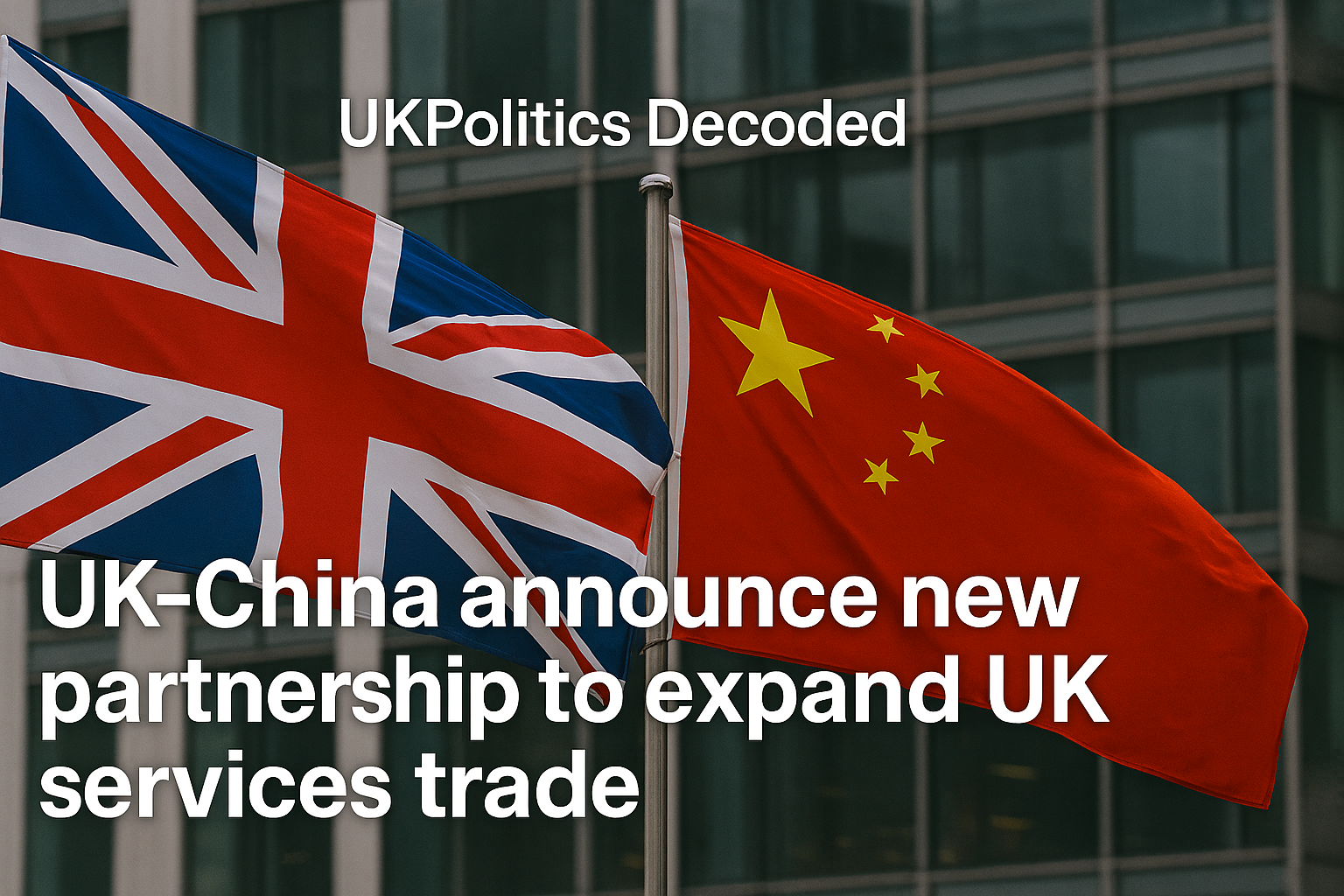
The UK and China have agreed a series of measures designed to make it easier for British companies to operate in the Chinese market, marking a significant step in economic diplomacy between the world's second and fifth largest economies. The announcements were made during the Prime Minister's visit to Beijing, where government officials and business leaders from both countries met to discuss enhanced economic cooperation.
The partnership focuses on services trade, where the UK maintains global competitive advantages and China represents a rapidly growing market. With UK services exports to China currently worth £13 billion annually, the agreements aim to unlock further growth potential in a relationship that could reshape Britain's economic positioning in Asia.
🤝 Partnership Highlights
- Services Partnership: Formal framework improving market access for UK healthcare, financial, legal, and education services
- Visa Free Travel: 30 day visa free entry for British citizens, supporting business travel and tourism
- Trade Agreement Study: Feasibility assessment for bilateral Trade in Services Agreement
- Sector Cooperation: Seven additional agreements covering crime, standards, education, and health
- Business Engagement: Major UK companies welcomed expanded cooperation opportunities
🎯 What Has Been Agreed
The Beijing visit produced a comprehensive package of agreements designed to address long standing barriers to UK services trade while establishing frameworks for deeper economic integration.
A New UK–China Services Partnership
Both governments will establish a formal partnership focused on improving market access for UK service industries that have faced regulatory and procedural barriers in Chinese markets:
- Healthcare: Enhanced opportunities for UK medical expertise and healthcare technology
- Financial and professional services: Expanded access for UK banking, insurance, and consulting firms
- Legal services: Recognition frameworks for UK legal qualifications and practice rights
- Education and skills: Partnerships in higher education, vocational training, and professional development
The partnership responds to long standing requests from UK businesses for clearer rules and more predictable conditions when operating in China's complex regulatory environment.
Visa Free Travel for Short Visits
China has confirmed that British citizens will be able to visit for up to 30 days without a visa, bringing the UK in line with around 50 other countries already eligible for short stay visa free entry.
The change is expected to support:
- Business travel: Simplified procedures for commercial meetings and negotiations
- Professional services: Easier access for consultants, lawyers, and technical specialists
- Tourism development: Reduced barriers for UK visitors exploring Chinese markets
- Cultural exchange: Enhanced people to people connections supporting commercial relationships
Trade in Services Agreement Feasibility Study
The UK and China will begin examining whether to start negotiations on a bilateral Trade in Services Agreement, which would set legally binding rules for UK firms operating in China's services sector.
Such an agreement would potentially cover:
- Market access commitments: Guaranteed access levels for UK service providers
- Regulatory transparency: Predictable rules and consultation processes
- Professional recognition: Mutual recognition of qualifications and standards
- Digital trade provisions: Data flows and electronic commerce facilitation
- Investment protection: Safeguards for UK service investments in China
Additional Cooperation Agreements
Seven sector specific agreements were also signed, demonstrating the breadth of UK-China cooperation potential:
📋 Sector Agreements
- Transnational organised crime and illegal immigration: Enhanced law enforcement cooperation
- Conformity assessment: Product standards and testing recognition procedures
- Technical and vocational education: TVET partnerships and skills development
- Food safety and quarantine: Agricultural trade facilitation measures
- Health cooperation: Medical research and healthcare technology collaboration
- Sports and domestic services: Cultural and lifestyle sector partnerships
- Joint Economic Commission: Strengthened bilateral trade coordination mechanisms
🌍 Strategic Context: UK's Wider Trade Strategy
The China partnership builds on the UK's broader trade activity in 2025, representing a significant year of international economic engagement following several years of limited post Brexit trade progress.
2025 Trade Achievement Portfolio
The China agreements complement a comprehensive trade strategy spanning multiple regions:
| Trade Initiative | Region/Partner | Focus Areas |
|---|---|---|
| 🇨🇳 UK–China Services Partnership | Asia-Pacific | Services, professional recognition, travel |
| 🇰🇷 UK–South Korea FTA | Asia-Pacific | Goods, digital trade, procurement |
| 🇮🇳 UK–India FTA | Asia-Pacific | Comprehensive trade and investment |
| Additional FTAs | Americas region | Market access expansion |
| Renegotiated Agreements | Multiple partners | Digital trade, regulatory cooperation |
This portfolio demonstrates strategic diversification across Asia-Pacific, Americas, and enhanced European cooperation, reducing dependence on single markets while accessing high growth regions and emerging economies.
Services Trade Focus Strategy
The UK is the world's second largest exporter of services, making the China partnership particularly significant for leveraging competitive advantages:
- Global positioning: UK services exports total over £400 billion annually across all markets
- China opportunity: Current £13 billion relationship represents significant expansion potential
- Growth sectors: Financial services, education, legal, and healthcare where UK excels globally
- Competitive advantage: English language, legal framework, and professional standards recognition
- Digital integration: UK fintech and educational technology particularly suited to Chinese demand
📈 Economic Opportunity Analysis
The partnership targets substantial growth potential in China's rapidly expanding services economy, where demand is forecast to increase dramatically over the next decade.
China Services Market Projections (to 2035)
Forecasts suggest extraordinary growth opportunities for UK service providers in Chinese markets:
📊 Projected Import Growth
- Professional and business services: 121% increase in Chinese imports
- Financial services: 71% growth in market demand
- Digital services: 78% expansion in technology and digital imports
- Educational services: Substantial growth in training and education demand
- Healthcare services: Rising demand for advanced medical expertise and technology
UK Competitive Position
The UK's strengths align well with China's projected services demand:
- Financial services expertise: London's global financial center status and regulatory experience
- Legal and professional services: Common law system experience valuable for international commerce
- Educational excellence: UK universities and vocational training globally recognized
- Healthcare innovation: NHS experience and medical technology development
- Digital capabilities: Fintech leadership and digital services innovation
Revenue and Employment Potential
The government argues that clearer rules, easier travel, and improved recognition of UK qualifications could help British firms expand substantially, though specific targets remain undisclosed.
Potential benefits include:
- Export revenue growth: Expansion beyond current £13 billion annual services trade
- Employment creation: High skilled jobs in services sectors across UK regions
- Investment attraction: Chinese investment in UK services capabilities and infrastructure
- Innovation partnerships: Joint research and development in emerging technologies
- Supply chain integration: UK services supporting Chinese global business expansion
🏢 Business Reaction and Corporate Engagement
Major UK companies have welcomed the partnership announcements, highlighting specific opportunities for expansion and deeper cooperation with Chinese partners.
Corporate Support and Delegation Participation
Senior figures from major UK companies including HSBC, KPMG, Standard Chartered and Arup welcomed the announcements, with many joining the Prime Minister's business delegation to Beijing.
Companies highlighted potential for:
- Deeper financial cooperation: Enhanced banking and insurance service provision
- Trade facilitation: Improved financing and support for UK-China commercial exchange
- Innovation partnerships: Joint technology development and research initiatives
- Increased two way investment: Chinese investment in UK capabilities and UK investment in Chinese opportunities
- Infrastructure collaboration: UK expertise in urban development and professional services
UK-China Business Council Engagement
During the visit, the Prime Minister and China's Premier Li Qiang co-hosted a meeting of the UK-China Business Council, bringing together UK delegates and senior leaders from major Chinese firms to discuss commercial opportunities and future collaboration.
The session focused on:
- Market access improvements: Addressing regulatory barriers and procedural challenges
- Partnership development: Joint ventures and strategic alliances between UK and Chinese firms
- Technology collaboration: Sharing expertise in emerging sectors and digital innovation
- Investment flows: Facilitating increased bilateral investment and commercial integration
- Long term strategy: Sustainable frameworks for ongoing economic cooperation
⚖️ Economic Context and Structural Challenges
The partnership launch occurs within broader economic pressures that shape both its necessity and potential for success in addressing UK structural challenges.
UK Employment and Economic Constraints
The economic backdrop remains challenging, with structural factors affecting the partnership's potential impact:
UK Economic Reality (February 2026)
- 734,000 vacancies nationwide according to ONS data, alongside larger numbers seeking work
- Declining full time employment: Gradual shift toward part time and reduced hours work over past decade
- Tax revenue pressure: Lower employment levels contributing to weakened government finances
- Budget 2025 measures: Increased business rates, National Insurance changes, and indirect tax adjustments
- Household pressure: Combined business and consumer impacts from fiscal adjustments
Deindustrialisation and Import Dependency
The UK continues to experience long term deindustrialisation, creating both challenges and opportunities for services trade expansion:
- Manufacturing decline: Reduced domestic production capacity increasing import reliance
- Chinese supply chains: Significant proportion of UK consumer products manufactured in China or using Chinese components
- Services compensation: Trade agreements potentially offsetting goods trade deficits through services exports
- Skills transition: Moving workforce from manufacturing to high skilled services requires investment and training
- Regional balance: Ensuring services growth benefits areas affected by industrial decline
Trade Policy as Economic Strategy
Supporters of the UK's recent trade activity argue that expanding access to overseas markets may help relieve some economic pressure over time by creating new opportunities for growth and employment.
However, analysts note several important caveats:
- Timeline expectations: Trade agreement benefits typically take several years to materialize as firms adapt to new markets
- Skills requirements: Services export success depends on high skilled workforce development
- Infrastructure needs: Digital and transport connectivity essential for services trade
- Competitive environment: Other nations also expanding services trade capabilities and market access
- Political sustainability: Long term policy consistency required for business confidence and investment
🌏 Geopolitical and Strategic Considerations
The UK-China partnership occurs within a complex geopolitical context that balances economic opportunities with security concerns and alliance relationships.
Balancing Economic and Security Interests
The government faces challenging decisions about economic engagement while maintaining security safeguards:
- Services focus: Emphasis on services trade reduces sensitive technology transfer concerns
- Regulatory oversight: Maintained security reviews for investments in critical sectors
- Alliance coordination: Balancing China engagement with US and EU partnership relationships
- Reciprocity principles: Ensuring mutual market access and fair treatment for UK firms
- Human rights considerations: Ongoing diplomatic concerns about governance and rights issues
Regional Strategy and Global Positioning
The China partnership forms part of broader UK strategy for Asia-Pacific engagement:
- CPTPP membership: UK's Trans-Pacific partnership providing alternative regional framework
- AUKUS cooperation: Security partnership with Australia and US balancing economic engagement
- India relationship: Comprehensive partnership offering alternative Asian market access
- ASEAN engagement: Broader Southeast Asian economic integration
- Japan and South Korea: Established partnerships in high tech and advanced manufacturing
Conclusion: Opportunity, Realism, and Strategic Balance
The UK-China services partnership represents a pragmatic approach to economic engagement with the world's second largest economy, focusing on areas where Britain maintains competitive advantages while China demonstrates growing demand.
The agreement's emphasis on services trade, visa facilitation, and professional recognition addresses genuine business needs identified through years of corporate engagement. With £13 billion in current services trade and projections of substantial Chinese import growth, the economic opportunity is significant.
However, success will depend on implementation quality and broader economic conditions. The UK's structural challenges of declining employment, fiscal pressure, and deindustrialisation require comprehensive policy responses beyond trade agreements alone. Services export growth, while valuable, cannot single handedly address these systemic issues.
Geopolitically, the partnership demonstrates the UK's commitment to constructive engagement rather than confrontation or isolation. By focusing on services and maintaining security safeguards, the government seeks to capture economic benefits while managing strategic risks.
The partnership's ultimate value will be measured not by announcements but by tangible outcomes: increased exports, job creation, business investment, and enhanced UK competitiveness in global markets. Early implementation and business uptake will indicate whether the framework can deliver substantive results.
For UK businesses and workers, the partnership offers expanded opportunities that require investment in skills, technology, and market development to realize. Success demands coordinated effort across government, business, and education sectors to ensure Britain can compete effectively in Chinese markets while maintaining strategic autonomy and alliance relationships.
🎯 Key Takeaways
- UK-China services partnership targets £13 billion trade relationship with significant growth potential
- 30 day visa free travel facilitates business engagement and professional services expansion
- Feasibility study for Trade in Services Agreement could create legally binding market access framework
- Partnership complements 2025 trade strategy including South Korea, India, and Americas agreements
- Economic benefits depend on implementation quality and addressing UK structural economic challenges
📚 Sources & Further Reading
- Gov.UK - Prime Minister unlocks new opportunities for British businesses in China
- Yahoo News - Why China sees UK as important economic partner
- Sky News - UK citizens to get visa-free travel to China
- CNBC - China-UK business relations strengthen during Beijing visit
- ONS - Jobs and vacancies in the UK: January 2026
- House of Commons Library - UK-China Trade Relations Brief