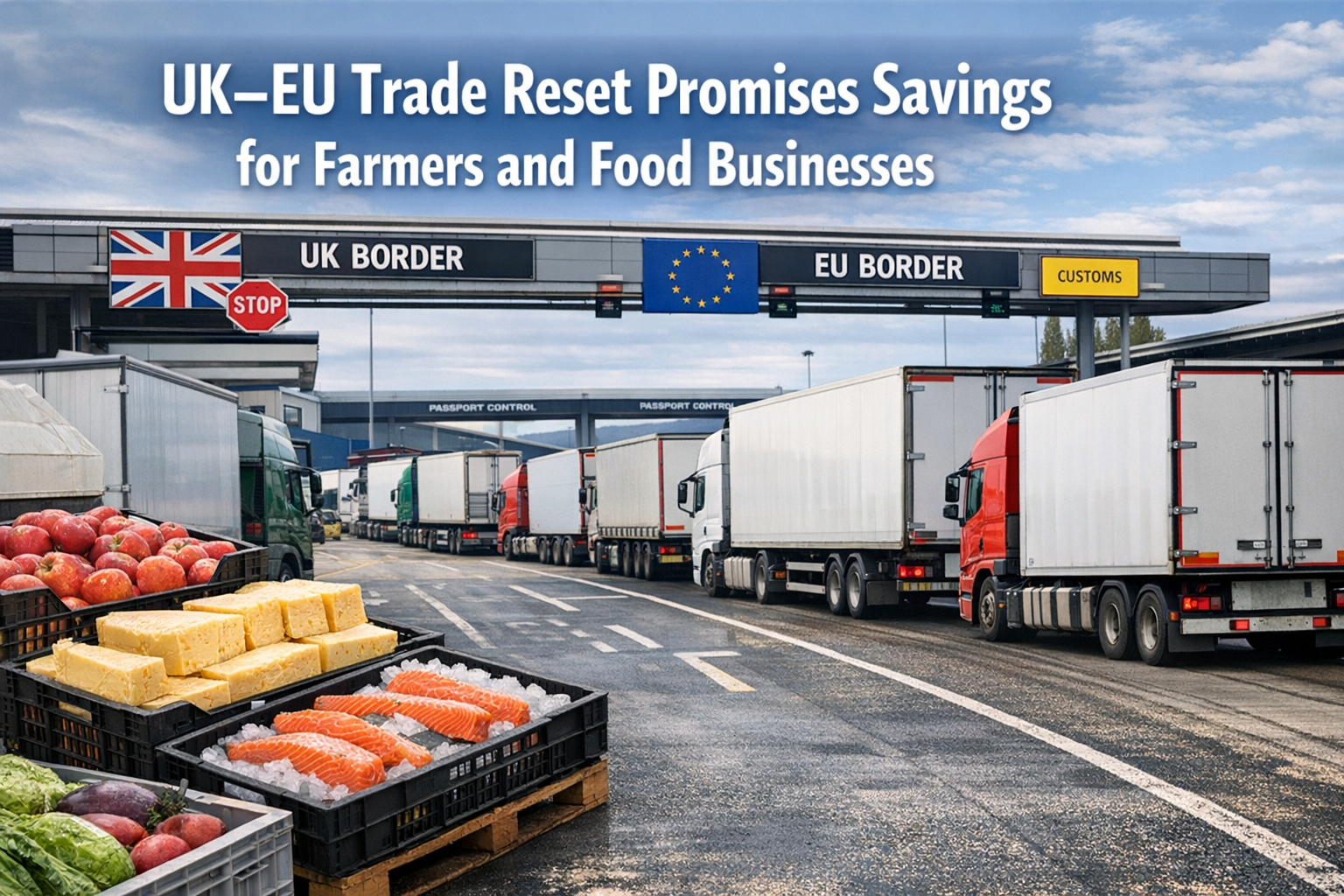
The Government has set out how a new Sanitary and Phytosanitary (SPS) agreement with the European Union is expected to reduce costs, paperwork and delays for UK agri‑food businesses trading with the EU. Ministers say the agreement, once finalised, would remove many routine health and safety checks at the border for qualifying goods, support more resilient supply chains and help ease pressures on food price inflation.
The UK and EU agreed in May 2025 to pursue an SPS agreement, alongside the Windsor Framework, to make it “easier, cheaper and more predictable” for relevant goods to move between the UK and EU and within the UK itself. The Government is working towards the agreement taking effect in mid 2027, with detailed guidance for businesses due to be issued from 2026 as negotiations progress.
Key Points at a Glance
- Mid 2027 start date targeted for the new SPS arrangements, subject to negotiations concluding in 2026.
- Around 500,000 businesses are expected to be affected, including some that do not currently trade directly with the EU.
- Many Export Health Certificates and routine checks on EU trade would be removed, cutting costs and delays for agri‑food exporters and importers.
- UK rules will be aligned with specified EU legislation in areas including food safety, animal and plant health, labelling, marketing standards and pesticides.
- Checks on Rest of World imports will remain, with UK check rates expected to align with EU levels for those goods.
How This Fits Into the UK’s Post Brexit Trade Approach
The SPS agreement is part of what ministers describe as an “EU reset”, aimed at improving day to day trading conditions with the UK’s largest trading partner while maintaining the UK’s post Brexit status outside the EU’s Single Market and Customs Union.
Environment Secretary Emma Reynolds says the Government is “resetting our relationship with the EU” to “make trade easier and cheaper” and deliver “tangible benefits for British businesses”. Business and Trade Secretary Peter Kyle similarly describes the agreement as a way to reduce barriers for exporters so that “more great British produce will be on European tables”.
According to the Government, the SPS deal is intended to streamline health and safety rules on cross border trade without altering the UK’s constitutional position or reversing the decision to leave the EU. It would sit alongside existing arrangements such as the Windsor Framework, which will continue to apply until any new agreement takes effect.
Why the Deal Matters for UK Agri‑Food Trade
Falling EU Exports Since 2018
The Government notes that since 2018, the value of UK exports of food and agricultural products to the EU has fallen by 22%, a reduction of almost £4 billion in real terms. Ministers link this to lost profits, shrinking markets and, in some cases, business closures.
Industry data from the Food and Drink Federation (FDF) similarly shows that, when comparing 2016–2020 with 2021–2025, food exports to the EU by volume fell by 23.4% from 6.7 billion kilograms to 5.1 billion kilograms. The FDF argues that this decline is greater than changes seen in several comparable European countries and reflects specific post Brexit trading challenges for the UK.
Delays, Costs and Spoilage at the Border
Current requirements for Export Health Certificates, phytosanitary certificates and routine checks at EU borders can create delays for perishable goods such as fresh produce, meat, dairy and seafood. The Government says these processes add costs, increase the risk of products arriving late or spoiled, and reduce the competitiveness of UK exporters in EU markets.
Reynolds highlights examples including a Somerset cheesemaker whose EU export trade has halved, a Welsh shellfish trader turning down orders because catches are no longer fresh by the time paperwork is completed, and a Scottish farmer unable to continue selling seed potatoes to long standing EU customers.
The Government argues that by reducing routine checks and paperwork, the SPS agreement should help goods “flow faster”, get fresh produce onto supermarket shelves more quickly, strengthen food security on both sides of the Channel and ease pressures on food price inflation.
What the Government Has Announced So Far
Scope of the SPS Agreement
The planned agreement covers a wide range of areas related to the trade, production and movement of plants, animals and their products. According to Government guidance for businesses, this includes:
- Food and feed safety rules, including hygiene requirements for food of animal origin and general food hygiene.
- Animal and plant health measures, including rules on pests, diseases, surveillance and movement controls.
- Broader nutrition related areas such as food supplements, fortified foods, foods for specific groups, nutrition and health claims, and nutrition labelling.
- Agrifood marketing and compositional standards, for example for products such as honey, cocoa and chocolate, fruit juices, jams, sugars and certain dairy products.
- Food labelling and food contact materials, including packaging that comes into contact with food.
- Organic production and labelling, feed and pet food rules, genetically modified organisms (GMOs), pesticides and biocides.
- Official controls carried out by authorities at borders and within supply chains.
The Government has published a detailed list of EU regulations and directives it currently expects to fall within scope of alignment, covering general food law, hygiene, additives, marketing standards, feed, GMOs, animal health and welfare, plant health, plant reproductive material, official controls, plant protection products, biocidal products and veterinary medicines.
How Rules Are Expected to Change
Government guidance indicates that, in many areas, UK requirements have so far diverged only minimally from EU rules, so alignment will often mean updating existing UK legislation rather than introducing entirely new frameworks.
In practice, for businesses this is expected to mean:
- Adjustments to processing methods, certification and labelling to meet aligned standards.
- Changes to IT systems and traceability processes to reflect revised official control and documentation requirements.
- Updated approaches to pesticides, biocides and GMOs, including residue limits and authorisation processes.
- Revised plant health and plant passporting arrangements, including a re‑introduced notification system for high risk plant imports from the EU.
What the Agreement Does and Does Not Change
Domestic Alignment with Specified EU Rules
Under the Common Understanding reached with the EU, the UK has agreed that businesses involved in the production or processing of plants, food, animals and animal products will align with specified EU rules in the areas covered by the agreement.
This commitment applies both to domestic producers serving only the UK market and to businesses trading with the EU or the rest of the world, meaning some firms that do not currently export may still need to make changes to comply.
At the same time, the Government states that there will continue to be areas where the UK retains its own rules, for example on certain animal welfare standards and new technologies. These are being negotiated with the EU and may be supported by “targeted transitional arrangements” for sectors that find change most challenging.
No Return to the EU, Single Market or Customs Union
The Government’s announcements make clear that the SPS agreement is being pursued within the UK’s existing post Brexit framework. The UK will remain outside the EU, Single Market and Customs Union, and the agreement is described as a technical arrangement to reduce trade friction in specific sectors rather than a broader political or constitutional change.
Ministers also highlight that the EU has accepted there will be “areas where the UK will retain its own rules”, and that the Government considers it important to be able to set high standards in areas such as animal welfare and public health.
Expected Cost Reductions and Where Savings May Come From
Costs the Government Expects to Remove
Government estimates suggest that the SPS agreement would remove several categories of cost currently faced by agri‑food businesses trading with the EU.
| Requirement | Typical Cost |
|---|---|
| Export Health Certificates for agri‑food goods | Up to £200 per consignment |
| Phytosanitary Certificates and associated inspections | Around £25 for the certificate plus inspection fees of at least £127.60 |
| Organic Certificates of Inspection for products such as organic lamb and cheese | Around £35 per certificate |
| Identity check fees on meat and dairy exports | On average £31 per load |
| Sampling costs on certain products | Approximately £1,200 for a cheese load, £1,400 for a salmon shipment, £440 for apples and £1,200 for a beef load |
The Government says removing these requirements for UK–EU trade would “cut red tape” and help put “British produce back on European tables”.
Costs the Government Expects to Reduce
Some costs are expected to fall rather than disappear entirely.
| Cost Type | Typical Cost |
|---|---|
| Queueing time related costs for beef and salmon shipments | Up to £149 per load |
| Additional driver charges linked to border related friction | Typically around £200 per shipment |
By reducing the frequency and intensity of checks at the GB‑EU border and for movements from Great Britain to Northern Ireland, the Government expects these time related costs to decline, although some checks will remain in place.
Industry Reaction
Several major businesses and trade bodies have publicly welcomed progress towards the SPS agreement while also highlighting that it will not remove all trade frictions.
- M&S Food Managing Director Alex Freudmann said the EU reset will “remove unnecessary bureaucracy” between the UK and EU, “easing cost pressures” for serving customers across Great Britain, Northern Ireland and the Republic of Ireland, and offering “much needed relief to British farmers” exporting meat, fruit and vegetables.
- Arla Foods UK Managing Director Bas Padberg called the progress “good news” for farmers, consumers and food security, and welcomed the commitment to work with businesses on the practical details.
- Ramsden International CEO Sean Ramsden said the forthcoming SPS agreement should “re‑open the European market” to British food and drink, and that removing friction could allow exporters to “recover much of the revenues lost as a result of Brexit”.
- The Food and Drink Federation has described the SPS deal as a “positive step” towards reducing cost and complexity, while noting that it “won’t remove all barriers to trade” and will require continued support so that businesses can adjust to new rules and take advantage of opportunities.
What Businesses Should Do Now
While negotiations are still ongoing and the agreement has not yet entered into force, the Government is encouraging businesses to begin preparing. Its guidance suggests that firms should:
- Engage with relevant trade bodies or industry associations, which will help interpret sector specific implications and are already in contact with Government.
- Talk to suppliers, hauliers and logistics partners to understand how changes may affect different parts of the supply chain.
- Sign up for Defra email alerts and business mailing lists to receive updates on negotiations, implementation timelines and guidance materials.
- Respond to the Government’s Call for Information, providing sector specific insight on readiness needs and the kind of support that would be most useful.
- Continue to follow existing rules, including the Windsor Framework, until the new agreement is in place and updated requirements take effect.
Defra says it plans to provide information in a range of formats including written guidance, checklists, webinars, newsletters and a dedicated online tool to establish a stakeholder advisory board so that businesses can feed into implementation plans.
Rest of World Trade and the SPS Agreement
The SPS agreement is primarily focused on trade with the EU and on movements within the UK, particularly from Great Britain to Northern Ireland. Government guidance makes clear that it is not expected to remove current checks on imports from the rest of the world (non‑EU countries).
For most Rest of World goods, routine inspections at Border Control Posts will continue to be required, and UK check rates are expected to align with those applied by the EU to similar imports. The Government anticipates increased check rates for certain non‑EU commodities, with more detail to follow as negotiations progress.
Next Steps and Timeline
The Government is aiming to conclude negotiations on the SPS agreement with the EU later in 2026 and is working towards a mid 2027 implementation date.
Before then, businesses are expected to receive:
- Sector specific guidance explaining which rules will change for different parts of the food and farming supply chain.
- Practical checklists and online tools to help firms understand the steps needed to comply.
- Opportunities to engage via webinars, workshops and advisory boards as the agreement moves closer to implementation.
Ministers say their objective is that businesses “are ready to benefit from day one” of the new arrangements, with a focus on smoothing trade, supporting growth in exports and helping to stabilise food prices.
Key Takeaways
- The UK and EU are negotiating a wide ranging SPS agreement expected to take effect from mid 2027, subject to talks concluding in 2026.
- The agreement is designed to remove many Export Health Certificates and routine checks for UK–EU agri‑food trade, reducing costs and delays.
- UK legislation in areas such as food safety, animal and plant health, labelling and pesticides will be aligned with specified EU rules across the domestic market.
- Around 500,000 businesses could be affected, including firms that do not currently export to the EU.
- Industry bodies broadly welcome the agreement but stress that it will not eliminate all trade barriers and that effective implementation support will be essential.
📚 Sources & Further Reading
- Gov.UK – Businesses urged to take simple steps for smoother trade with the EU (9 March 2026) Archived copy (OGL): archived page
- Gov.UK – UK–EU SPS Agreement: Information for Businesses (9 March 2026) Archived copy (OGL): archived page
- Gov.UK – UK–EU SPS Agreement: Legislation in Scope (9 March 2026) Archived copy (OGL): archived page
- Food and Drink Federation – Food exports to the EU drop by almost a quarter compared to pre‑Brexit (17 December 2025) Archived internally for verification (09 March 2026)
- House of Commons Library – Brexit: UK trade relations with the EU (briefing CBP‑7851) Archived copy (OGL): archived page