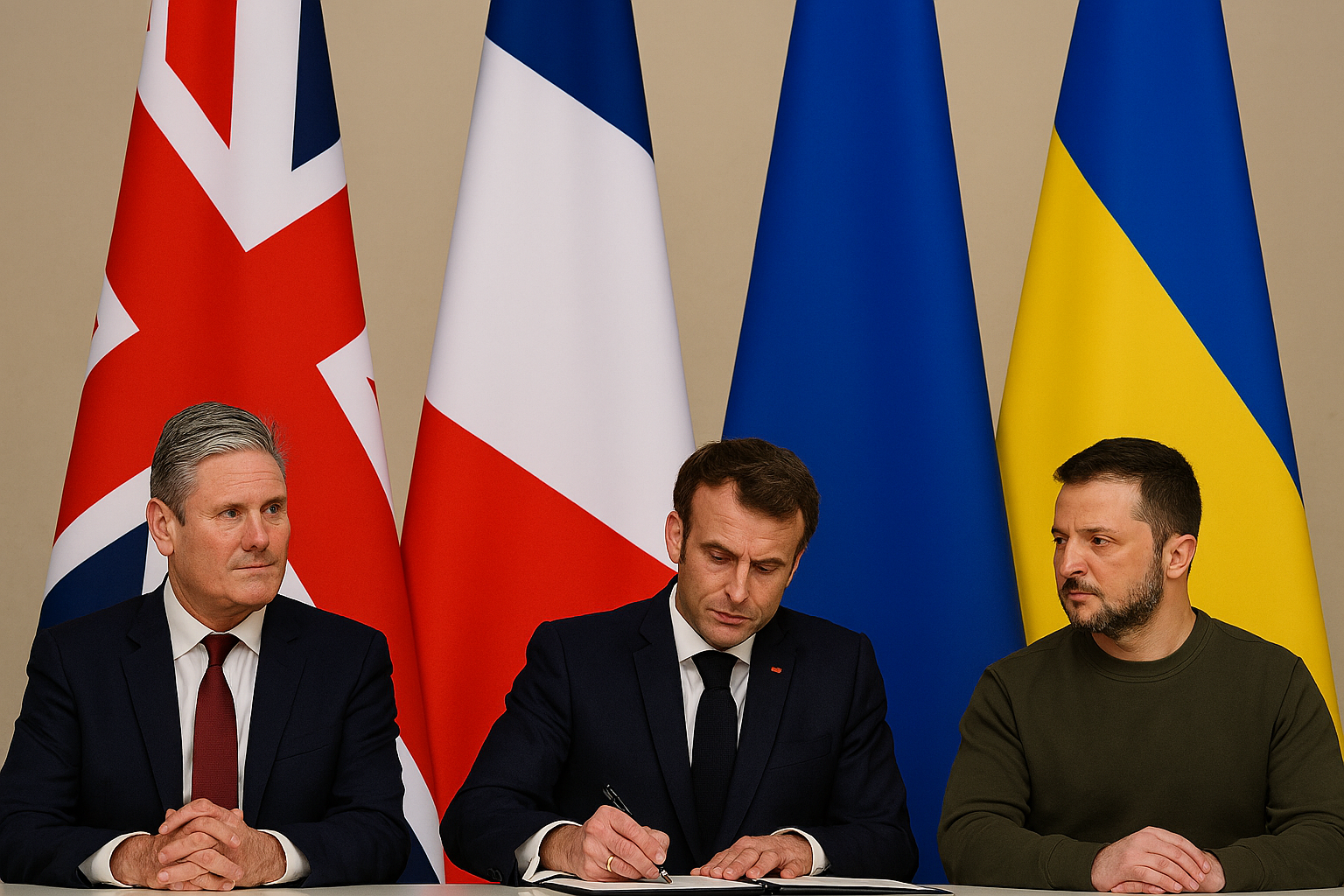
Key Point: The declaration is an intent, not an operational order. It does not deploy troops, change the status of the conflict, or authorise military action. Instead, it establishes the political and legal framework for a future Multinational Force – Ukraine (MNF‑U) that could deploy after a ceasefire or peace agreement with Russia.
The UK, France and Ukraine have signed a Declaration of Intent outlining how a multinational force would support Ukraine's defence, reconstruction and long term strategic sustainability. This is the most significant Western commitment yet to a post war security presence inside Ukraine.
The declaration establishes the political framework for future deployment of international forces to Ukraine, but only after peace conditions are established. It represents a shift from reactive wartime support to proactive planning for Ukraine's long term sovereignty and reconstruction.
🎯 Declaration Highlights
- Political framework for future Multinational Force – Ukraine (MNF‑U)
- Post ceasefire deployment only, with Ukraine's consent
- UK-France leadership of coalition of willing nations
- Support for defence, reconstruction and strategic sustainability
- First formal Western commitment to post war troop presence in Ukraine
📋 What Was Announced?
The UK government published a joint declaration signed by:
- The United Kingdom of Great Britain and Northern Ireland
- The French Republic
- Ukraine
Declaration Framework
The declaration sets out:
🏗️ Core Commitments
- Shared intention to deploy multinational forces to Ukraine once conditions allow
- Framework for military hubs, security guarantees, and post‑war stabilisation
- Support for defence, reconstruction and strategic sustainability of Ukraine
- Coalition building with other willing nations
- Legal and operational planning for future deployment
This is groundwork, not a deployment. No troops are being sent immediately, and any future deployment depends entirely on a ceasefire or peace agreement being reached first.
🛡️ What Is the Multinational Force – Ukraine (MNF‑U)?
The MNF‑U is envisioned as a coalition of willing nations, initially led by the UK and France, designed to provide security guarantees and reconstruction support in post conflict Ukraine.
Core Functions
⚔️ MNF-U Mission Areas
- Stabilisation after a ceasefire agreement
- Deterrence against renewed Russian aggression
- Support for reconstruction of critical infrastructure
- Training and modernisation of Ukrainian forces
- Securing air, land and maritime domains
Deployment Conditions
The MNF‑U would only deploy under strict conditions:
- After a ceasefire or peace agreement
- With Ukraine's consent
- Under international law
- In coordination with existing international frameworks
- With clear legal basis and parliamentary approval
This represents the first formal Western commitment to a post war troop presence inside Ukraine, marking a significant evolution in international support.
🇬🇧🇫🇷 Why Are the UK and France Leading?
The declaration reflects both solidarity with Ukraine and clear strategic benefits for the UK and France. Both countries already have long‑term bilateral security agreements with Ukraine and extensive experience leading multinational missions.
Strategic and Political Drivers
🎯 UK-France Strategic Interests
- Supporting a key ally under attack - A stable, sovereign Ukraine strengthens the European security order
- Strengthening European defence leadership - Positioning as backbone of self reliant European security
- Protecting critical resources and trade routes - Ukraine central to European food security and energy transit
- Shaping the post war settlement - Leading MNF‑U provides influence over Ukraine's future security arrangements
- Reinforcing global roles - Maintaining status as nuclear powers and leading European military actors
Operational Advantages
Both countries bring unique capabilities:
- Rapid deployment capacity: Both can quickly deploy and sustain multinational forces
- Existing programmes: Already run training, intelligence, and logistics programmes for Ukraine
- Diplomatic networks: Established relationships to build broader coalition around MNF‑U
- Military expertise: Extensive experience in international stabilisation missions
- Nuclear deterrent: Provides additional security guarantee against Russian escalation
🇺🇦 What Does This Mean for Ukraine?
The declaration provides Ukraine with the most concrete security guarantee yet offered by Western allies, though its implementation depends on peace conditions.
Short Term Impact
🔄 Immediate Effects
- No immediate troop deployment - Forces only deploy after peace agreement
- Reinforced diplomatic backing - Strong signal of long term Western commitment
- Clearer pathway to security guarantees - Concrete framework for post war protection
- Enhanced negotiating position - Strengthens Ukraine's position in future peace talks
- Planning coordination - Joint preparation for post conflict reconstruction
Medium Term Implications
- Planning for reconstruction and stabilisation
- Integration with European defence structures
- Multinational presence to secure any peace deal
- Enhanced training and modernisation programmes
- Coordinated approach to post war challenges
Long Term Strategic Benefits
- Deterrent force on Ukrainian soil
- More predictable security environment for rebuilding
- Integration with European security architecture
- Pathway to eventual NATO or EU membership
- Sustained international investment and support
🗺️ What Happens Next?
The declaration is a political commitment, not an operational plan. Significant work remains before any deployment could occur.
Implementation Steps
📋 Next Phase Requirements
- Building the coalition of participating nations beyond UK and France
- Designing command structure and operational frameworks
- Agreeing rules of engagement and legal authorities
- Preparing logistics, basing and legal frameworks
- Coordinating with US led ceasefire monitoring mechanism
Parliamentary and Legal Process
Before any deployment, several democratic processes must be completed:
- Parliamentary approval: UK Parliament must authorise troop deployment
- Legal framework: Clear legal basis under international law required
- Rules of engagement: Specific authorities and limitations defined
- Funding arrangements: Budget allocation and cost sharing agreements
- Public consultation: Democratic oversight of major military commitment
The MNF‑U will only deploy once a peace agreement is in place. This is not preparation for combat deployment, but for post conflict stabilisation and reconstruction support.
📈 Why This Is Historically Significant
This declaration represents several unprecedented commitments in European security policy.
Historic Firsts
🏛️ Unprecedented Commitments
- First formal Western commitment to deploy troops to Ukraine after a peace deal
- First guarantee of Ukraine's security with a physical military presence
- First European led stabilisation force designed specifically for Ukraine
- First post Brexit major defence initiative led jointly by UK and France
- First framework for long term Western security presence in Eastern Europe
Strategic Shift
The declaration marks a fundamental evolution:
- From reactive to proactive: Moving from crisis response to post war planning
- From aid to presence: Physical security guarantee rather than just material support
- From temporary to permanent: Long term commitment beyond electoral cycles
- From bilateral to multilateral: Framework for broader coalition building
- From defence to reconstruction: Comprehensive post conflict support model
🏛️ What This Means for UK Politics
This declaration represents a major foreign policy moment for the UK government, with significant implications for Britain's post Brexit international role.
Strategic Positioning
🇬🇧 UK Strategic Benefits
- European security leadership - Reinforces UK's role as leading European defence power
- Long term commitment - Signals stability beyond electoral cycles
- Post Brexit strategy - Bilateral and minilateral defence partnerships model
- Special relationship complement - European leadership alongside US alliance
- Global Britain realisation - Concrete example of post Brexit international engagement
Parliamentary Implications
The declaration sets expectations for future parliamentary scrutiny on:
- Legal basis for deployment: International law compliance and domestic authority
- Funding requirements: Long term budget implications and cost sharing arrangements
- Force composition: Numbers, capabilities, and deployment duration
- Relationship with NATO: Coordination with existing alliance structures
- Exit strategy: Conditions for reducing or ending UK involvement
Political Risk Management
The government will need to manage several political challenges:
- Public support: Maintaining domestic backing for long term military commitment
- Parliamentary approval: Securing cross party support for deployment
- Financial sustainability: Ensuring adequate funding without domestic cuts
- Mission creep prevention: Maintaining focus on post conflict rather than combat roles
- Alliance coordination: Balancing European leadership with NATO solidarity
🌍 What This Means for Europe
The declaration reflects and accelerates several broader trends in European security and defence policy.
European Security Evolution
🛡️ Broader European Implications
- Europe preparing for long term security responsibility - Reduced dependence on US security guarantees
- France and UK acting as framework nations - Leading European defence initiatives
- Ukraine's future tied to European defence integration - Pathway to eventual EU/NATO membership
- Post American European security order - Europe taking primary responsibility for regional security
- Deterrence signal to Russia - Any future ceasefire will be internationally enforced
Defence Architecture Changes
The initiative reflects significant shifts in European defence:
- Minilateral leadership: Small groups of capable nations leading larger coalitions
- Post Brexit cooperation: UK-EU defence cooperation despite political separation
- Burden sharing evolution: European nations taking primary security responsibility
- Deterrence modernisation: Physical presence complementing nuclear deterrent
- Crisis to structure: Temporary crisis response becoming permanent security architecture
🔍 Key Questions and Challenges
Several important questions remain about the MNF-U's implementation and effectiveness.
Operational Challenges
❓ Critical Questions
- Coalition building: Which other nations will join beyond UK and France?
- Force size and capability: What scale of deployment will be required?
- Command structure: How will multinational command and control work?
- Geographic scope: Will MNF-U cover all of Ukraine or specific regions?
- Duration: How long will the international presence be required?
Political and Legal Issues
- UN authorisation: Will Security Council approval be sought or required?
- NATO relationship: How will MNF-U coordinate with Alliance structures?
- Russian response: How might Russia react to permanent Western military presence?
- Peace agreement terms: What ceasefire conditions would enable deployment?
- Financial sustainability: How will long term costs be managed and shared?
Conclusion: From Declaration to Deployment
The UK-France-Ukraine Declaration of Intent represents the most significant Western security commitment to Ukraine since the conflict began. By establishing a framework for post war multinational force deployment, it moves beyond reactive crisis support toward proactive peace building and security guarantee provision.
This is not about immediate military deployment, but about creating the political and operational framework for ensuring any future peace agreement is internationally guaranteed and enforced. It represents a fundamental shift in European security thinking, with the UK and France positioning themselves as framework nations for a more self reliant European defence architecture.
The declaration's success will depend on three critical factors: building a broader international coalition, securing democratic approval in participating nations, and designing an operational framework that deters aggression while supporting reconstruction. Most importantly, it depends on achieving the peace agreement that would enable deployment in the first place.
For Ukraine, it provides the strongest security guarantee yet offered by Western allies. For Europe, it marks a historic step toward strategic autonomy and defence responsibility. For the UK, it demonstrates post-Brexit Britain's continued commitment to European security leadership alongside France.
The declaration is just the beginning. The real work of building this multinational framework, securing international support, and preparing for eventual deployment now begins. But by establishing this framework, the UK, France, and Ukraine have fundamentally changed the conversation about post-war European security.
🎯 Key Takeaways
- Declaration establishes framework for post ceasefire multinational force deployment
- UK and France leading coalition of willing nations for Ukraine security guarantee
- No immediate deployment, forces only deploy after peace agreement
- Represents shift from reactive crisis support to proactive security architecture
- Parliamentary approval and international coalition building required before implementation
📚 Sources & Further Reading
- Gov.UK - Declaration of Intent between the UK, France and Ukraine
- Full Declaration Text (PDF)
- Anadolu Agency - UK, France, Ukraine issue details of declaration on multinational force deployment
- Sky News - UK and France sign declaration of intent to send forces to Ukraine in event of peace deal
- Kyiv Independent - Zelensky: UK, France sign declaration on multinational force deployment in Ukraine post-war