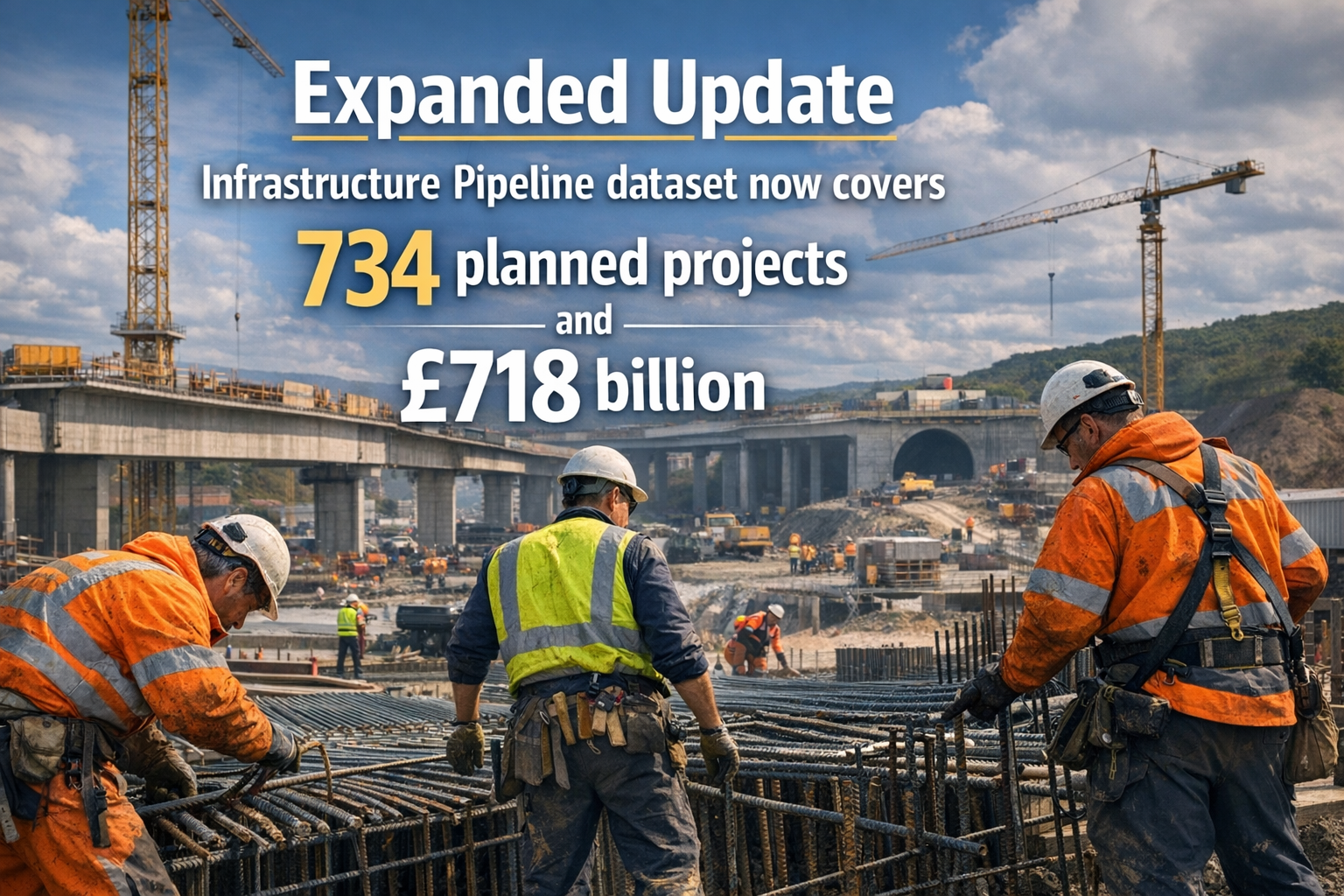
The government has published the first update to the National Infrastructure and Service Transformation Authority's (NISTA) Infrastructure Pipeline since its launch in July 2025. The expanded dataset now covers 734 planned projects and £718 billion in anticipated public and private investment over the next decade. For the first time, the Pipeline includes detailed workforce and skills demand estimates, giving industry a clearer view of the labour required to deliver the UK's long term infrastructure programme.
Key Points at a Glance
- 734 projects and £718 billion in planned investment over ten years, up significantly from the July 2025 Pipeline.
- First ever workforce demand estimates included, projecting 621,000-697,000 workers needed annually over the next two years and 629,000-706,000 over the next five.
- Over two thirds of projected workforce demand is in construction roles, with education and health infrastructure the largest contributors.
- Energy remains the dominant sector with £365 billion in planned investment over ten years.
- New commercial metrics, investment type details, and regional workforce projections included for the first time.
What Has Changed Since the 2025 Pipeline?
The July 2025 Infrastructure Pipeline was the first publication of its kind under NISTA, consolidating planned investment data across major sectors. The March 2026 update expands both the scope and depth of that dataset.
A Larger, More Detailed Dataset
The updated Pipeline covers £718 billion in planned investment over ten years, up significantly from the July 2025 figure. Part of this increase reflects new data contributed by Mayoral Combined Authorities and other providers, broadening the geographic and institutional coverage of the dataset.
More Granular Project Information
The update also introduces new commercial metrics, details on investment types and business models, and regional and sector level workforce projections. The government says these changes respond directly to industry feedback calling for clearer, more actionable data to support planning and investment decisions.
Workforce and Skills Demand: The New Core Feature
This update marks the first time the Pipeline has attempted to quantify the labour needed to deliver the UK's infrastructure ambitions. The government frames the inclusion of workforce demand data as a response to persistent industry calls for better visibility of long term skills requirements.
Estimated Annual Workforce Demand
| Time horizon | Estimated annual workforce demand |
|---|---|
| Next 2 years | 621,000 - 697,000 workers |
| Next 5 years | 629,000 - 706,000 workers |
Where Demand Is Concentrated
Construction roles account for over two thirds of the total projected workforce needs. The largest contributors to this demand are education and health infrastructure projects. Regional breakdowns have been included for the first time, which the government says will support more targeted local planning and skills investment.
The government frames the workforce data as part of a wider effort to align infrastructure delivery with the Industrial Strategy and the national skills agenda.
Sector Breakdown: Where the Money Is Going
Energy remains the dominant sector in the Pipeline, with £365 billion in planned investment over ten years. Other major areas of investment include transport, education, health, and water and environmental resilience. The updated Pipeline aims to give investors a clearer view of investable opportunities, including the scale and type of capital sought across each sector.
The Government's Position
The Treasury describes the update as part of its broader "Plan for Change". James Murray MP, Chief Secretary to the Treasury, emphasises infrastructure as a driver of economic security and highlights the need for a highly skilled workforce to deliver hospitals, schools, railways, reservoirs, and renewable energy projects.
Becky Wood, NISTA Chief Executive Officer, highlights the importance of government, industry, and investor collaboration, and the value of granular workforce data for planning skills, capacity, and technology investment. Wood also points to the Pipeline's role in addressing the construction skills gap.
Industry Reaction: Broad Support, Clear Expectations
Industry bodies and major firms have welcomed the update, particularly the inclusion of workforce demand data. Their responses cluster around three themes.
Clarity and Certainty
ACE (the Association for Consultancy and Engineering) highlights the value of stronger commercial metrics and richer regional data. AECOM notes that workforce estimates will help reduce delivery bottlenecks by enabling earlier planning of labour supply.
Skills Planning
Costain stresses the need to align investment commitments with long term workforce planning. Mace argues that the new dataset supports what it describes as a "demand led skills system". Skanska describes linking the infrastructure pipeline to skills planning as the "critical step" in making delivery ambitions realistic.
Delivery Focus
Across industry responses, a consistent message emerges: the value of the Pipeline depends on converting mapped out ambition into real projects. Several responses specifically highlight regional opportunities, including in the East of England, as areas where the new data could support local supply chain and workforce development.
Why This Update Matters
The updated Pipeline represents a shift from high level strategy towards delivery readiness. By including workforce demand, commercial metrics, and regional data in a single dataset, NISTA is attempting to give industry the information it needs to make long term investment decisions in skills, capacity, and technology.
What the Update Enables and What Remains to Be Seen
- Better long term workforce planning across sectors and regions.
- More informed investment decisions for both public and private capital.
- Greater supply chain visibility across a decade of planned projects.
- Stronger alignment between infrastructure investment, skills policy, and the Industrial Strategy.
- Whether the new data translates into coordinated skills programmes remains to be seen.
- How effectively government and industry can address regional shortages will depend on follow through beyond the data.
How This Fits with Wider Government Strategy
The Infrastructure Pipeline update does not stand alone. It sits within a broader legislative and policy framework that the government has been building since 2024, designed to accelerate infrastructure delivery, reform planning, and align investment with environmental and skills objectives.
Planning and Infrastructure Act 2025
The most significant legislative backdrop is the Planning and Infrastructure Act 2025, which became law in December 2025. The Act makes several changes directly relevant to the scale of investment mapped out in the Pipeline.
For nationally significant infrastructure projects (NSIPs) which include the large energy, transport, water, and environmental projects that dominate the Pipeline, the Act streamlines the development consent process. It removes certain pre-application requirements, reforms the acceptance and examination stages, and strengthens the ability to change or revoke consent orders, aiming to reduce the time it takes to move from planning to construction.
On electricity infrastructure specifically, the Act addresses connection to the transmission and distribution network, a longstanding bottleneck for renewable energy projects. New powers allow licence modifications to manage connection queues more strategically, which is directly relevant to the £365 billion energy sector that leads the Pipeline.
The Act also introduces Environmental Delivery Plans (EDPs) and a nature restoration levy, replacing the previous system of project by project habitat assessments with a strategic, area based approach. For large infrastructure programmes this is significant: developers contributing to an approved EDP gain greater certainty over environmental compliance, which reduces a major source of delay and cost uncertainty for the kinds of projects the Pipeline maps out.
Transport infrastructure also features in the Act, with reforms to the Highways Act 1980 and the Transport and Works Act 1992 streamlining procedures and setting deadlines for decisions on major transport schemes, again directly relevant to the transport projects in the Pipeline.
The Industrial Strategy
The government has explicitly linked the Pipeline to its Industrial Strategy, framing long term infrastructure investment as a driver of economic growth and domestic industrial capacity. The Industrial Strategy identifies energy, transport, and digital infrastructure as priority sectors, and the Pipeline's sector breakdown with energy accounting for over half of the total investment figure reflects that alignment. The government's stated aim is that clearer pipeline data will give private investors the confidence to commit capital to UK infrastructure at scale.
The National Skills Agenda
The inclusion of workforce demand data in this Pipeline update connects directly to the government's wider skills reform agenda. By quantifying the labour needed sector by sector and region by region, the Pipeline is intended to inform decisions about training provision, apprenticeship investment, and further education capacity. The government frames this as creating a "demand led" approach to skills planning using mapped infrastructure need to drive investment in the workforce required to deliver it, rather than relying on supply side assumptions.
Taken together, the Planning and Infrastructure Act 2025, the Industrial Strategy, and the national skills agenda form the framework within which the Pipeline operates. The Pipeline's role is to provide the data layer that connects these strategies to actual investment decisions, giving developers, investors, and training providers a common picture of what is planned, when, and where.
The Bigger Picture
The Infrastructure Pipeline is becoming a central planning tool for the UK's infrastructure system. By integrating workforce demand estimates, commercial metrics, and regional breakdowns, NISTA aims to give industry the confidence to invest in skills, capacity, and technology at the scale the programme requires.
The challenge now is delivery, turning a decade of mapped out investment into real projects, supported by a workforce with the right skills in the right places.
📚 Sources & Further Reading
- Gov.UK – Infrastructure Pipeline update signals future workforce needs (10 March 2026) Archived copy (OGL): archived page
- NISTA – National Infrastructure and Service Transformation Authority: Infrastructure Pipeline Archived copy (OGL): archived page
- Legislation.gov.uk – Planning and Infrastructure Act 2025 (2025 c. 34) Archived copy (OGL): archived page