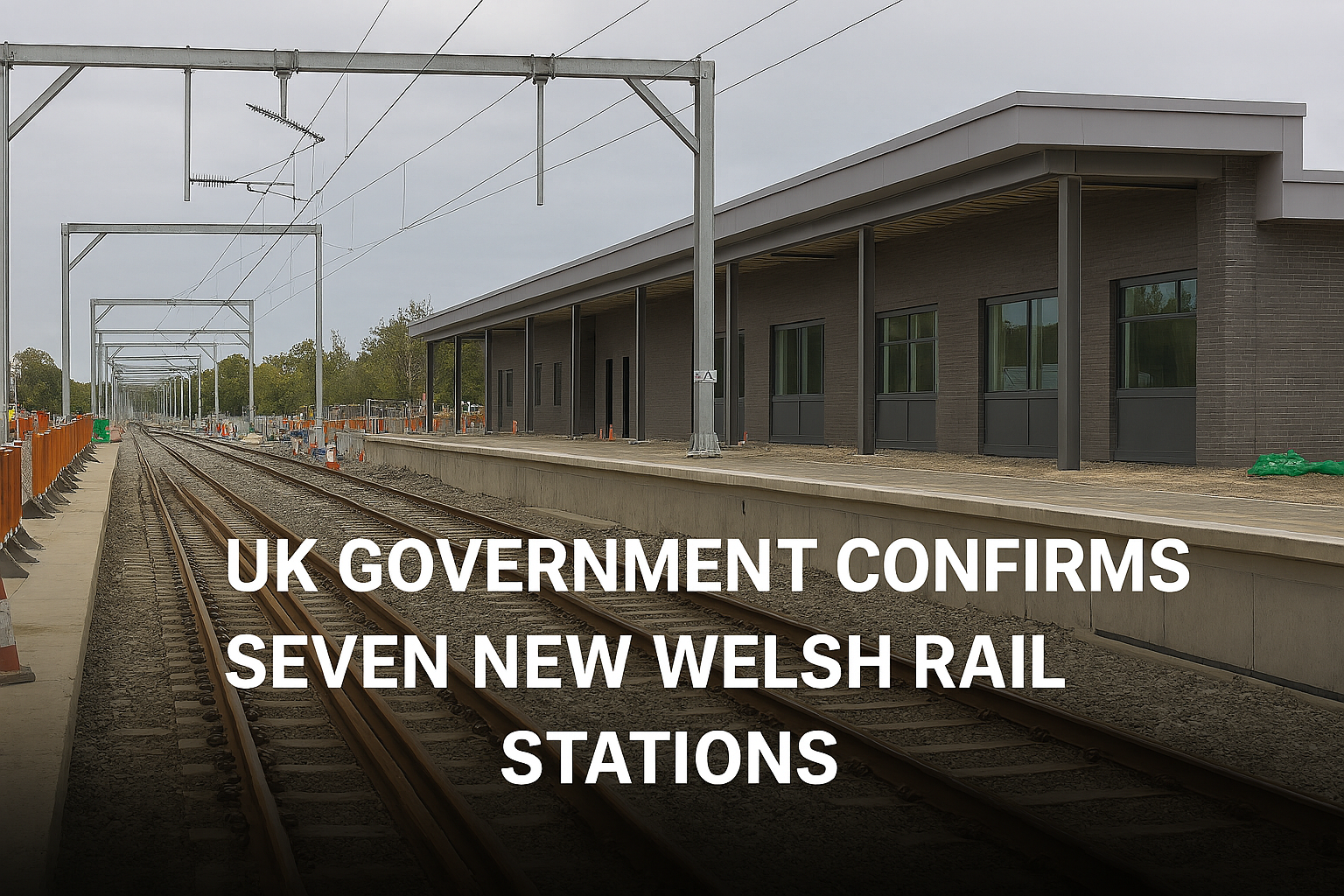
The UK Government has announced a major long term commitment to modernise rail infrastructure in Wales, including seven new stations, expanded investment, and a joint delivery plan with the Welsh Government. Ministers describe the programme as a "generational" shift intended to reverse historic underinvestment and support around 12,000 jobs across Wales.
The announcement forms part of the government's wider plan to bring rail operations back into public ownership, replacing the fragmented model created in the 1990s with a single, publicly run system intended to enable long term planning and stable investment.
🚄 Programme Overview
- Seven new stations confirmed with nearly £500 million allocated in latest Spending Review
- Joint delivery plan between UK Government and Welsh Government with Wales Rail Board oversight
- 43 enhancement schemes identified in Transport for Wales' long term pipeline
- 12,000 jobs estimated to be supported across construction and operations
- £6.3 billion projected wider economic benefits from full programme
🚉 Seven New Stations Confirmed
Nearly £500 million allocated in the latest Spending Review will fund the construction of seven new rail stations across Wales, representing the largest single expansion of Welsh rail infrastructure in decades.
Station Locations and Significance
The confirmed stations span key economic and population centres:
- Magor and Undy: Expected to be the first completed, serving the South Wales corridor
- Llanwern: Supporting Newport's eastern development areas
- Cardiff East: Enhancing connectivity to Wales' capital city
- Newport West: Complementing existing Newport Central services
- Somerton: Improving regional accessibility in South Wales
- Cardiff Parkway: Major interchange designed to serve 800,000 passengers annually
- Deeside Industrial Park: Part of wider Wrexham–Liverpool line upgrades
Cardiff Parkway: Economic Catalyst
Cardiff Parkway represents the programme's flagship development, designed as more than a transport interchange:
🏭 Cardiff Parkway Impact
- 800,000 passengers annually projected to use the new station
- 6,000 jobs unlocked in surrounding industrial district
- Major interchange facility connecting multiple transport modes
- Economic development catalyst for South Wales business growth
- Strategic location maximising regional connectivity benefits
North Wales Connectivity
Deeside Industrial Park forms part of wider upgrades to the Wrexham–Liverpool line, strengthening North Wales' connections to English markets and improving cross border economic links.
🤝 Joint UK–Welsh Government Delivery
The programme represents a significant shift towards collaborative infrastructure planning between the UK Government and devolved administrations.
Today, Tomorrow, Together Vision
The plan is based on Transport for Wales' new long term vision, "Today, Tomorrow, Together", which outlines a comprehensive pipeline of 43 rail enhancement schemes across Wales and the Borders:
- Formal UK Government endorsement: Full backing for Transport for Wales' strategic vision
- Partnership delivery model: Joint planning and implementation between governments
- Long term commitment: Multi decade programme spans multiple political cycles
- Integrated approach: Coordinated with broader economic development strategies
- Evidence based planning: Built on detailed analysis of transport needs and economic benefits
Wales Rail Board Oversight
The Wales Rail Board provides governance structure ensuring coordinated delivery:
Governance Framework
- Joint representation: Both UK Government and Welsh Government participation
- Industry expertise: Transport for Wales and Network Rail involvement
- Strategic oversight: Programme coordination and progress monitoring
- Accountability mechanism: Clear reporting lines and performance metrics
- Stakeholder engagement: Regular consultation with communities and businesses
Funding and Timeline Realities
Transport for Wales estimates the full pipeline could cost up to £14 billion over multiple spending cycles. Funding allocations for later stages will depend on future Spending Reviews, creating uncertainty about programme completion timescales.
📊 Projected Benefits and Economic Impact
Transport for Wales' modelling presents comprehensive projections for the programme's economic, environmental, and social benefits.
Economic Benefits Analysis
The long term programme could deliver substantial economic returns:
💰 Economic Returns
- £6.3 billion in wider economic benefits
- 13.3 million additional rail journeys per year
- 1,000+ permanent jobs created
- 6,000+ construction jobs during delivery
🌱 Environmental Impact
- 3.8 million fewer car journeys annually
- 115 million vehicle kilometres avoided
- 55,000 tonnes of CO₂ saved each year
- Decarbonisation support for transport sector
Passenger Growth and Mode Shift
The programme targets significant increases in rail usage:
- Modal shift benefits: Encouraging transfer from private cars to public transport
- Accessibility improvements: Better connections for currently underserved areas
- Journey time reductions: More efficient routes and improved services
- Capacity increases: Addressing overcrowding and supporting economic growth
- Regional connectivity: Strengthening links between Welsh communities and economic centres
Long term Economic Development
Beyond direct transport benefits, the programme aims to catalyse broader economic development:
- Business location decisions: Improved transport links attracting investment
- Labour market access: Connecting workers to employment opportunities
- Tourism potential: Enhanced visitor access to Welsh destinations
- Supply chain benefits: Better freight connections supporting industry
- Property development: Station areas becoming focal points for regeneration
🏛️ Public Ownership and Long Term Planning
The Welsh rail programme exemplifies the Government's broader strategy of bringing rail operations into public ownership and enabling long term infrastructure planning.
Unified System Benefits
Ministers argue that a unified system allows for more effective infrastructure development:
🔄 Public Ownership Advantages
- Long term investment pipelines: Planning beyond short term franchise cycles
- Integrated planning: Coordination between UK and devolved governments
- Consistent service standards: Unified approach to passenger experience
- Reduced duplication: Elimination of overlapping administrative structures
- Democratic accountability: Direct government responsibility for service delivery
Strategic Planning Approach
This programme represents one of the first major examples of the new approach: a single, jointly agreed pipeline rather than a patchwork of short term schemes:
- Multi decade vision: Planning horizons extending beyond political cycles
- Systematic prioritisation: Evidence based scheme selection and sequencing
- Integrated delivery: Coordination across multiple infrastructure projects
- Stakeholder alignment: Bringing together different levels of government
- Sustainable funding: Structured approach to long term investment
Contrasting Models
The programme contrasts with the fragmented privatisation model:
- Privatisation era: Short term franchise cycles limiting infrastructure investment
- Fragmented responsibility: Multiple operators with competing priorities
- Public ownership model: Single system enabling coordinated long term planning
- Democratic control: Government accountability for investment decisions
- Strategic coherence: Aligned objectives across transport network
💼 Job Creation in a Tight Labour Market
The government highlights the programme's potential to support 12,000 jobs across Wales, but this projection requires examination within current labour market realities.
Labour Market Context
The UK labour market is experiencing significant challenges that affect job creation promises:
Current Labour Market Conditions
- Shrinking vacancy numbers: Particularly in construction and engineering sectors
- Rising competition: Millions of jobseekers competing for fewer opportunities
- Skills shortages: Gaps in technical capabilities needed for infrastructure projects
- Regional disparities: Uneven distribution of available work across Wales
- Supply exceeds demand: Labour demand significantly outstrips available opportunities
Infrastructure Employment Reality
Infrastructure projects do create employment, but within constrained market conditions:
- Construction phase jobs: Temporary positions during building phase
- Operational roles: Long term employment once stations are completed
- Skills requirements: Many positions requiring specialist training and qualifications
- Local accessibility: Not all created jobs will be available to local communities
- Timing uncertainty: Employment creation spread over extended delivery timeline
Impact Assessment
The real impact on jobseekers will depend on several factors:
- Project delivery pace: Speed of construction affecting job creation timeline
- Skills matching: Alignment between available workers and required capabilities
- Training provision: Programmes to prepare local workers for infrastructure roles
- Geographic distribution: Where jobs are created versus where jobseekers are located
- Employment duration: Balance between temporary and permanent positions
Conclusion: Ambition Meets Reality
If delivered, this programme would represent one of the most significant expansions of Welsh rail infrastructure in decades. It would reshape commuter access in South Wales, strengthen North Wales connectivity, and form a foundation for a publicly run rail system built around long term planning rather than short term political cycles.
The programme's strengths lie in its comprehensive approach, joint governance structure, and integration with broader economic development objectives. The collaboration between UK and Welsh Governments provides political stability, while public ownership enables the long term planning essential for infrastructure projects of this scale.
However, delivery will depend on sustained political commitment, future Spending Reviews, business case progression, and the capacity of the labour market to supply the required skills. The £14 billion full programme cost requires funding decisions spanning multiple electoral cycles, creating uncertainty about completion timescales.
The job creation promises, while significant, must be understood within current labour market realities where demand for work significantly exceeds supply, and infrastructure employment is often temporary and requires specialist skills. The programme will create opportunities, but not necessarily for all those currently seeking employment.
Most importantly, the success of this programme will be measured not just in stations built or jobs created, but in its contribution to Welsh economic competitiveness, environmental sustainability, and social connectivity. The integration of transport planning with economic development strategy suggests recognition that infrastructure investment must serve broader societal objectives.
The scale of the ambition is clear; the challenge will be sustaining it. This programme represents a test case for whether public ownership can deliver the long term infrastructure investment that privatisation struggled to provide. Its success or failure will influence transport policy across the UK for decades to come.
🎯 Key Takeaways
- Seven new Welsh rail stations confirmed with £500 million initial funding from latest Spending Review
- Joint UK-Welsh Government delivery through Wales Rail Board demonstrates collaborative infrastructure planning
- Cardiff Parkway projected to serve 800,000 passengers annually and unlock 6,000 jobs in industrial district
- Full £14 billion programme spans multiple spending cycles with future funding dependent on Spending Reviews
- Success depends on sustained political commitment, business case delivery, and labour market capacity
📚 Sources & Further Reading
- Gov.UK - Prime Minister announces seven new stations and major rail funding commitment Archived copy (OGL): archived page
- ONS - Jobs and vacancies in the UK: February 2026 Archived copy (OGL): archived page
- Gov.UK - UK Labour Market Statistics: February 2026 Archived copy (OGL): archived page