AI Use: AI tools were used to support source discovery and to structure the article for clarity. All research, verification, drafting, and final editorial decisions are fully human led. Learn about our AI policy.
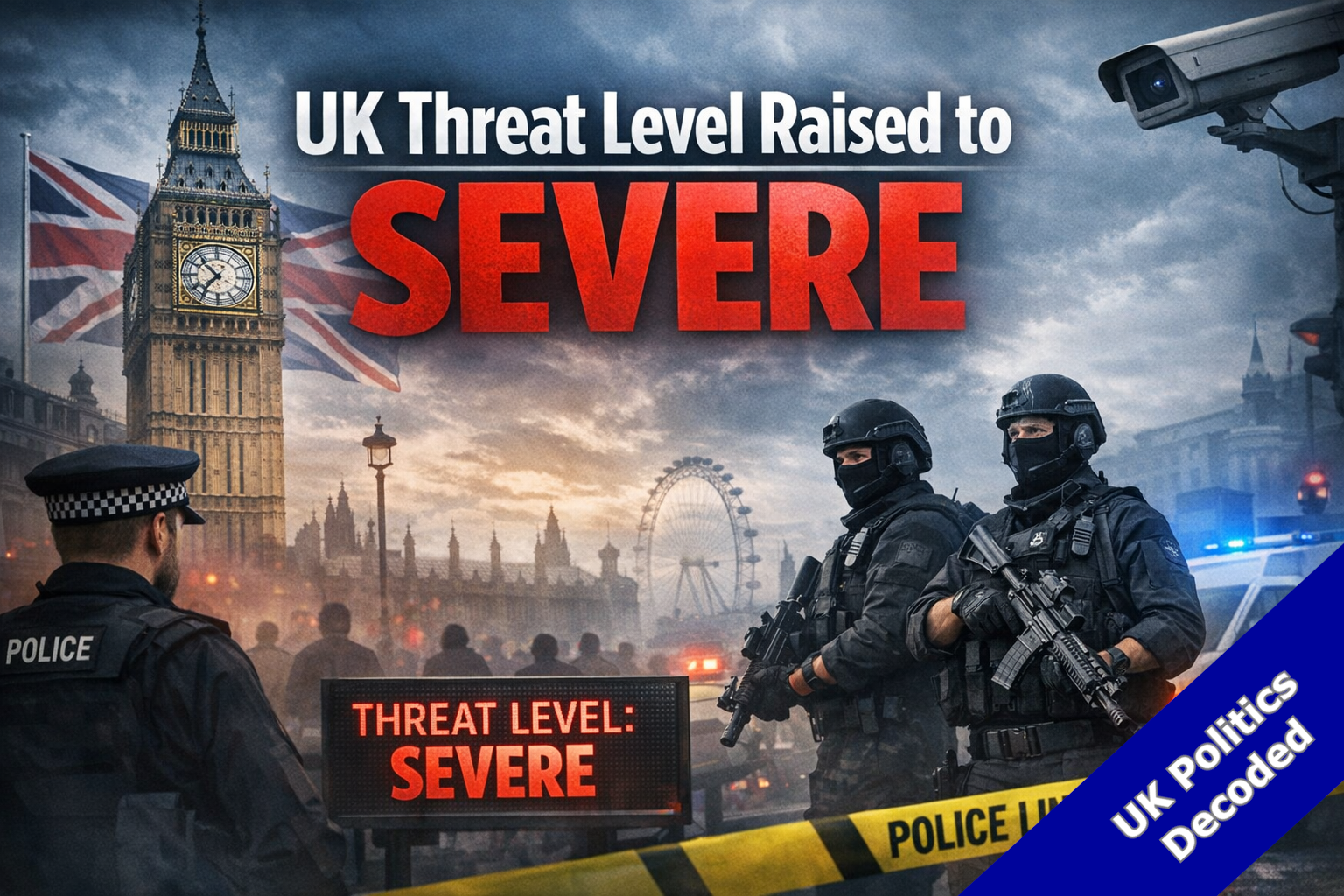
On 30 April 2026, the Joint Terrorism Analysis Centre (JTAC) raised the UK's national terrorism threat level from SUBSTANTIAL to SEVERE. This means that, in JTAC's assessment, a terrorist attack in the UK is now considered highly likely. The change was announced publicly on 1 May 2026 by the government and by MI5. While the stabbings in Golders Green, North London, on 29 April were a contributing factor, JTAC has been clear that the decision was not solely a result of that attack. It reflects a broader and sustained increase in the terrorism threat facing the UK.
The Announcement at a Glance
- Threat level raised to SEVERE, JTAC raised the UK national terrorism threat level on 30 April 2026. SEVERE means a terrorist attack is considered highly likely.
- Not solely triggered by one event: While the Golders Green stabbings on 29 April were a factor, JTAC states the level reflects a longer term rise in both Islamist and Extreme Right Wing terrorism from individuals and small groups based in the UK.
- Elevated threat to Jewish and Israeli communities: MI5 notes a sustained threat to Jewish and Israeli individuals and institutions in the UK, in the context of the conflict in the Middle East.
- State linked threats also rising: Separately from the terrorist threat, the UK is also experiencing a significant and sustained tempo of state linked physical threats, including against the Jewish community.
- Public advice, remain alert, not alarmed: Members of the public are asked to stay alert, report anything that does not feel right, and in an emergency always call 999.
What Are the UK Terrorism Threat Levels?
The UK uses a five level system set independently by JTAC, the Joint Terrorism Analysis Centre. JTAC is part of MI5 and draws on intelligence from across the UK security and intelligence community. The threat level reflects the likelihood of a terrorist attack in the UK, not a specific or imminent plot.
- LOW: An attack is highly unlikely.
- MODERATE: An attack is possible but not likely.
- SUBSTANTIAL: An attack is likely. This was the previous level.
- SEVERE: An attack is highly likely. This is the current level.
- CRITICAL: An attack is highly likely in the near future.
A SEVERE rating does not mean an attack is imminent or that a specific plot has been identified. It means the overall intelligence picture indicates that the conditions for an attack are present and the likelihood is assessed as high.
What Has Driven the Increase?
JTAC's decision reflects a pattern that the UK security community has been tracking for some time. The Golders Green stabbings on 29 April 2026 contributed to the decision, but MI5 has been explicit that the level reflects a sustained and multi faceted increase in risk across several areas.
The Three Key Factors Behind the Raised Level
- Volume and complexity of terrorism cases: There is a significant and growing number of terrorism investigations across multiple ideologies in the UK, including attack planning, extremist travel intent, and online and offline radicalisation.
- Rise of Extreme Right Wing Terrorism. While Islamist terrorism remains the primary threat to the UK, Extreme Right Wing Terrorism (ERWT) has been on a steadily rising trajectory. Both types of threat are being driven largely by individuals and small groups, rather than large organised networks.
- Elevated threat to Jewish and Israeli individuals and institutions: There is a specific and documented elevated threat to Jewish and Israeli communities in the UK, in the context of the conflict in the Middle East, evident in recent incidents both in the UK and overseas.
The Wider Picture: State Linked Threats to the UK
Alongside the terrorism threat level, the UK faces a separate and also growing threat from hostile state actors. This is not reflected in the terrorism threat level, which covers only terrorism, but it forms an important part of the overall national security picture.
In his October 2025 annual threat update, MI5 Director General Sir Ken McCallum described the UK as being in a "new era", with state threats escalating at a pace not seen since 9/11. He reported a 35% increase in the number of individuals investigated for involvement in state threat activity in the preceding year alone. This encompasses espionage, sabotage, arson, and attempts to commission physical violence on UK soil, with Russia and Iran identified as the most active state level threats.
Russia has been using proxies recruited online to carry out surveillance and sabotage in the UK and across Europe. Six individuals were convicted in 2025 for carrying out a range of malign activities at Russia's direction. Five further men were convicted for setting fire to an East London warehouse containing supplies for Ukraine. Iran has been linked to more than twenty potentially lethal plots in the UK in just one year, targeting individuals perceived as opponents of the Iranian regime. Both Russia and Iran have been linked to activity that has affected the Jewish community in the UK.
What SEVERE means for the public
- Remain alert: The public are asked to stay aware of their surroundings and report anything that does not feel right via the ACT (Action Counters Terrorism) portal.
- Not alarmed: SEVERE does not mean an attack is imminent. The UK's security and intelligence services, counter terrorism police, and partner agencies are actively working to disrupt threats.
- Emergency response unchanged: In an emergency, always call 999. This has not changed.
What SEVERE does not mean
- Not a specific threat: The threat level is not tied to a single identified plot or imminent attack. It is an assessment of the overall likelihood based on intelligence.
- Not a new emergency: The threat level was already at SUBSTANTIAL, meaning an attack was assessed as likely. SEVERE raises the assessed likelihood, but the UK has been dealing with significant terrorism risk for many years.
- Not a reason to avoid public spaces: The government and security services are not advising the public to change their daily routines or avoid public places.
How to Report Suspicious Activity
The government's Action Counters Terrorism (ACT) portal is the public facing resource for reporting concerns about potential terrorism. Counter Terrorism Policing teams review every report around the clock, and reports can be made anonymously. The ACT website also includes guidance to help the public spot the signs of terrorism and radicalisation.
How to Report a Concern
- In an emergency, always call 999.
- Online: Report via the ACT: Action Counters Terrorism website. You can also report online content you believe is related to terrorism via the same portal.
- By phone: Call the Anti Terrorist Hotline on 0800 789 321. Calls are not recorded and you do not have to give your name.
- It is ok to be unsure: You do not need to be certain before reporting. Counter Terrorism Policing take every report seriously. It is better to be safe and report, even if you are not sure. It won't ruin lives, but it could save them.
- Spotting the signs: The ACT portal has guides to help you recognise behaviours or activity that may be linked to terrorism planning, including what to look out for online and offline.
What the Security Services Are Doing
MI5, working with Counter Terrorism Policing, MI6, GCHQ, and partner agencies, continues to run a large volume of active terrorism investigations. Since the start of 2020, MI5 and the police have disrupted 19 late stage attack plots, and intervened in many hundreds of developing threats. The UK security community also works closely with Five Eyes partners and European allies to share intelligence and disrupt threats before they reach UK shores.
MI5 is also investing in new approaches to counter the radicalisation of young people, with a significant proportion of terrorism arrests in recent years involving minors. The Counter Terrorism Operations Centre now hosts the Interventions Centre of Expertise, a multi agency team designed to provide better support for vulnerable young people who may be on a pathway towards extremist violence.
Key Takeaways
- JTAC raised the UK national terrorism threat level from SUBSTANTIAL to SEVERE on 30 April 2026. SEVERE means a terrorist attack is highly likely.
- The Golders Green stabbings on 29 April were a contributing factor, but the decision reflects a broader and sustained rise in both Islamist and Extreme Right Wing terrorism in the UK.
- There is an elevated and specific threat to Jewish and Israeli individuals and institutions in the UK.
- Separately, state linked threats from Russia and Iran have been rising sharply, with MI5 reporting a 35% increase in state threat investigations in 2025.
- The public are asked to remain alert but not alarmed. Report anything that does not feel right via the ACT portal at act.campaign.gov.uk or call 0800 789 321. In an emergency always call 999.
📚 Sources & Further Reading
-
GOV.UK – UK National Threat Level raised to SEVERE (1 May 2026)
Archived copy: Archived page -
MI5 – UK National Terrorism Threat Level Raised To SEVERE (1 May 2026)
Archived copy: Archived page -
MI5 – Director General Sir Ken McCallum gives threat update (16 October 2025)
Archived copy: Archived page - Action Counters Terrorism (ACT) – Report suspicious activity and spot the signs of terrorism