AI Use: AI tools were used to support source discovery and to structure the article for clarity. All research, verification, drafting, and final editorial decisions are fully human led. Learn about our AI policy.
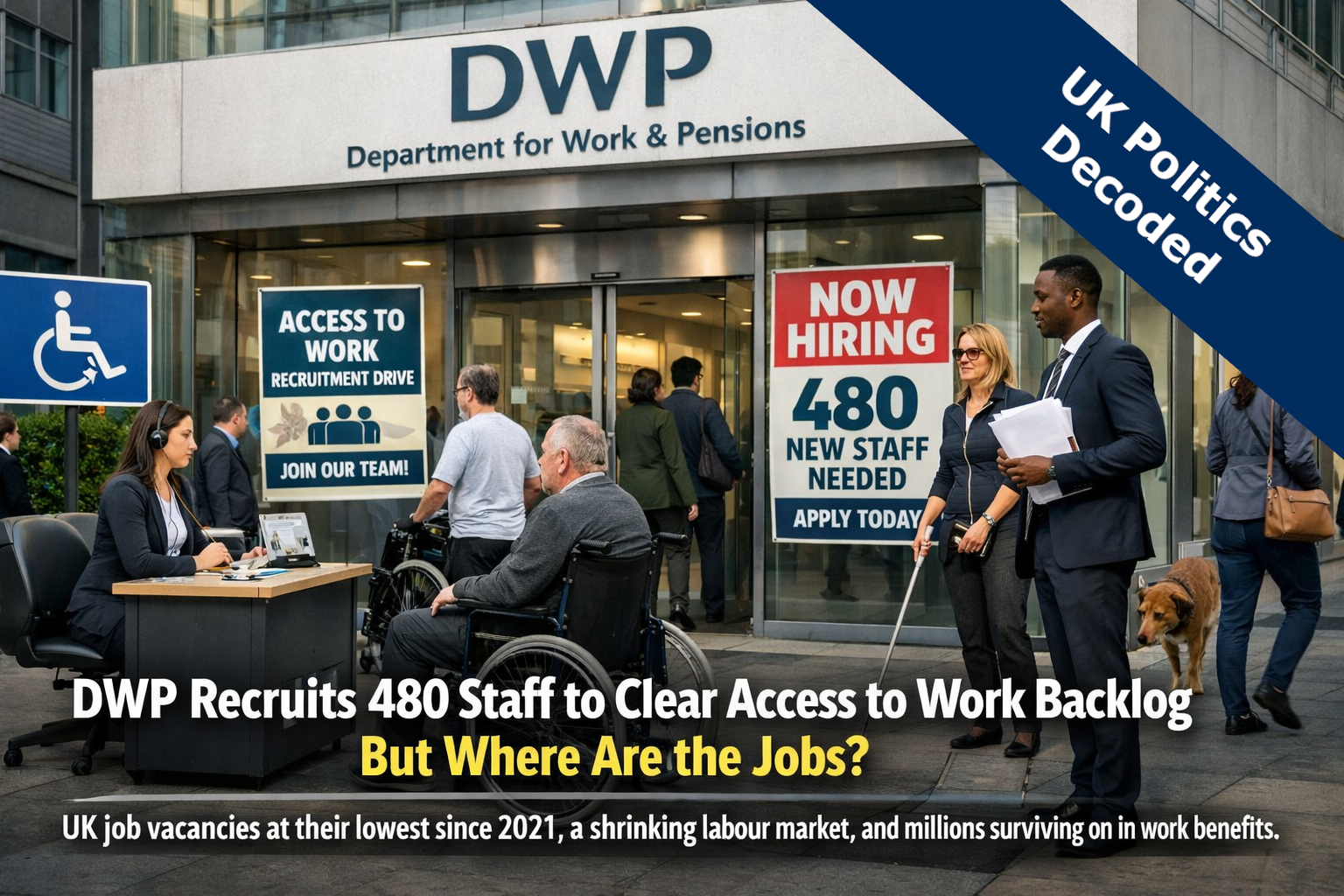
The Department for Work and Pensions announced on 19 May 2026 that it will recruit nearly 500 new staff to tackle a mounting backlog in the Access to Work scheme, which funds practical employment support for disabled people and those with health conditions. Around 60,000 applicants are currently waiting for a decision, a figure that has built up since demand for the scheme more than doubled from 2018/19 onwards, compounded by what ministers describe as an inherited backlog of 48,270 cases left at the end of June 2024.
The announcement is a welcome step in addressing what charities have described as a crisis. But it lands on the same day that the Office for National Statistics published its latest jobs and vacancies bulletin, showing UK vacancies have now fallen to their lowest level since 2021 and more than 10% below pre pandemic levels. That context matters, because clearing the backlog faster only helps if there are jobs on the other side of the wait.
At a Glance
- 480 new caseworkers to be recruited, representing a 72% increase to the 658 staff currently working on Access to Work
- 60,000 people currently awaiting a decision on Access to Work support
- Backlog clearance target: September 2027
- UK vacancies: 705,000 in February to April 2026, the lowest since February to April 2021 (ONS)
- Annual vacancy decline: down 54,000 (7.1%) year on year, with falls in 13 of 18 industry sectors
- 2.5 unemployed people per vacancy in the UK, up from 2.1 a year ago
What the Government Announced
Access to Work is a scheme that provides practical and financial support to help disabled people and those with health conditions start or stay in employment. It can fund specialist equipment, dedicated support workers such as British Sign Language interpreters, and travel costs for people who cannot use public transport.
The scheme has grown substantially. Demand has more than doubled since 2018/19, putting processing capacity under strain. Payment delays had begun to affect individuals relying on the support, and some providers and employers told the DWP they were losing confidence in the scheme's reliability. The DWP says payment delays have now been eliminated and 96% of urgent start date cases are being decided within 28 days, but the broader backlog around 60,000 cases remains.
The 480 new case managers and caseworkers will receive training to handle complex applications. New staff are expected to be in post by September 2027. The DWP says this represents a 72% increase on the current workforce of 658. Staff numbers have already risen by around 30% since March 2024.
Pat McFadden, Secretary of State for Work and Pensions, said Access to Work was "a lifeline for disabled people and those with health conditions" and that the backlog inherited from the previous government had been a "major issue" that required action. The announcement sits alongside a wider package of employment support measures, including Connect to Work, WorkWell, the Right to Try, and the redeployment of Pathways to Work advisers.
The Labour Market Those Cleared Cases Are Entering
The ONS published its Vacancies and Jobs in the UK bulletin on the same morning as the DWP's announcement. The picture it sets out is not an expanding labour market.
Total UK vacancies fell by 28,000 (3.9%) to 705,000 in the three months to April 2026. Compared with a year ago, vacancies are down by 54,000, a fall of 7.1%. They have now declined in 13 of 18 industry sectors year on year. The level is the lowest recorded since February to April 2021, when the economy was still recovering from the pandemic, and sits more than 10% below pre pandemic levels.
The vacancy decline is concentrated in lower paid sectors. Wholesale and retail trade saw the largest volume drop, down 7,000 on the quarter. Accommodation and food services fell by 6,000. Arts, entertainment and recreation recorded the largest percentage decrease, down 24% on the quarter and nearly 30% year on year. These are sectors that have historically provided accessible entry level routes into employment for people with health conditions or disabilities.
The unemployment to vacancy ratio, a measure of how many unemployed people are chasing each available job now stands at 2.5. A year ago it was 2.1. That tightening matters for anyone entering the labour market, and it matters more for those who already face additional barriers.
Small employers are pulling back hardest
Of the overall quarterly fall in vacancies, 19,000 of the 28,000 decline came from businesses with between 1 and 9 employees. Small employers disproportionately employ disabled people and those with health conditions and they are the ones cutting back fastest. The Federation of Small Businesses, which welcomed the Access to Work announcement, acknowledged the scheme is important precisely because small firms "disproportionately employ disabled people." That same cohort of employers is now posting fewer vacancies than at any point in the recovery.
The Regional Picture, Outside London and the South East
The vacancy data does not break down neatly by region, but the structural pressures are well established. The UK's economic geography has long been concentrated in London and the South East, where financial services, professional services, and tech sectors generate the bulk of high productivity employment. Outside that zone across much of the North, Midlands, coastal communities, and rural areas the job market has always been thinner, more seasonal, and more dependent on the sectors now seeing the sharpest vacancy falls.
For someone with a health condition or disability living in a post industrial town in the North East, or a coastal community in the South West, Access to Work clearing their backlog case is necessary but not sufficient. The scheme funds support once someone is in work. It does not create the job itself.
ONS feedback from its Vacancy Survey suggests some firms are not recruiting because of "economic and geopolitical uncertainty." That hesitancy tends to affect regional markets where employer bases are smaller and less diversified, more acutely than it does London and its commuter zone.
What the recruitment drive addresses
- Processing speed: 60,000 people waiting for decisions will be seen faster
- Payment reliability: delays that were straining individuals and providers can be reduced
- Urgent cases: 96% of start date cases already cleared within 28 days
- Scheme confidence: employers and providers report concerns about delivery, faster processing helps restore that
What it does not address
- Vacancy levels: 705,000 vacancies is the lowest since 2021, fewer jobs to enter
- Regional disparity: labour markets outside London and the South East remain thin
- Employer demand: the scheme supports people once hired, it cannot compel hiring
- In work poverty: many in work already rely on Universal Credit top ups, getting a job does not automatically resolve financial precarity
Welfare, Work, and the Bigger Welfare Bill
The government's language around welfare reform consistently centres on a shift "from a welfare state to a working state." That framing assumes work is the solution to welfare dependency. The data on in work poverty complicates that picture significantly.
A substantial portion of the UK's welfare bill does not go to people who are out of work. It goes to people who are working either part time or full time but whose wages are not enough to cover their basic costs. Universal Credit was designed in part to support those in low paid employment, and millions of working households claim it. According to DWP statistics, the majority of new Universal Credit claims in recent years have come from people who are already employed.
This matters for the Access to Work backlog in particular. The scheme helps people with disabilities access and stay in work. But if the jobs available to them are part time, low paid, or insecure, those individuals may find themselves working while still relying on Universal Credit to close the gap between wages and living costs. That is not a failure of the individual or of Access to Work, it reflects the structure of the labour market they are entering.
The ONS data reinforces this. The largest vacancy declines are in sectors characterised by low pay, variable hours, and limited career progression, retail, hospitality, and arts. These are also the sectors most likely to generate the kind of employment that leaves workers welfare dependent even while in work. Vacancy falls in those sectors do not just mean fewer jobs, they mean fewer of the accessible, entry level roles that often form the first step into the labour market for disabled people.
In work poverty and the cost of getting this wrong
There is a risk embedded in the current approach that deserves attention. If the government succeeds in clearing the Access to Work backlog which is worth doing and helps more disabled people move into employment, but those jobs are concentrated in a contracting, low wage sector with insufficient hours, those individuals may move off one part of the welfare bill and onto another. The welfare state does not shrink, it reshapes.
A genuinely successful outcome requires not just that disabled people are supported into work, but that the work available is secure enough, well paid enough, and accessible enough to reduce dependency rather than relocate it. That is a much larger challenge than processing 60,000 Access to Work applications and it is one the government has not yet answered.
What the Charities Said
Responses to the announcement from the disability and employment sector were broadly positive about the recruitment drive, while pointing to the scale of work still needed.
Jon Sparkes, Chief Executive of Mencap, said the drive was "a positive step in tackling the systematic delays and bogged down administration that has threatened this vital programme," adding that payment delays were putting "enormous pressure on disabled people" and on charities that employ and support them.
Harriet Oppenheimer of RNID which represents people who are deaf or have hearing loss highlighted that for BSL users, Access to Work is not supplementary but essential delays force some people to change how they work, reduce hours, or cover interpretation costs from their own income. Laura Davis of BASE noted that while the backlog must be cleared, delays in decisions and payments were already undermining provider confidence and threatening the supply of specialist support.
Craig Beaumont of the Federation of Small Businesses said the announcement would help staff in small businesses, the employers who disproportionately take on disabled people and that demand for the scheme was likely to rise further. That last point is worth holding onto. Even with 480 new staff, if demand continues to grow at the pace seen since 2018, the backlog question will return.
Conclusion: Clearing the Queue Is Necessary, Not Sufficient
The announcement arrives in a labour market that is quietly contracting. Vacancies are at a five year low. The unemployment to vacancy ratio has been rising since mid 2024. The sectors shedding vacancies fastest are the ones most accessible to people entering the labour market with health conditions or disabilities. And outside London and the South East, the structural thinness of regional job markets means the gap between being supported into work and actually finding work has always been harder to close.
Millions of people in the UK are already working and still relying on the welfare system to bridge the gap. Getting more disabled people into employment is only a meaningful solution to welfare dependency if the employment available provides enough hours, enough stability, and enough pay to make that dependency unnecessary. The Access to Work scheme is a vital tool. But it is one piece of a far larger puzzle and the puzzle is not getting easier.
Key Takeaways
- 480 new DWP caseworkers will be recruited to clear a 60,000 case Access to Work backlog by September 2027
- UK vacancies fell to 705,000 in February to April 2026, the lowest level since 2021, and 10.6% below pre pandemic figures (ONS)
- There are now 2.5 unemployed people per vacancy, up from 2.1 a year ago, the labour market is tightening, not expanding
- The largest vacancy falls are in low paid, accessible sectors, retail, hospitality, arts which provide many of the routes into employment for disabled people
- A large share of the welfare bill already goes to people who are in work but on low pay, moving more people into employment does not automatically reduce welfare dependency
- Regions outside London and the South East face structurally thinner labour markets, where clearing an Access to Work case does not guarantee a job exists to move into
Sources & Further Reading
-
GOV.UK — Huge recruitment boost to tackle backlog in vital disability work scheme (DWP, 19 May 2026)
Archived copy (OGL): archived page -
ONS — Vacancies and jobs in the UK: May 2026 (Office for National Statistics, 19 May 2026)
Archived copy (OGL): archived page - GOV.UK — Access to Work: get support if you have a disability or health condition (DWP)