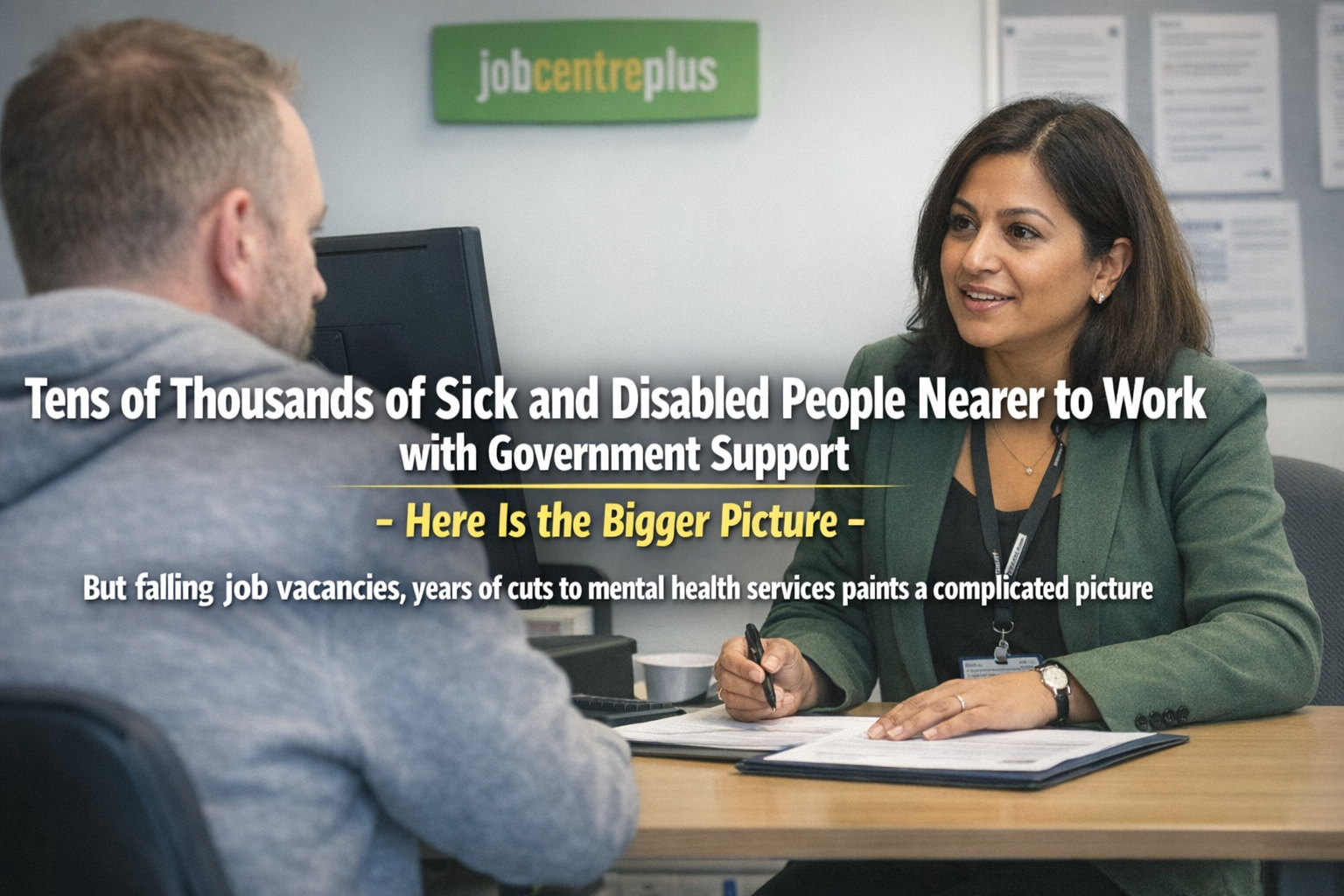
The Government has announced that more than 65,000 people with Limited Capability for Work and Work Related Activity (LCWRA) have received voluntary, personalised employment support through its Pathways to Work programme since April 2025. Ministers describe this as evidence that the welfare system is being "fixed" and that people previously "written off" are now closer to work.
But behind the headline figure lies a more complex story. Job vacancies have been falling since 2022. Personal Independence Payment (PIP) caseloads have grown partly because NHS mental health services have become harder to access. And from 6 April 2026, new Universal Credit claimants with health conditions will receive a lower rate of support than those already on the system, creating, in effect, a two tier benefit structure.
This explainer sets out what the Government announced, and the wider context that helps make sense of it.
📋 At a Glance
- 65,000+ people with LCWRA have received tailored employment support since April 2025
- 1,000 Pathways to Work advisers are now based in Jobcentres across Great Britain
- Support is voluntary and one to one
- Part of a £3.5bn employment support package
- From 6 April 2026, new UC claimants with health conditions receive a lower health element than existing claimants
- Job vacancies have been falling quarter on quarter since 2022
🏛️ What the Government Announced
The Government announced that over 65,000 people assessed as having Limited Capability for Work and Work Related Activity the highest tier of health related Universal Credit have now received voluntary, one to one employment support through the Pathways to Work programme.
LCWRA is the category used in Universal Credit for people whose health condition or disability means they face the most significant barriers to employment. Historically, many of these claimants received their benefit with little or no active employment support attached to it.
The programme places 1,000 dedicated Pathways to Work advisers inside Jobcentres across Great Britain. These advisers provide personalised, voluntary support rather than mandated job seeking activity. Government analysis suggests that people who take part are more likely to be in work two years later, though the full outcomes data is not yet available.
The announcement also comes ahead of Universal Credit reforms taking effect on 6 April 2026, including an increase to the standard allowance and changes to the health related element for new claimants.
The Government frames the programme as a shift away from "writing people off" and towards "unlocking potential".
📉 The Labour Market Context: Fewer Vacancies, More Competition
The Government's announcement focuses on the number of people receiving support. It does not reference the labour market conditions those people are entering.
ONS data shows that job vacancies surged after the pandemic but have been declining quarter on quarter since 2022. The labour market is not expanding, it is tightening.
This matters for several reasons:
- A shrinking vacancy pool means more competition for each available role
- Employers become more selective as the number of applicants rises relative to openings
- Disabled people already face additional barriers, inaccessible workplaces, the challenge of managing fluctuating conditions, transport difficulties, and evidence of persistent employer bias
- Employment support alone cannot create jobs where jobs do not exist
Research published by the Cabinet Office's Disability Unit confirms that disabled people in the UK are more than twice as likely as non‑disabled people to be unemployed (6.9% versus 3.6%), and nearly three times as likely to be economically inactive (43.1% versus 15.4%). These gaps exist even before considering a tightening job market.
The risk in the current approach is that programmes increase the supply of jobseekers without increasing the demand for labour, redistributing scarcity rather than expanding opportunity.
📋 What Is LCWRA and Why Does It Matter?
LCWRA stands for Limited Capability for Work and Work Related Activity. It is the highest health related category within Universal Credit, awarded to people whose condition is severe enough that they are not expected to look for work or prepare for employment.
To receive LCWRA status, a claimant must pass a Work Capability Assessment carried out by the DWP. The assessment looks at how a person's physical or mental health condition affects their ability to carry out a range of everyday tasks and activities.
People awarded LCWRA receive a higher rate of Universal Credit. From 6 April 2026, however, new claimants who are awarded this status will receive a lower rate than existing claimants, a significant change explained further below.
🧠 Why the PIP Caseload Grew: A System Design Issue
The Government has pointed to the rising number of people receiving Personal Independence Payment as evidence that the welfare system needs reform. But the press release does not address the underlying reasons why the PIP caseload grew.
PIP was designed to support people with:
- Chronic physical conditions
- Sensory impairments
- Severe mental health conditions
- Mobility limiting illnesses
- Long term functional impairment
It was not designed to absorb widespread, untreated depression or anxiety disorders linked to socioeconomic stress, post pandemic mental health deterioration, or people who cannot access NHS mental health services.
Over the past decade, waiting lists for talking therapies increased, early intervention services were reduced, and community mental health support became harder to access. A 2023 National Audit Office report found that despite increases in funding and staffing since 2016, many people still cannot access mental health services or face lengthy waits for treatment. It also found that demand for mental health services will continue to significantly outstrip provision over the coming years.
As a result, more people deteriorated into severe, long term conditions that would previously have been treated at an earlier stage. PIP became the only accessible support route for many of them. The benefit system absorbed cases that would, in a well resourced health service, have been addressed clinically.
This is a system design issue not a reflection of claimant behaviour, and not something that employment support programmes alone can resolve.
🍺 Addiction and PIP: A Gap in Treatment, Not a Benefit Problem
Alcohol dependency is a recognised health condition that can significantly impair daily functioning. Some PIP claimants have alcohol‑related conditions that affect their ability to carry out everyday tasks and therefore qualify under the PIP assessment criteria.
PIP was not designed to replace:
- Detox and withdrawal services
- Addiction treatment programmes
- Counselling and dual diagnosis support
- Community alcohol and drug services
Statistics published by the Office for Health Improvement and Disparities show that substance misuse treatment services for adults, young people, and people in secure settings have faced significant pressures. Where treatment is inaccessible or unavailable, people with alcohol or drug dependencies may rely on PIP for basic financial stability. This does not incentivise recovery. It reflects a gap in the treatment system.
💸 Universal Credit Reforms: What Changes on 6 April 2026
From 6 April 2026, the Government is making changes to Universal Credit that affect how much financial support new claimants with health conditions receive.
The changes include:
- An increase to the standard allowance for all UC claimants
- The removal of the existing higher LCWRA linked health element (currently £429.80 per month) for new claimants only
- A new, lower health element of £217.26 per month for new claimants awarded LCWRA status
- Tighter functional definitions for eligibility to the health element
- More conditions being routed into work related requirements or Pathways to Work support rather than the higher support tier
Existing claimants who already receive the higher LCWRA element will continue to do so. New claimants from 6 April 2026 will receive the lower rate. This creates a two tier system in which the level of support a person receives depends partly on when they became unwell or disabled.
The Government frames these reforms as rebalancing Universal Credit and tackling what it describes as "perverse incentives" in the current system. Critics argue the changes reduce financial support at precisely the point when people need stability to take steps towards employment.
📊 Government Framing Versus Structural Reality
| Policy Area | Government Framing | Structural Reality |
|---|---|---|
| LCWRA employment support | "65,000 people helped into personalised support." | Support does not change the fact that job vacancies are falling, increasing competition for disabled people entering the labour market. |
| Universal Credit reforms | "Rebalancing UC with a higher standard allowance." | Tighter LCWRA definitions mean fewer new claimants qualify for the health, those who do receive less than existing claimants. |
| Health related UC element | "Lower rate for new claimants, but everyone gets personalised help." | New claimants receive £217.26/month instead of £429.80/month, a difference of over £200 per month creating a two tier system. |
| Disability employment | "Unlocking potential" and "breaking down barriers." | Barriers remain systemic, inaccessible workplaces, employer bias, fluctuating conditions, transport, and a shrinking job market. |
| PIP caseload growth | "Rising numbers" framed as a welfare problem to be solved. | Growth driven substantially by unmet mental health needs, long NHS waiting lists, and PIP being used as a substitute for clinical services. |
| Mental health conditions | "Too many people being assessed as LCWRA." | Many claimants deteriorated due to cuts to mental health services, not because the criteria were too generous. |
| Addiction related claims | Not addressed in the announcement. | PIP is absorbing people with alcohol and drug dependency because treatment services are overstretched. PIP cannot incentivise recovery. |
🔍 What the Research Says About Disabled People and Employment
A thematic review of the literature published by the Cabinet Office's Disability Unit in July 2025 examined over 75 research documents on disabled people's experience of employment in the UK. Its findings are relevant to understanding what "employment support" can and cannot achieve.
The review found that disabled people face barriers at every stage of employment, including during recruitment, applications, interviews, hiring, training, career progression, and retention. Negative perceptions from employers heavily influence whether disabled people are hired and whether reasonable adjustments are provided.
By far the most prominent theme in the evidence was systemic discrimination, the finding that barriers to work stem more from barriers in society than from individual impairments. These include inaccessible workplaces, inflexible working practices, employer attitudes, a lack of awareness among managers, and the difficulties of disclosing a health condition without facing negative consequences.
The review also found that disabled workers frequently reported a lack of career progression, few positive disabled role models in organisations, and inadequate equality and diversity training. Employment support programmes, however well designed, operate within these structural realities.
🏥 The Mental Health Services Background
A 2023 National Audit Office report on progress in improving mental health services in England found that while funding and workforce numbers had increased since 2016, many people still could not access services or faced lengthy waits. The report found that the COVID‑19 pandemic led to a large rise in mental health conditions particularly among young people and that demand would continue to significantly outstrip provision for the foreseeable future.
The Royal College of Psychiatrists has consistently called for improved funding, earlier intervention, and greater parity between mental and physical health services. Without those investments, the pressures on the benefits system that the Government is now seeking to address are likely to persist regardless of how employment support programmes are structured.
🔎 The Bigger Picture
The Government's milestone reflects a genuine expansion of employment support provision. Placing dedicated advisers in Jobcentres and offering voluntary, personalised help to people with significant health conditions is a meaningful step.
But the wider context matters:
- The labour market is tightening, not expanding, and job vacancies have fallen steadily since 2022
- Mental health funding was previously ring fenced, and the removal of that protection over the 14 years of previous governments means the services was scaled back, leaving many people unable to access early intervention or treatment.
- PIP caseloads grew substantially because mental health and addiction services became harder to access, not because eligibility criteria were too loose but due to under funding and lack of access
- Mental health services remain overstretched, with demand continuing to outstrip provision
- Universal Credit reforms from 6 April 2026 reduce the health related element for new claimants by over £200 per month compared to existing claimants
- Structural barriers to disabled people's employment, employer attitudes, inaccessible workplaces, fluctuating conditions remain significant and are not addressed by employment support alone
Understanding the full picture is essential for assessing whether current reforms will genuinely improve outcomes for sick and disabled people, or whether they will simply change the route by which those people encounter difficulty.
📚 Sources & Further Reading
-
Gov.UK — Tens of thousands of sick and disabled people nearer to work with government support (25 March 2026)
Archived copy (OGL): archived page -
Gov.UK — Personal Independence Payment statistics (Department for Work and Pensions, updated March 2026)
Archived copy (OGL): archived page -
Gov.UK — Alcohol and drug misuse and treatment statistics (Office for Health Improvement and Disparities, updated February 2026)
Archived copy (OGL): archived page -
Gov.UK — Disabled people's employment in the UK: A thematic review of the literature (Cabinet Office Disability Unit, July 2025)
Archived copy (OGL): archived page -
National Audit Office — Progress in improving mental health services in England (February 2023)
Archived copy (OGL): archived page -
Royal College of Psychiatrists — Campaigning for better mental health policy
Archived internally for verification (25 March 2026)
AI Use: AI tools were used to support source discovery and to structure the article for clarity. All research, verification, drafting, and final editorial decisions are fully human led.