AI Use: AI tools were used to support source discovery and to structure the article for clarity. All research, verification, drafting, and final editorial decisions are fully human led. Learn about our AI policy.
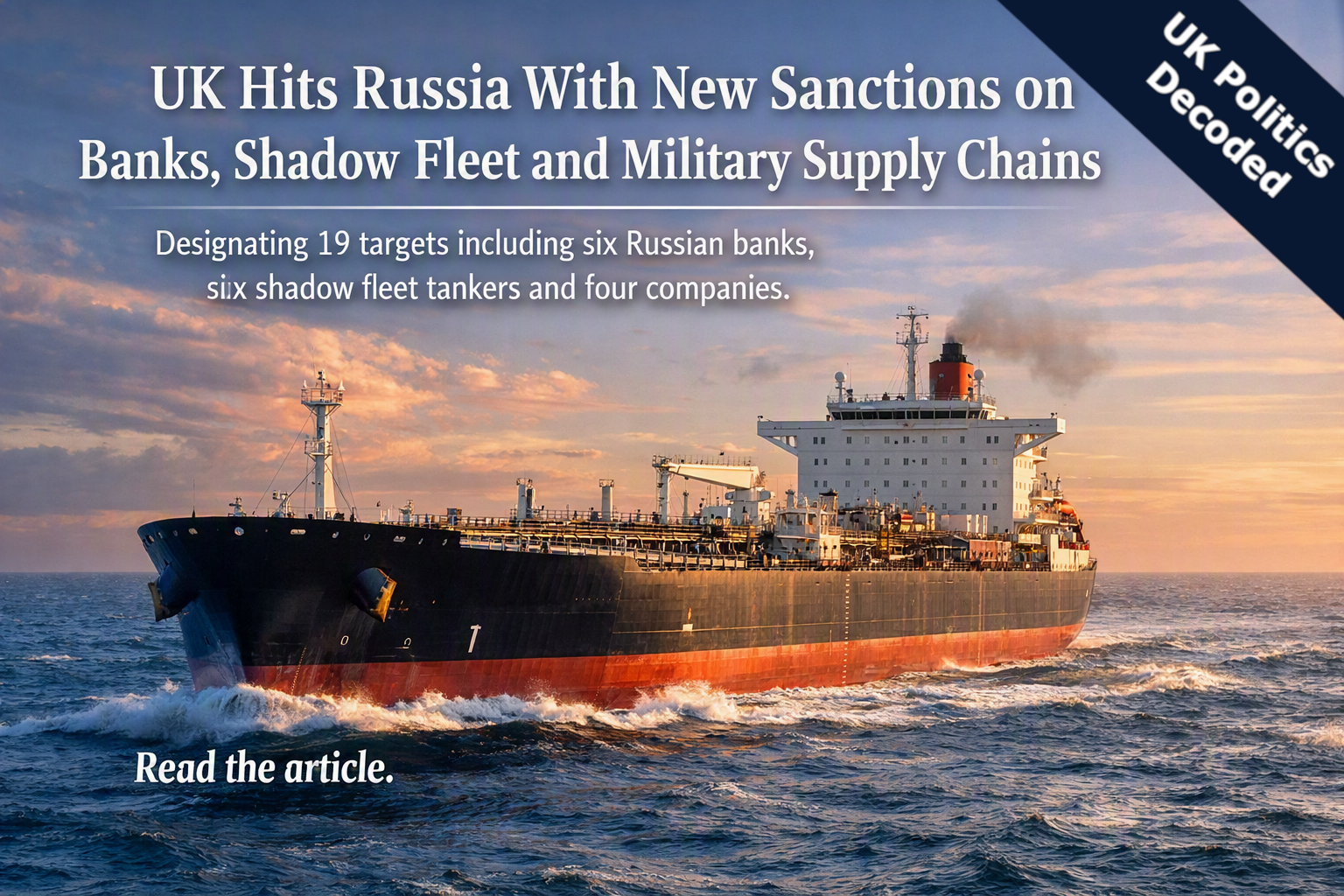
Foreign Secretary Ed Miliband announced 19 new Russia sanctions on 6 August 2026, in what he described as his first major package since taking office. The designations span Russian banks propping up the war economy, shadow fleet tankers circumventing Western oil restrictions, and companies supplying rare metals used in battlefield equipment.
The announcement came a day after Miliband met US Secretary of State Marco Rubio in Washington DC, where the two discussed maintaining pressure on Russia. It follows the Prime Minister and Foreign Secretary hosting President Zelenskyy in Portsmouth the previous week, where the UK committed cutting edge drone capabilities to Ukraine's frontline.
What Was Announced
- 19 total targets: Six Russian banks, six shadow fleet tankers, four rare metal importing companies, and one individual
- Shadow fleet: Six newly acquired tankers sanctioned for evading Western oil restrictions, the vessels are named Asteras, Perseas, Torvian, Visund, Zenturo, and Arctic Express
- Banks sanctioned: Ozon Bank, Realist Bank, Teleport Bank, Bank Stavr, Center Invest, and the State Specialised Russian Export-Import Bank
- Rare metals: Four firms Metallkomplekt, Nikom, Technolux, and Promsiz importing tantalum and niobium, materials critical for producing Russian military equipment
- Individual: Alexander Aleksandrovich Zhdanov designated under the regime
The shadow fleet is a network of tankers operating outside mainstream Western shipping and insurance markets. Russia has used these vessels to keep exporting oil and generating revenue despite Western sanctions introduced after the full scale invasion of Ukraine in February 2022.
The tankers typically share several characteristics that allow them to evade detection and enforcement:
- Flag of convenience: Ships are often registered in countries with lighter regulatory oversight
- Opaque ownership: Beneficial ownership is obscured through complex corporate structures
- No Western insurance: Vessels operate without P&I club coverage, removing a key compliance lever
- Ship to ship transfers: Cargo is sometimes transferred between vessels at sea to further obscure its origin
- Price cap evasion: The fleet helps Russia sell oil above the G7 price cap by cutting out Western service providers
UK Shadow Fleet Enforcement Milestones
- March 2026: UK gained powers to interdict shadow fleet vessels transiting UK waters, allowing the British military to board sanctioned ships
- June 2026: The UK successfully intercepted a Russian shadow fleet vessel in the English Channel, the first such interdiction
- July 2026: As of that date, the UK had specified over 600 vessels under the Russia sanctions regime, including over 580 oil tankers
- August 2026: Six further tankers added with today's package, bringing the regime's total designations to over 3,400 individuals, entities and ships
Sanctioning Russian banks is one of the principal tools available for disrupting the financial flows that fund the conflict. The six banks named in this package operate within Russia's domestic financial system and, according to the FCDO, support the Kremlin's war effort.
Each institution has been added to the UK Sanctions List, meaning UK persons are prohibited from dealing with them:
Banks Sanctioned on 6 August 2026
- LLC Ozon Bank: Designated for supporting Russia's war economy
- JSC Realist Bank: Designated for supporting Russia's war economy
- JSC Teleport Bank: Designated for supporting Russia's war economy
- PJSC Bank Stavr: Designated for supporting Russia's war economy
- PJSC Center Invest: Designated for supporting Russia's war economy
- State Specialised Russian Export-Import Bank (JSC): Designated for supporting Russia's war economy
When a bank is designated under UK sanctions, UK persons and businesses are prohibited from entering financial transactions with it. This includes making funds available directly or indirectly, and applies to individuals and companies operating under UK jurisdiction, as well as those operating overseas in certain circumstances.
- Asset freeze: Any assets held or controlled in the UK are frozen
- Transaction ban: UK persons cannot make funds or economic resources available to the designated entity
- Secondary risk: Non-UK entities may also face reputational and legal exposure for continuing to work with sanctioned parties
- Financial isolation: Combined with EU, US and other allied sanctions, the effect is to progressively cut Russian institutions off from Western financial systems
The four companies designated in this package are accused of importing tantalum and niobium into Russia. Both are critical metals used in the manufacture of military equipment, including components for electronic systems found in weapons deployed on the battlefield in Ukraine.
Tantalum and niobium have specific industrial and military applications that make them strategically significant:
Tantalum
- Used in: Capacitors and resistors in electronic devices, including guidance systems and communications equipment
- Military relevance: Found in smartphones, computers, and military electronics that require miniaturised, heat resistant components
- Supply source: Primarily mined in Africa, Australia and Brazil, Russia is not a major producer and relies on imports
- Sanctioned firms: Metallkomplekt and Nikom among those accused of supplying it to Russia
Niobium
- Used in: High strength steel alloys and superalloys for aerospace and defence applications
- Military relevance: Critical for armour plating, aircraft structures and rocket components
- Supply source: Brazil produces the vast majority of global supply again, Russia is import dependent
- Sanctioned firms: Technolux and Promsiz among those designated for importing niobium
Targeting the supply chain for these metals is part of a broader allied effort to disrupt Russia's ability to manufacture and replenish military equipment. Western export controls have already restricted the flow of semiconductors, precision components, and dual use technologies into Russia since 2022.
- Scale of impact: UK, US and EU sanctions have denied Russia access to at least $450 billion since February 2022, equivalent by one estimate to around two more years of funding for the invasion
- Trade disruption: Between October 2024 and September 2025, UK imports from and exports to Russia dropped by 98.1% and 97.5% respectively compared to 2021 levels
- 2026 pace: This year alone the UK has imposed sanctions on over 500 individuals, entities and ships under its Russia sanctions regime prior to today's package
- Cumulative total: The UK has now sanctioned over 3,400 individuals, entities and ships under the Russia regime, over 3,200 of which have been designated since Putin's full scale invasion began
Today's designations are the latest in a sustained campaign of pressure that forms one strand of the UK's wider support for Ukraine. Since the full scale invasion in February 2022, the UK has committed £25 billion for Ukraine across military, non-military and humanitarian programmes.
The UK's total Ukraine commitment breaks down across three broad areas:
UK Support for Ukraine Key Figures (as of July 2026)
- Military support: £16 billion committed, including a £2.26 billion contribution to the G7 ERA Loan. The UK will sustain £3 billion per year in military aid until 2030 to 2031
- Non-military support: Up to £5.6 billion, including fiscal guarantees and bilateral assistance
- Export finance: £3.5 billion cover limit via UK Export Finance for reconstruction and defence projects
- Training: Over 63,000 Ukrainian personnel trained in the UK under Operation INTERFLEX
- Drones: 150,000 drones and 350 air defence missiles to be delivered to Ukraine by the end of 2026
Sanctions sit alongside military, diplomatic and humanitarian tools in the UK's Ukraine strategy. The June 2026 interception of a shadow fleet vessel in the English Channel, the first of its kind showed that these powers are being actively used, not just added to a list.
- Crypto and illicit finance: Sanctioned in May 2026 for circumventing UK restrictions
- Shadow fleet (June 2026): 70 new designations targeting Russia's tanker network and military procurement supply chains
- Cyber and hybrid operations (July 2026): 24 individuals and entities sanctioned in the first joint package with the EU
- Chemical weapons (July 2026): Russians linked to the development of chemical weapons used to kill Alexei Navalny and Dawn Sturgess designated
- February 2026: Nearly 300 targets in what was described as the largest Russia sanctions package since the early months of 2022
The 6 August package reinforces a pattern of sustained, layered sanctions activity that has accelerated throughout 2026. By targeting banks, tankers and materials suppliers in a single package, the FCDO is hitting three distinct pressure points simultaneously, Russia's financial system, its oil revenues, and its ability to manufacture military equipment.
The involvement of tantalum and niobium firms is notable. It signals that the UK is now tracing the supply chains that keep Russian weapons factories running, rather than focusing solely on the more visible financial and shipping networks. Combined with the interdiction powers gained in March 2026 and the first successful shadow fleet boarding in June, the enforcement machinery is becoming more operational.
With over 3,400 designations now in place and more than 500 added in 2026 alone, the pace shows no sign of easing. The Foreign Secretary framed today's announcement plainly, "We will continue stepping up the pressure on Russia until a just and lasting peace has been reached."
Key Takeaways
- Ed Miliband's first major Russia sanctions package designated 19 targets on 6 August 2026, six banks, six shadow fleet tankers, four rare metals firms, and one individual
- The six tankers Asteras, Perseas, Torvian, Visund, Zenturo and Arctic Express were sanctioned for dodging Western oil price restrictions
- The four metals firms were importing tantalum and niobium, rare materials used to manufacture Russian military equipment and electronics
- The UK has now sanctioned over 3,400 individuals, entities and ships under the Russia regime, with over 500 added in 2026 alone prior to this package
- UK, US and EU sanctions have denied Russia access to at least $450 billion since February 2022, equivalent by one estimate to around two more years of war funding
Sources & Further Reading
- UK continues crackdown on Russia with tough new sanctions – GOV.UK, 6 August 2026 Archived copy (OGL): archived page
- UK support to Ukraine: factsheet – GOV.UK, updated 24 July 2026 Archived copy (OGL): archived page
- UK Sanctions List – FCDO sanctionslist.fcdo.gov.uk Archived copy (OGL): archived page