On 28 May 2026, the government published data showing that 2025 was the strongest year on record for solar deployment in the UK. Some 269,000 new installations were completed the vast majority on homes, businesses and buildings. That works out to a new rooftop solar installation roughly every two minutes throughout the year.
The UK passed the two million total solar installations milestone for the first time in March 2026. Nine of the ten best ever months for new solar uptake have occurred in the past twelve months. Businesses from Numatic International, maker of Henry the Hoover, to Mid Cheshire Hospitals NHS Trust are adding solar capacity. The government's clean power mission, accelerated partly in response to the war in Iran and the renewed exposure it revealed to volatile fossil fuel markets, is generating genuinely notable momentum.
Energy Secretary Ed Miliband framed this as the UK "taking back control of their energy" backing homegrown generation and reducing reliance on markets Britain cannot influence.
It is a compelling narrative. The problem is that for the households and businesses actually paying electricity bills, the clean power revolution does not show up in the numbers that matter.
The gap between generation and bills
Renewable electricity from solar farms and offshore wind is genuinely cheap to produce. Once the infrastructure is built, the marginal cost of generating electricity from wind or sunshine is close to zero. That is precisely why the government and industry keep pointing to it as the route to long term energy security and lower costs.
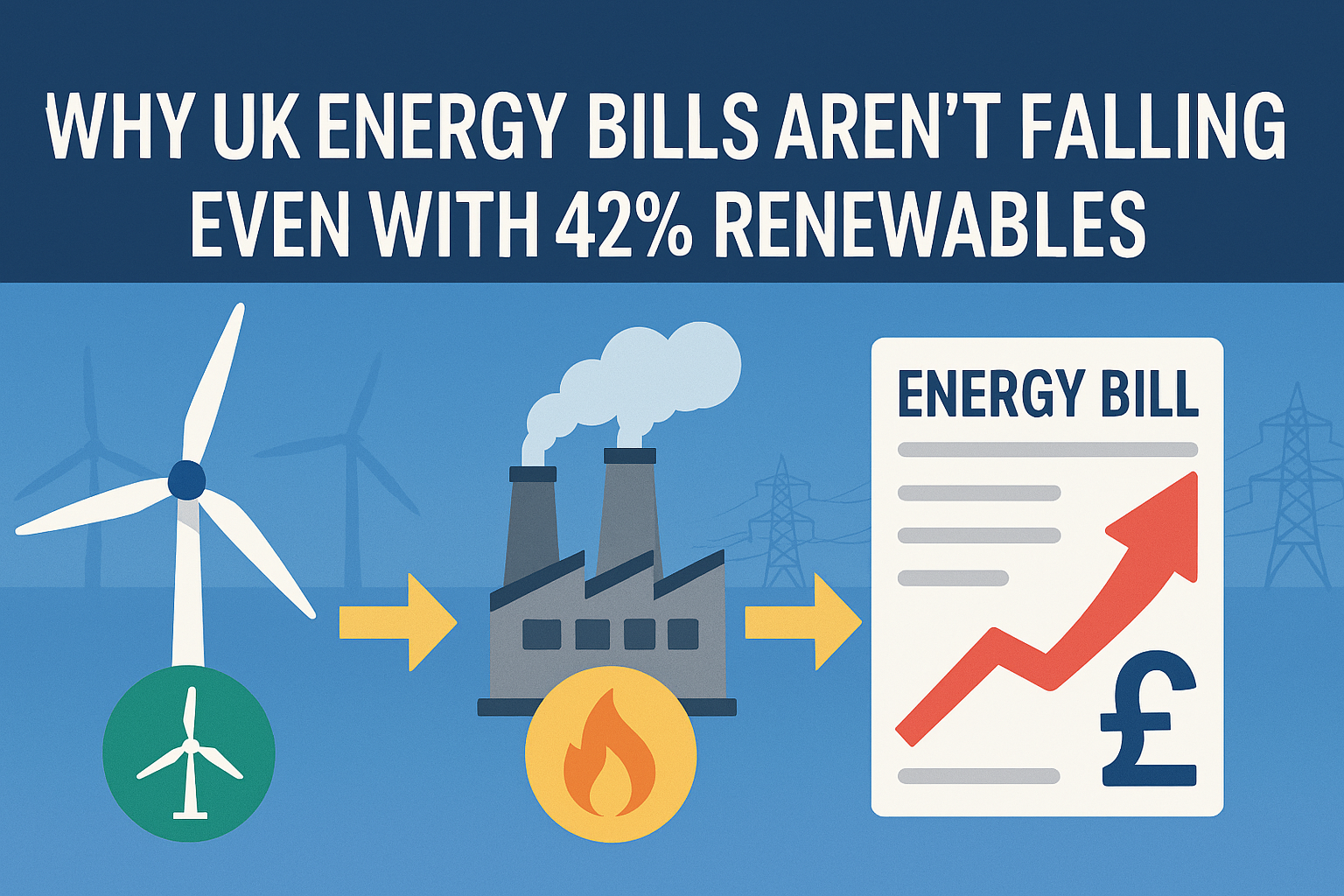
But here is the structural reality, cheap generation does not automatically translate into cheap bills. Around 40% of household and business electricity bills in the UK is shaped not by the cost of producing electricity, but by how the market prices it and the mechanism used is called marginal pricing.
How marginal pricing works and why it is the wrong tool for today's grid
The UK electricity market is settled across 48 half hour periods each day. In each window, generators bid to supply power. Those bids are stacked from cheapest to most expensive, and the grid works up through them until demand is met. The price paid to every generator in that period is set by the last and therefore most expensive bid accepted.
That last bidder is almost always a gas plant. Gas turbines can ramp up and down quickly to meet fluctuating demand, which is why they often end up as the marginal generator. And under this system, whatever a gas plant charges for electricity in that half hour window becomes the price paid to every generator supplying electricity in that window including the offshore wind farm that was producing power for almost nothing.
It is a system designed for a grid that ran primarily on fossil fuels in the 1990s. On that grid, pricing everything off the last generator made reasonable sense because most generation had broadly similar cost structures. Today, with renewables making up an ever larger share of supply, the system is increasingly disconnected from reality. The UK is regularly paying gas linked prices for wind generated electricity.
In practical terms
When gas prices spiked following Russia's invasion of Ukraine, UK electricity bills surged even on days when most power was coming from wind and solar. The cheap generation was there. The system simply did not allow its lower cost to reach the consumer.
Policy levies add further pressure
On top of marginal pricing, policy related charges including network costs, capacity market payments, and various levies tied to energy policy obligations account for a further estimated 10 to 15% of household and business electricity bills. These are real costs, but they are often conflated in public debate with the underlying price of electricity itself, which makes it harder for people to understand where the money is actually going.
The combined effect is significant. A household paying an electricity bill today is not paying for the cost of generating the electricity it uses. It is paying a gas linked wholesale price, plus transmission and distribution network costs, plus a series of policy levies regardless of whether the power came from a North Sea wind farm that was built and paid for years ago.
This is why so many people feel, with some justification, that the green energy transition is not working for them. The infrastructure is being built. The records are being broken. But the mechanism for translating cheap renewable generation into cheaper bills simply does not exist.
A usage based model could change this
The alternative, a system that prices electricity based on actual generation costs rather than the marginal generator has been discussed within government under the Review of Electricity Market Arrangements (REMA) process. The principle is straightforward, different types of generation are priced according to what they actually cost to produce, rather than all being levelled up to the most expensive source active in a given half hour window.
Under such a model, cheap renewable electricity would be priced cheaply. Gas generated electricity, when the grid needs it, would be priced accordingly. Households and businesses could potentially access tariffs that reflect the actual mix of generation supplying their power.
The savings would not be trivial. If 40% of an electricity bill is shaped by marginal pricing, and that mechanism is replaced with one that reflects the actual low cost of renewable generation for significant periods of the day, the direct financial benefit to households would be substantial. In a cost of living crisis where energy remains one of the most acute household pressures, that matters.
It would also fundamentally change the political story around clean energy. Right now, a government that announces record solar deployment can simultaneously preside over households who feel no benefit from it. That is not a communications failure, it is a structural one. Fix the pricing mechanism, and the falling cost of renewable generation actually reaches the people who need it.
Why the government has not moved faster
Market reform at this scale is genuinely complex. Changing the pricing mechanism affects every participant in the electricity market, generators, suppliers, large industrial consumers, network operators. There are legitimate questions about investment incentives, would renewable developers still build new capacity under a reformed system? How do you manage the transition without creating new instability?
These are real challenges. But they are engineering and policy problems, not reasons to leave the current system intact indefinitely. The REMA process has been running since 2022. Four years on, the architecture of the electricity market looks much as it did before renewables became a majority source of generation.
The government's clean power mission is real, and the deployment numbers support it. But announcements about record solar installations sit awkwardly alongside energy bills that households struggle to pay. The gap between what the grid produces and what bills reflect is not a mystery, it is a policy choice, deferred.
Britain is installing a rooftop solar panel every two minutes. At some point, the pricing system needs to catch up.