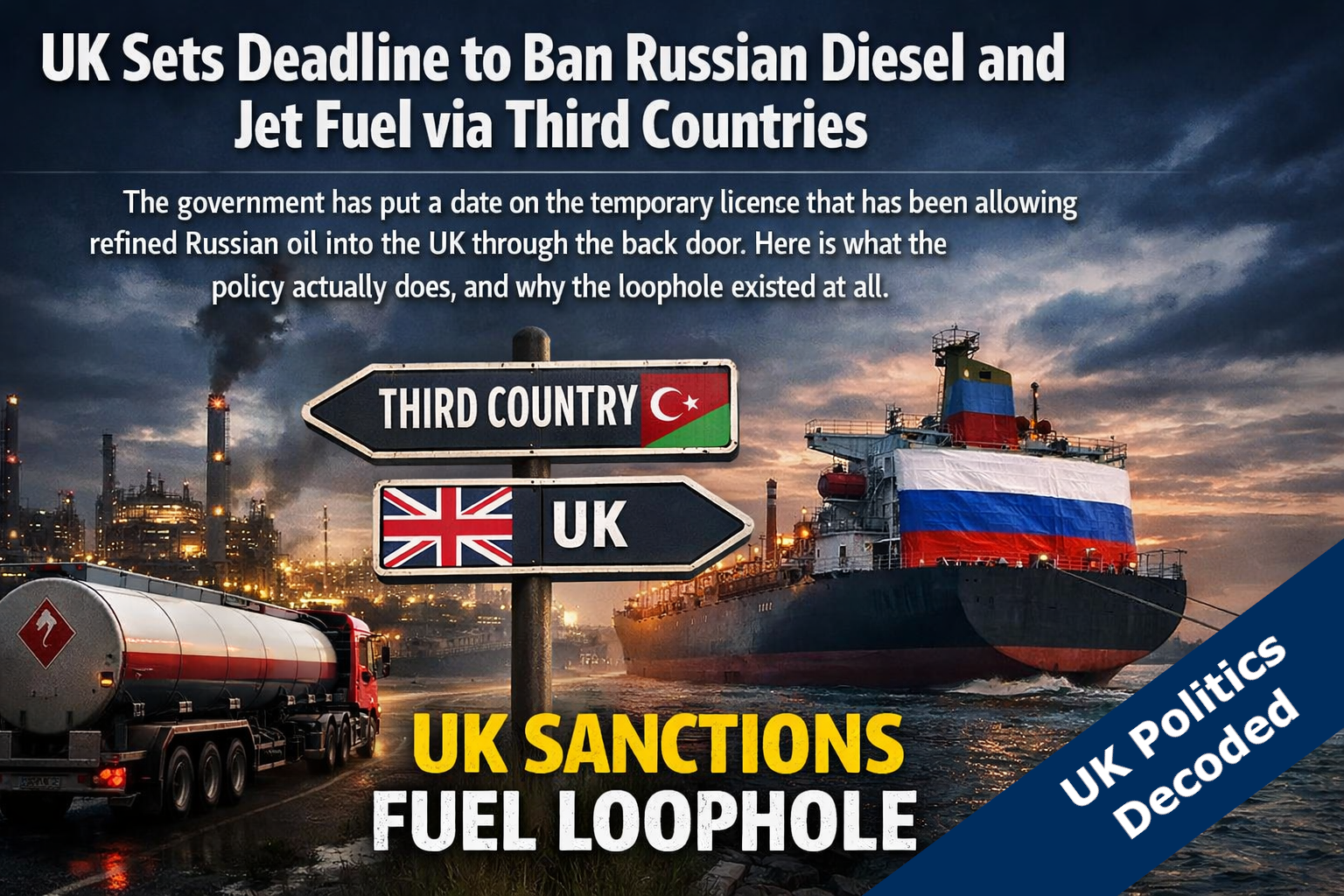
On 12 June 2026, the government confirmed that a temporary licence allowing the continued import of diesel and jet fuel refined from Russian crude oil will expire no later than 1 January 2027. The announcement puts a hard deadline on what had been a deliberately vague transition arrangement, one that drew criticism for leaving a significant gap in sanctions coverage.
The backdrop matters. Since Russia's full scale invasion of Ukraine in 2022, the UK has progressively tightened its sanctions on Russian energy. Direct imports of Russian crude oil and refined products were banned some time ago. But there was always a more complicated question lurking underneath, what about oil that starts as Russian crude, gets processed in a third country say, India or Turkey and then arrives in the UK carrying a different country of origin? Until May 2026, that route remained open.
Key Points at a Glance
- On 20 May 2026, the UK introduced a new ban on refined oil products made from Russian crude, even when processed in third countries
- A temporary licence was issued alongside the ban to give supply chains time to adjust
- The government has now confirmed the licence will end no later than 1 January 2027
- The licence is being reviewed every two weeks, with the aim of removing it sooner if possible
- Industry will receive at least four months notice of any changes to the licence
- The UK has now sanctioned over 3,300 individuals, businesses and vessels under its Russia regime
On 20 May, the government moved to close that gap, banning refined oil products specifically diesel and jet fuel that were made from Russian crude, regardless of where they were subsequently processed. The measure was part of a broader sanctions package targeting Russia's energy revenues, which also introduced new restrictions on liquefied natural gas maritime services.
But new bans rarely land cleanly. Supply chains need time to find alternative sources, and a sudden cut off risked disrupting fuel markets. So the government also issued a targeted licence, essentially a time limited exemption to allow the continued import of the affected products while businesses adapted. That licence was always described as temporary. The June announcement simply attached a firm date to it.
Trade Minister Chris Bryant told the House of Commons he had committed to reviewing the licence fortnightly and lifting it as soon as practicable. That review process continues, and the government has said it may end the licence before January 2027 if conditions allow. Whatever happens, industry will get at least four months notice before any change takes effect.
There is a genuine policy tension at the heart of this kind of measure. The whole point of sanctions is to maximise economic pressure on Russia. But a hard, immediate cut off on fuel products risks pushing up prices at home, disrupting logistics and aviation, and potentially undermining public support for the broader sanctions effort. The phased approach is a compromise between those two pressures and it is one the government has been transparent about, at least in broad terms.
What the announcement does not resolve is how effectively a ban on third country refined products can actually be enforced. Russia has been resourceful in finding workarounds, moving crude through intermediary countries, using shadow fleets, and routing funds through cryptocurrency networks and obscure financial systems. The UK's broader May sanctions package targeted some of those channels directly, designating 18 entities linked to illicit financial infrastructure including a Kyrgyz bank and a global cryptocurrency exchange suspected of funnelling more than $1.5 billion back into Russian hands.
Those parallel moves reflect an awareness in government that energy bans alone are not enough. Shutting the front door while leaving the back door unguarded simply shifts traffic. The A7 network, a Kremlin backed operation that claimed to have moved more than $90 billion last year illustrates the scale of the parallel economy Russia has built to bypass Western restrictions.
The UK's position, at least on paper, is one of progressive tightening rather than symbolic gesture. Having sanctioned over 3,300 individuals, businesses and vessels, the government argues that international sanctions have collectively deprived Russia of more than $450 billion, roughly equivalent to two years of military expenditure at current levels. Whether those numbers translate into meaningful constraint on the war in Ukraine is a harder question, and not one the press release attempts to answer.
For businesses that have been importing diesel or jet fuel refined from Russian crude via third countries, the 1 January 2027 date provides the planning certainty they asked for. The six month window is not generous, but it is predictable, which in this area of policy is something.
The wider question is whether the fortnightly review process leads to an earlier end date, or whether the January deadline becomes the de facto target. Government language about lifting the licence "as soon as practicable" has a familiar ring to it. Practicable, in policy terms, often turns out to be later than it sounds.