🔎 Series Recap: What We've Learned
- Part 1 (Industrial Spiral): UK industry trapped in wage-cost-price cycle, compounded by energy profiteering and tax bias against production
- Part 2 (Small Business Cliff Edge): Entrepreneurs face cliff-edge taxation hitting before cash flow stabilizes, tipping viable firms into collapse
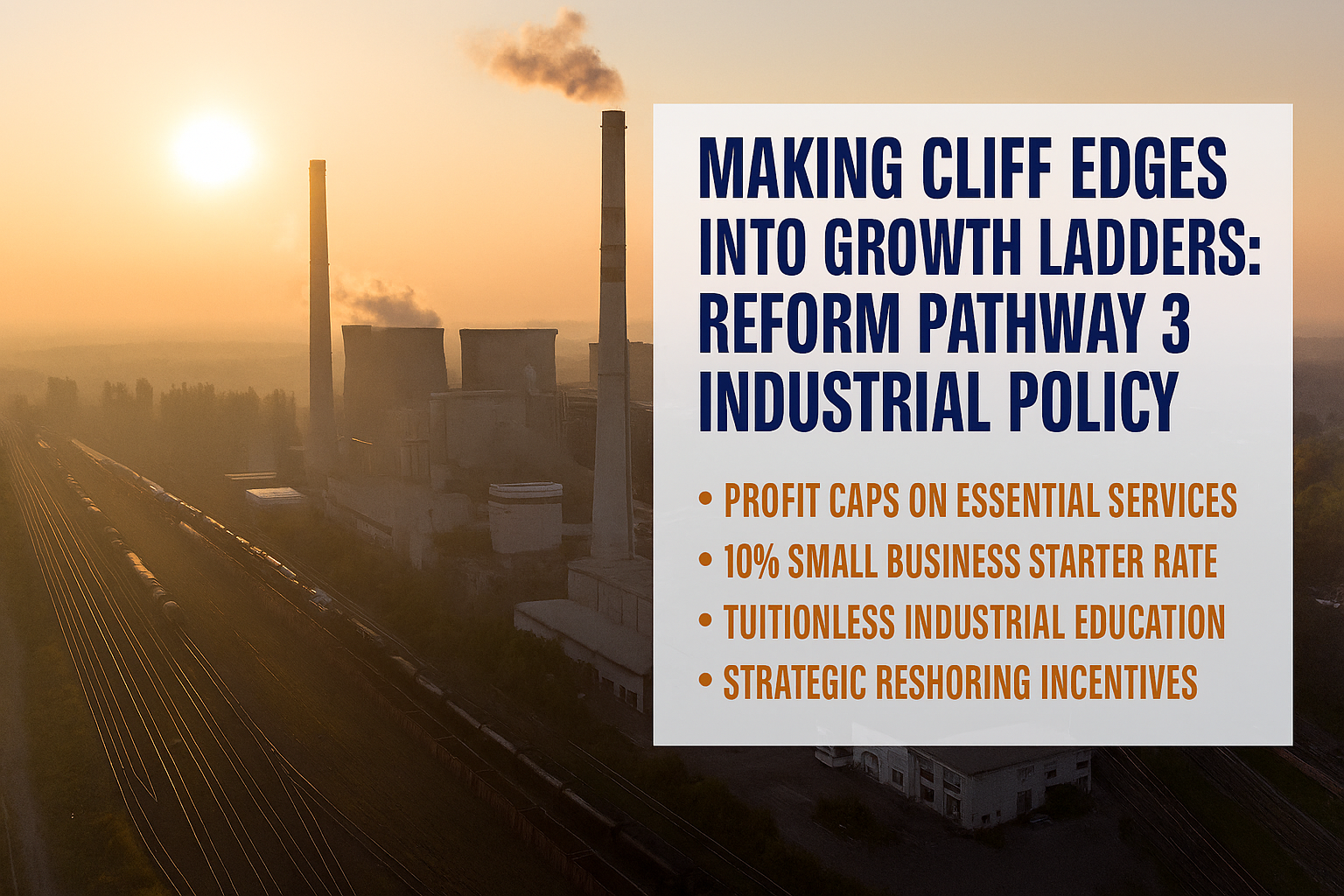
- Part 3 (Solutions): Comprehensive reform pathway from cliff edge to growth ladder, prioritizing long-term economic health over short-term Treasury receipts
The Reform Imperative: Why Change Must Come Sooner Than Later
The UK faces a window of opportunity that is closing. Each year of delay allows more industrial capacity to relocate permanently overseas, more small businesses to collapse under tax pressures, and more regions to lose their productive economic base. The choice is stark: implement comprehensive reform now, or accept deindustrialization and small business sector decline.
The Compounding Crisis
The problems identified in Parts 1 and 2 are accelerating, creating cumulative damage that becomes harder to reverse with time:
- Industrial Capacity Loss: Each plant closure takes specialized equipment, skilled workers, and supply chain links offshore permanently.
- Skills Exodus: Experienced manufacturing workers retrain into service sectors or emigrate, eroding the UK’s industrial skill base.
- Small Business Collapse: Entrepreneurs are discouraged by VAT cliff edges and compliance burdens, reducing new business formation.
- Regional Economic Hollowing: Industrial towns lose their economic anchors, driving unemployment, social instability, and political discontent
- Innovation Drain: R&D and product development follow production overseas, weakening domestic innovation ecosystems.
- Strategic Vulnerability: Critical supply chains becoming dependent on potentially adversarial or unstable regions.
International Competition Intensifies
While the UK debates reform, competitor nations are implementing aggressive policies to attract investment and manufacturing:
- United States: Inflation Reduction Act providing massive subsidies for green technology manufacturing
- European Union: Green Deal Industrial Plan offering state aid for clean technology production
- Germany: Industrial energy support packages protecting manufacturing competitiveness
- South Korea: K-Semiconductor Belt project with $470 billion in government support
- China: Continued state-directed investment in strategic manufacturing sectors
The Economic Multiplier Effect
Successful reform would create positive feedback loops that amplify benefits across the economy:
- Employment Growth: Each manufacturing job typically supports 3-4 additional service sector positions
- Tax Base Expansion: More businesses surviving longer generates exponentially more tax revenue over time
- Innovation Acceleration: Manufacturing and R&D clustering creates competitive advantages
- Regional Revival: Industrial towns becoming attractive to young entrepreneurs and skilled workers
- Export Growth: Competitive domestic production reducing trade deficits and generating foreign exchange
Reform Pathway 1: Energy Market Transformation
Energy costs are the foundation of industrial competitiveness. Without affordable, predictable power prices, manufacturing cannot compete with countries that prioritize industrial energy access over energy company profits.
Essential Service Profit Cap Framework
The centerpiece of energy reform must be profit caps that restore industrial competitiveness while maintaining investment incentives:
10% Profit Cap Implementation
Core Principle: Maximum 10% margin above verifiable wholesale costs for essential services
- Scope: Electricity generation, gas supply, water services, essential food like budget ranges of supermarkets, and essential transport infrastructure
- Calculation Method: Audited wholesale input costs plus 10% margin for operational efficiency and profit
- Investment Incentives: Additional returns up to 20% allowed for genuine infrastructure investment projects
- Innovation Rewards: Efficiency gains through technology adoption can be retained for 5 year periods
- Regional Variation: Different caps reflecting genuine cost differences between regions
- Transparency Requirements: Monthly public reporting of cost structures and profit calculations
Industrial Energy Tariff System
Manufacturing businesses require predictable, affordable energy pricing to plan investments and compete internationally:
Manufacturing Energy Support
- Industrial Tariffs: Industrial users get discounted tariffs, but the government could subsidise the difference.
- Long-term Contracts: 5-10 year price agreements allowing businesses to plan major investments
- Peak Load Management: Incentives for flexible consumption reducing grid stress and costs
- Renewable Direct Access: Manufacturers able to contract directly with wind and solar farms
- Combined Heat and Power: Support for industrial energy efficiency through cogeneration
- Energy Storage Incentives: Battery systems allowing manufacturers to optimize energy timing especially during peak demand.
Windfall Profit Redistribution
Excess energy sector profits should fund industrial development rather than shareholder enrichment:
Industrial Development Fund
- Revenue Source: Windfall taxation on energy profits exceeding 12% margins
- Manufacturing Grants: Direct support for energy intensive production returning to the UK
- Infrastructure Investment: Grid improvements specifically supporting industrial users
- Research Support: Funding for industrial energy efficiency and innovation projects
- Regional Distribution: Prioritizing former industrial areas for economic revival
- Small Business Access: Micro-grants for energy efficiency improvements in small manufacturers
Strategic Energy Independence
Reducing dependence on volatile international energy markets through domestic capacity expansion:
- Nuclear Acceleration: The UK government has committed to small modular reactors (SMRs), with Rolls Royce leading development. Planning and regulatory pathways are being streamlined, though commercial deployment is still years away.
- Renewable Expansion: - The UK is already a global leader in offshore wind, with projects like Dogger Bank. Grid upgrades are being planned, but industrial specific pricing and access remain limited.
- Energy Storage Investment: Grid‑scale battery projects are underway (e.g., in Yorkshire and Scotland), but capacity is still modest compared to future needs.
- Heat Pump Manufacturing: Domestic production is being encouraged, with government targets for 600,000 installations per year by 2028. UK based manufacturing capacity is growing but still heavily reliant on imports.
- Critical Mineral Security: The UK has launched a Critical Minerals Strategy (2022), focusing on securing supply chains and exploring domestic processing. Strategic reserves are in planning, but not yet at scale.
These initiatives exist in fragments today. Reform means joining them into a coherent industrial energy strategy one that ensures predictable, affordable power for UK manufacturing while reducing geopolitical vulnerability.
Reform Pathway 2: Tax System Rebalancing
The UK tax system must shift from punishing productive investment toward supporting entrepreneurship and manufacturing competitiveness. This requires eliminating cliff edges while rebalancing the burden away from productive activity.
Small Business Starter Rates
New businesses require breathing room during their critical early development phase:
Starter Corporation Tax Framework
- Rate Structure: 10% on first £50,000 profit, 15% on £50,000-£100,000, 19% above £100,000
- Duration: Available for first 3 years of trading, with year 4 transition to standard rates
- Eligibility: New companies with fewer than 10 employees and under £250,000 annual revenue
- Anti-Avoidance: Rules preventing established businesses from claiming startup status through restructuring
- Manufacturing Bonus: Additional 2% reduction for businesses engaged in physical production
- Innovation Credits: R&D expenditure qualifying for enhanced deductions during startup phase
Employment Tax Holiday
Eliminating the penalty for job creation during the crucial early growth phase:
National Insurance Employment Support
- NICs Holiday: Zero employer National Insurance for first 24 months of employment
- Job Creation Incentive: Graduated reintroduction over months 25-36 to avoid cliff edge
- Apprenticeship Enhancement: Extended 36 month holiday for businesses training apprentices
- Youth Employment Bonus: Additional 12 month extension for employing under-25s
- Regional Variation: Longer holidays in areas with high unemployment or industrial decline
- Manufacturing Priority: Enhanced support for production-sector employment
VAT Threshold and Rate Reform
Eliminating the most destructive cliff edge in UK business taxation:
Graduated VAT Implementation
- Raised Threshold: VAT registration threshold increased from £90,000 to £150,000
- Graduated Rates: 5% VAT on turnover £90,000-£100,000, 10% on £100,000-£125,000, 15% on £125,000-£150,000, 20% above £150,000
- Voluntary Registration: Businesses able to register early if beneficial for supply chain or export
- Simplified Accounting: Flat rate schemes available to all small businesses with annual turnover adjustments
- Manufacturing Exemption: Extended thresholds for businesses engaged in physical production
- Export Support: Simplified VAT procedures for businesses developing export markets
Compliance Simplification
Reducing the administrative burden that consumes small business resources:
Small Business Administrative Relief
- Reporting Frequency: Annual instead of quarterly returns for businesses under £150,000 turnover
- Simplified Records: Basic record keeping requirements for micro businesses under £50,000
- Digital Support: Free government provided accounting software for small businesses
- Professional Advice: Subsidized accountancy support grants for first-time business owners
- Error Tolerance: Warning system instead of immediate penalties for minor compliance mistakes
- Language Support: Multi-language guidance supporting diverse entrepreneurship
Investment Tax Incentives
Encouraging productive capital investment over financial speculation is essential to rebuilding the UK’s industrial base and supporting small business growth. A targeted incentive framework would reward firms that invest in equipment, innovation, and regional regeneration.
- Manufacturing Capital Allowances: 150% deduction for purchases of industrial equipment, accelerating modernisation and productivity.
- R&D Enhancement: 200% deduction for research and development expenditure, incentivising innovation and technology leadership.
- Green Technology Incentives: Additional allowances for energy‑efficient production equipment, aligning industrial revival with net‑zero goals.
- Reshoring Grants: Direct cash payments for companies relocating production back to the UK, rebuilding domestic supply chains.
- Regional Investment Zones: Enhanced tax relief in former industrial areas, encouraging regeneration and balanced regional growth.
Reform Pathway 3: Industrial Policy and Reshoring
Active government policy can reverse decades of deindustrialisation through targeted support for strategic sectors and systematic reshoring initiatives. The UK must identify industries where it can achieve global competitive advantage and concentrate resources accordingly.
Strategic Industry Identification
Government support should focus on sectors with high growth potential, strong multiplier effects, and strategic importance:
Priority Manufacturing Sectors
- Automotive: Electric vehicle production, battery manufacturing, and autonomous vehicle technology
- Semiconductors: Chip design and specialized semiconductor manufacturing for AI and quantum computing
- Green Technology: Wind turbine components, solar panel manufacturing, and energy storage systems
- Aerospace: Advanced materials, jet engine components, and space technology
- Pharmaceuticals: Active pharmaceutical ingredients and advanced drug manufacturing
- Defense Technology: Advanced weapons systems, cybersecurity hardware, and military electronics
Reshoring Incentive Programs
Systematic support for companies bringing production back to the UK is essential to rebuild domestic supply chains, strengthen industrial capacity, and reduce dependence on fragile international markets.
Manufacturing Return Initiative
- Capital Grants: Up to £2 million per project for equipment purchases and facility investment.
- Training Support: Government funding for worker retraining and skills development, ensuring a ready labour force.
- Site Preparation: Public investment in industrial site remediation and infrastructure upgrades to make locations viable.
- Regulatory Fast-track: Accelerated planning and permitting processes to cut delays and reduce costs.
- Energy Guarantees: Long term industrial energy contracts at competitive rates, giving manufacturers predictable pricing.
- Export Finance: Government backed loans and insurance to support manufacturing exports and global competitiveness.
Supply Chain Development
Rebuilding domestic supply chains is essential to support advanced manufacturing and ensure that reshoring initiatives translate into long‑term competitiveness. A joined‑up approach strengthens supplier networks, logistics, and innovation capacity.
- Supplier Networks: Programs connecting large manufacturers with UK based suppliers, fostering domestic procurement and reducing reliance on imports.
- Quality Certification: Government support for small manufacturers to achieve international quality standards, enabling them to compete in global markets.
- Logistics Investment: Strategic upgrades to freight rail, ports, and intermodal hubs to reduce transport costs and improve reliability.
- Digital Integration: Adoption of Industry 4.0 technologies across supply chains, including IoT monitoring, predictive analytics, and digital twins.
- Regional Clusters: Geographic concentration of related manufacturing activities to create innovation ecosystems and economies of scale.
Innovation and Research Integration
Linking university research with manufacturing applications is essential to drive innovation, accelerate technology adoption, and retain talent in the UK. A network of Manufacturing Innovation Hubs would bridge the gap between academic research and industrial application.
Manufacturing Innovation Hubs
- University Partnerships: Co-location of research facilities with manufacturing plants
- Catapult Centers: Expansion of manufacturing technology demonstration facilities
- Startup Incubators: Support for technology companies developing manufacturing innovations
- International Collaboration: Partnerships with leading manufacturing research centers globally
- IP Development: Support for patent development and technology commercialization
- Talent Retention: Programs keeping top graduates in UK manufacturing careers
Skills and Education Revolution
Industrial revival requires massive expansion of technical education and apprenticeship programs to create the skilled workforce needed for advanced manufacturing.
Technical Education Expansion
Rebuilding the technical education system to support manufacturing careers:
National Skills Strategy
- Further Education Investment: £5 billion expansion of technical college capacity
- Advanced Apprenticeships: 100,000 new manufacturing apprenticeship places annually
- Industry Integration: Technical curricula designed directly with manufacturing employers
- Regional Focus: Skills centers located in former industrial areas needing economic revival
- Adult Retraining: Massive programs for workers transitioning from declining sectors
- International Standards: Technical qualifications recognized globally to support export manufacturing
University-Industry Integration
Aligning higher education with manufacturing innovation needs:
- Engineering Expansion: Doubling engineering graduate numbers over 5 years
- Manufacturing Research: Research funding prioritizing manufacturing applications
- Industry Placement: Mandatory industry experience for engineering students
- Continuing Education: Part time degree programs for working manufacturing professionals
- International Recruitment: Targeted immigration programs for manufacturing skills
Youth Engagement Programs
Changing perceptions of manufacturing careers among young people:
- School Workshops: Hands on manufacturing experiences in secondary schools
- Career Guidance: Professional manufacturing career advisors in schools
- Industry Visits: Regular student visits to advanced manufacturing facilities
- Competition Programs: Manufacturing and engineering competitions with significant prizes
- Mentor Networks: Experienced manufacturing professionals mentoring students
The Economic Payoff: Modeling Reform Benefits
Comprehensive analysis of these reforms suggests transformational economic benefits that far exceed the initial Treasury cost of implementation. By eliminating cliff edges and reducing startup burdens, the UK can dramatically improve business survival, employment, and regional regeneration.
Business Survival Rate Improvements
Eliminating cliff edges and reducing startup costs could dramatically improve business survival statistics:
- First Year Survival: Increase from 80% to 90% through reduced tax pressures and simplified compliance
- Five Year Survival: Increase from 40% to 60% through graduated tax introduction and support programs
- Employment Impact: Each additional surviving business creating 2-3 jobs over 5-year period
- Regional Concentration: Improved survival rates particularly benefiting former industrial areas
- Sector Diversity: More viable businesses across manufacturing, retail, and advanced services
Manufacturing Revival Projections
Industrial policy and energy reform could reverse decades of manufacturing decline:
- Production Growth: 15-20% increase in manufacturing output over 5 years
- Employment Recovery: 300,000-500,000 new manufacturing jobs over decade
- Productivity Gains: Advanced manufacturing achieving higher productivity than traditional sectors
- Export Growth: Competitive domestic production replacing imports and developing export markets
- Innovation Acceleration: Manufacturing and R&D clustering creating competitive advantages
Tax Revenue Analysis
Lower startup tax rates could generate higher total revenue through business survival and growth:
Revenue Impact Modeling
- Short-term Cost: £8-12 billion annually in reduced immediate tax receipts
- Medium-term Recovery: Revenue neutral within 3-4 years as business survival improves
- Long-term Gains: 15-25% higher tax revenue within decade through larger business base
- Employment Taxes: More jobs generating substantially more income tax and NICs
- Consumer Spending: Higher employment driving increased VAT revenue
- Corporate Tax Growth: Successful businesses eventually graduating to higher tax brackets
Regional Economic Revival
Manufacturing and small business recovery could transform struggling regions:
- Employment Growth: Industrial areas gaining 20,000-50,000 jobs each over decade
- Property Values: Industrial land and housing becoming valuable again
- Service Sector Growth: Manufacturing employment supporting 3x additional service jobs
- Young Talent Retention: Career opportunities keeping graduates in industrial regions
- Infrastructure Investment: Private investment following successful manufacturing revival
Overcoming Political Resistance
Reform will face predictable opposition from interests that benefit from the current system. Success requires building broader coalitions, demonstrating benefits quickly, and addressing stakeholder concerns with credible strategies.
Treasury Revenue Concerns
Addressing government fears about short term revenue reduction:
Treasury Engagement Strategy
- Pilot Program Evidence: Demonstrating revenue neutrality through regional pilots
- Dyn Modeling: Sophisticated analysis showing long term revenue benefits
- International Precedents: Evidence from Estonia, Ireland, and Germany on growth-oriented tax policy
- Staged Implementation: Gradual rollout allowing revenue impact monitoring
- Alternative Revenue Sources: Windfall taxes and speculation taxes offsetting startup relief
- Economic Growth Dividend: Demonstrating how manufacturing revival increases overall tax base
Energy Sector Opposition
Companies benefiting from excessive profit margins will resist reform. Their concerns can be managed by balancing fairness with incentives:
- Investment Protection: Guaranteeing reasonable returns for genuine infrastructure investment
- Innovation Incentives: Allowing higher returns for efficiency improvements and technology adoption
Transition Timeline: Phased implementation allowing business model adaptation - Public Support: Demonstrating popular backing for affordable energy through polling
- International Examples: Showing how other countries successfully regulate essential service profits
Large Business Resistance
Established companies may fear increased competition from a revitalised SME sector. These concerns can be reframed as opportunities:
- Supply Chain Benefits: Demonstrating how healthy small business sector supports large company operations
- Innovation Partnerships: Creating opportunities for large companies to work with innovative startups
- Export Growth: Showing how manufacturing revival benefits entire business ecosystem
- Skilled Workforce: Highlighting how technical education expansion benefits all employers
- Infrastructure Improvements: Demonstrating how industrial policy benefits established companies
International Models: Learning from Success
The proposed reforms draw on proven approaches from countries that have successfully maintained or rebuilt industrial competitiveness through smart policy design. Each case demonstrates how targeted interventions can transform national economies.
Estonia: The Startup Nation Model
Estonia's transformation from Soviet republic to digital economy leader demonstrates the power of growth-oriented tax policy:
Estonian Success Factors
- Reinvestment Incentive: Zero corporate tax on retained earnings encouraging business growth
- Digital Infrastructure: Government investment in digital systems reducing business compliance costs
- Startup Support: Simplified business registration and operation procedures
- International Orientation: Tax and regulatory system designed to attract global investment
- Innovation Focus: Government policy prioritizing technology development and commercialization
- Results: GDP per capita increased 340% since 1995, becoming known as "the startup nation"
Germany: Industrial Ecosystem Preservation
Germany's Mittelstand model demonstrates how policy can maintain manufacturing competitiveness:
German Manufacturing Support
- Energy Cost Management: Industrial electricity pricing designed to maintain manufacturing viability
- Technical Education: World-leading apprenticeship system producing skilled manufacturing workers
- Regional Balance: Manufacturing distributed across regions rather than concentrated in single areas
- Long-term Finance: Banking system oriented toward productive investment rather than speculation
- Export Orientation: Government support for manufacturing exports and international competitiveness
- Results: Manufacturing remains 20% of GDP vs 10% in UK, maintaining high-wage industrial employment
Ireland: Competitive Tax Strategy
Ireland's economic transformation through strategic tax policy offers lessons for the UK:
Irish Development Model
- Corporate Tax Competitiveness: 12.5% rate attracting international investment and domestic growth
- Education Investment: Massive expansion of higher education producing skilled workforce
- Infrastructure Development: Government investment in transport, energy, and digital infrastructure
- EU Integration: Using EU membership to access markets while maintaining tax competitiveness
- Innovation Support: R&D tax credits and grants supporting technology development
- Results: GDP per capita increased from 60% to 140% of EU average since 1990
South Korea: Strategic Industrial Development
South Korea's transformation from agricultural to industrial economy demonstrates the power of strategic government intervention:
- Sectoral Priorities: Government identification and support of strategic industries
- Technology Transfer: Active policies to acquire and develop industrial capabilities
- Infrastructure Investment: Massive public investment in industrial infrastructure
- Education Alignment: Technical education closely aligned with industrial development needs
- Export Promotion: Government support for industrial export development
- Results: GDP per capita increased from $1,200 to $35,000 since 1980
Conclusion: A Call to Courage
This series has revealed a systematic failure of economic policy design. Part 1 showed how wage cost spirals, energy profiteering, and tax bias against production create industrial decline. Part 2 demonstrated how cliff edge taxation destroys small businesses at their moment of promise. Part 3 has presented comprehensive solutions: energy market reform, tax system rebalancing, and active industrial policy.
The choice facing Britain is stark. Continue with a system designed to extract maximum short term revenue while watching productive capacity relocate overseas, or implement reforms that prioritize long term economic health over immediate Treasury receipts. Other nations prove this is possible Estonia's startup success, Germany's manufacturing strength, and Ireland's competitive transformation demonstrate that policy design determines economic outcomes.
The technical solutions are clear. Cap essential service profits at 10% above wholesale costs. Introduce starter corporation tax rates and National Insurance holidays. Eliminate VAT cliff edges through graduated rates. Support strategic manufacturing sectors through targeted investment. Expand technical education and apprenticeships. These are not radical proposals they are proven approaches adapted from successful economies worldwide.
The political challenge is building the coalition and public support necessary to overcome vested interests. Energy companies earning excessive profits, Treasury officials focused on immediate revenue, and large corporations benefiting from reduced competition will resist change. Success requires demonstrating that reform benefits the broader economy even if it reduces returns for narrow interests.
The economic prizes are enormous. Business survival rates could improve from 40% to 60% over five years. Manufacturing employment could grow by 300,000-500,000 jobs over a decade. Regional economies hollowed out by deindustrialization could experience revival. Tax revenue could increase by 15-25% within a decade through a larger business base rather than higher rates on struggling enterprises.
The social benefits would be equally transformative. Young people in former industrial areas would have career opportunities beyond minimum wage service jobs. Entrepreneurs would face growth ladders rather than cliff edges. Regions dependent on declining industries would gain economic diversification and resilience. The UK would regain strategic independence in critical sectors rather than depending on potentially hostile nations for essential goods and the cost of living crisis will be addressed.
Time is running out. Each year of delay allows more industrial capacity to relocate permanently overseas, more small businesses to collapse under tax pressures, and more skilled workers to emigrate or abandon productive careers. The capability to rebuild becomes harder as the remaining industrial base and skills network deteriorates.
The technology exists. The workers can be trained. The market opportunities are real. International examples prove success is possible. What's missing is political courage to prioritize long term economic health over short term political convenience and Treasury revenue.
Reform means shifting from cliff edges to growth ladders, from taxing ambition out of existence to nurturing it into sustainable prosperity. It means accepting that supporting business success creates larger tax bases than squeezing struggling enterprises. It means choosing industrial competitiveness over energy company profits, entrepreneurship over bureaucratic control, and regional revival over London-centric service sector dominance.
The choice is Britain's to make. Continue on the current trajectory toward complete deindustrialization and small business sector collapse, or implement the reforms necessary to rebuild a competitive, innovative, and regionally balanced economy.
It is time to make Britain manufacture again. It is time to support entrepreneurs rather than destroying them. It is time to choose long-term prosperity over short-term revenue extraction. It is time for the political courage to implement the reforms that can restore British economic leadership.
The diagnosis is complete. The solutions are clear. The choice awaits.