AI Use: AI tools were used to support source discovery and to structure the article for clarity. All research, verification, drafting, and final editorial decisions are fully human led. Learn about our AI policy.
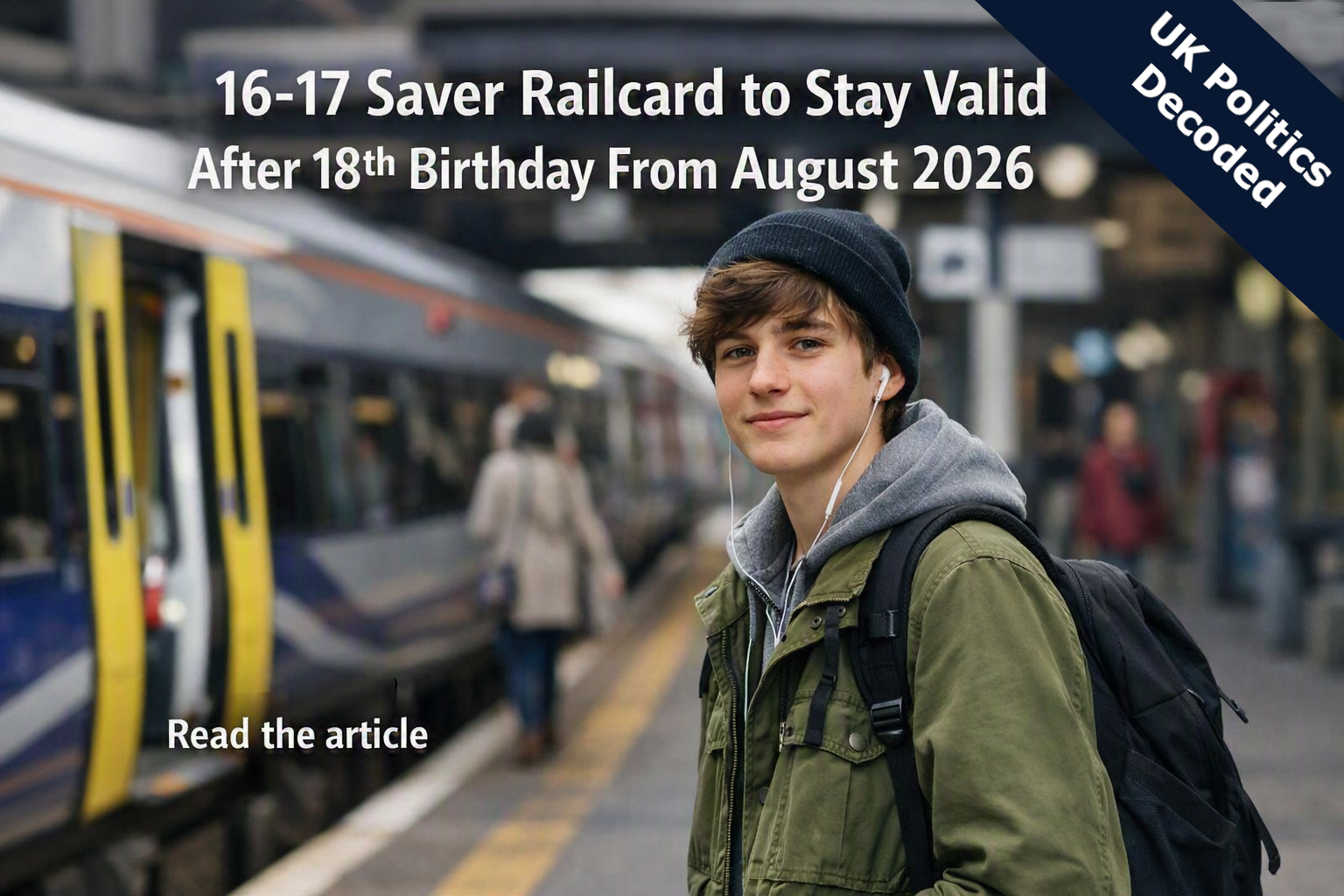
The 16-17 Saver railcard will remain valid for a full 12 months from the date of purchase, even if the holder turns 18 during that period. The change takes effect from 17 August 2026 and applies to new and renewed cards. It was announced by the Department for Transport on 3 August 2026, ahead of the new academic year.
Under the previous rules, the card expired when the holder turned 18 regardless of when it was bought. That meant a student who purchased a card shortly before their birthday could lose the benefit after just a few weeks. According to the Department for Transport, more than 70,000 cardholders were affected in the past year alone, losing an average of £175 in discounted fares compared to peers whose cards ran for the full year.
At a glance
- Change date: Takes effect 17 August 2026, in time for the new academic year
- New rule: 16-17 Saver cards valid for 12 months from purchase, not capped at the 18th birthday
- Who benefits: Students still in education or training who turn 18 during the card's validity period
- Estimated saving: Average of £175 for each previously affected cardholder, per Department for Transport analysis
- Scale: More than 70,000 cardholders were affected under the old rules each year
From the 17 August the 16-17 Saver card is valid for exactly 12 months from the date of purchase, matching the approach already used by the 26-30 Railcard. There is no longer any provision that automatically ends the card on the holder's 18th birthday.
To buy a 16-17 Saver, the holder must be aged 16 or 17 at the time of purchase and in education or training. This does not change. What changes is the duration, once purchased, the card runs for the full year.
Practical examples
- Card bought in August 2026, turns 18 in October 2026: Card now remains valid until August 2027, previously it would have expired in October
- Card bought in January 2027, turns 18 in February 2027: Card valid until January 2028, previously it would have lapsed within weeks
- Card bought at 16, no birthday until 17: No change, these cardholders already received the full year under the old rules
- Renewal: Cards can be renewed while the holder is still 16 or 17 at point of purchase, the same 12 month validity applies
- Other concessions: The 50% discount applies to most standard and advance fares on National Rail, existing terms on excluded services remain in place
The Department for Transport published a methodology note alongside the announcement. It used ticket sales data from the LENNON settlement system, the industry database that records most National Rail ticket purchases and allocates revenue between train operators.
The calculation identifies the average daily saving a passenger makes using a 16-17 Saver, then multiplies that by the additional days of discounted travel provided under the new rules for each card purchased with less than a full year's validity. The DfT notes that the estimate assumes travel behaviour stays constant and does not account for any changes in journey frequency or ticket choices that might result from the policy.
Rail Minister Lord Peter Hendy described the change as "common sense" and said it supports young people during "a critical time for teenagers, whether they're pursuing further education, vocational pathways or getting their footing in the jobs market."
The National Union of Students Vice President Further Education, Kaynat Ahmad, welcomed the move, noting that transport costs have acted as a barrier to education and training and that the change would ease financial pressure on commuting students.
The railcard change sits alongside a wider government programme of transport affordability measures announced in the run up to the creation of Great British Railways (GBR):
- £2 bus fare cap: From January 2027, single bus fares in England outside London are to be capped at £2, backed by £400 million in government funding
- Rail fare freeze: The government previously announced a freeze on regulated rail fares
- Tap in, tap out expansion: Contactless pay as you go ticketing is being extended beyond London to Manchester, Yorkshire, and the East and West Midlands
- GBR app and website: A single platform is planned to allow passengers to buy tickets, check timetables, and claim Delay Repay in one place
The 16-17 Saver change is a relatively narrow but practical fix to a rule that the Rail Delivery Group, which administers railcards, and the government had identified as an anomaly. It does not require primary legislation, the DfT can implement it through changes to railcard terms and conditions in advance of the GBR transition.
Several aspects of the 16-17 Saver remain unchanged:
- Eligibility age at purchase: Applicants must still be 16 or 17 when they buy the card
- Cost: The card still costs £30 per year
- Discount level: The 50% reduction on most fares remains as before
- Exclusions: Existing exclusions peak restrictions on certain services, minimum fare rules continue to apply
- Geographic coverage: The card is valid across England, Scotland, and Wales on National Rail services
For the students directly affected, this is a straightforward and meaningful fix. A teenager who buys a 16-17 Saver in the spring and turns 18 in the summer has, until now, been paying for a year's worth of discounts they never received. From August 2026, that gap closes.
The wider significance is modest. This is not a structural reform to rail fares, and the financial benefit while real, applies to a specific group, students who happened to buy their railcard close to their birthday. The estimated 70,000 figure covers those who were most disadvantaged by the previous rules.
What it does illustrate is the direction of travel set out by the government ahead of the GBR launch, aligning rail products across the board, removing anomalies, and framing affordability particularly for young people as central to how the railway should work going forward.
Key Takeaways
- From 17 August 2026, the 16-17 Saver railcard is valid for 12 months from the date of purchase, it no longer expires on the holder's 18th birthday
- More than 70,000 students per year were losing part of their 50% rail discount under the old rules, with an average loss of £175 per affected cardholder
- The change aligns the 16-17 Saver with the 26-30 Railcard, which already allowed full 12 month validity from the date of purchase
- Eligibility rules are unchanged, applicants must still be 16 or 17 at the time of purchase and in education or training
- The railcard change is part of a broader package of transport affordability measures ahead of Great British Railways, including the £2 bus fare cap from January 2027
Sources & Further Reading
- GOV.UK - More students to save from September as changes to 16-17 Saver railcard come in (Department for Transport, 3 August 2026) Archived copy (OGL): archived page
- GOV.UK - Estimated passenger savings from change to the 16-17 Saver railcard (Department for Transport, 3 August 2026) Archived copy (OGL): archived page
- GOV.UK - Estimated passenger savings: methodology detail (Department for Transport, 3 August 2026) Archived copy (OGL): archived page
- GOV.UK - Estimated passenger savings: LENNON data used for analysis (Department for Transport, 3 August 2026) Archived copy (OGL): archived page