AI Use & Transparency: AI tools were used to support source discovery and to structure the article for clarity. All research, verification, drafting, and final editorial decisions are fully human led. Learn about our AI policy.
UKPoliticsDecoded is an IMPRESS regulated publisher. Read our editorial standards.
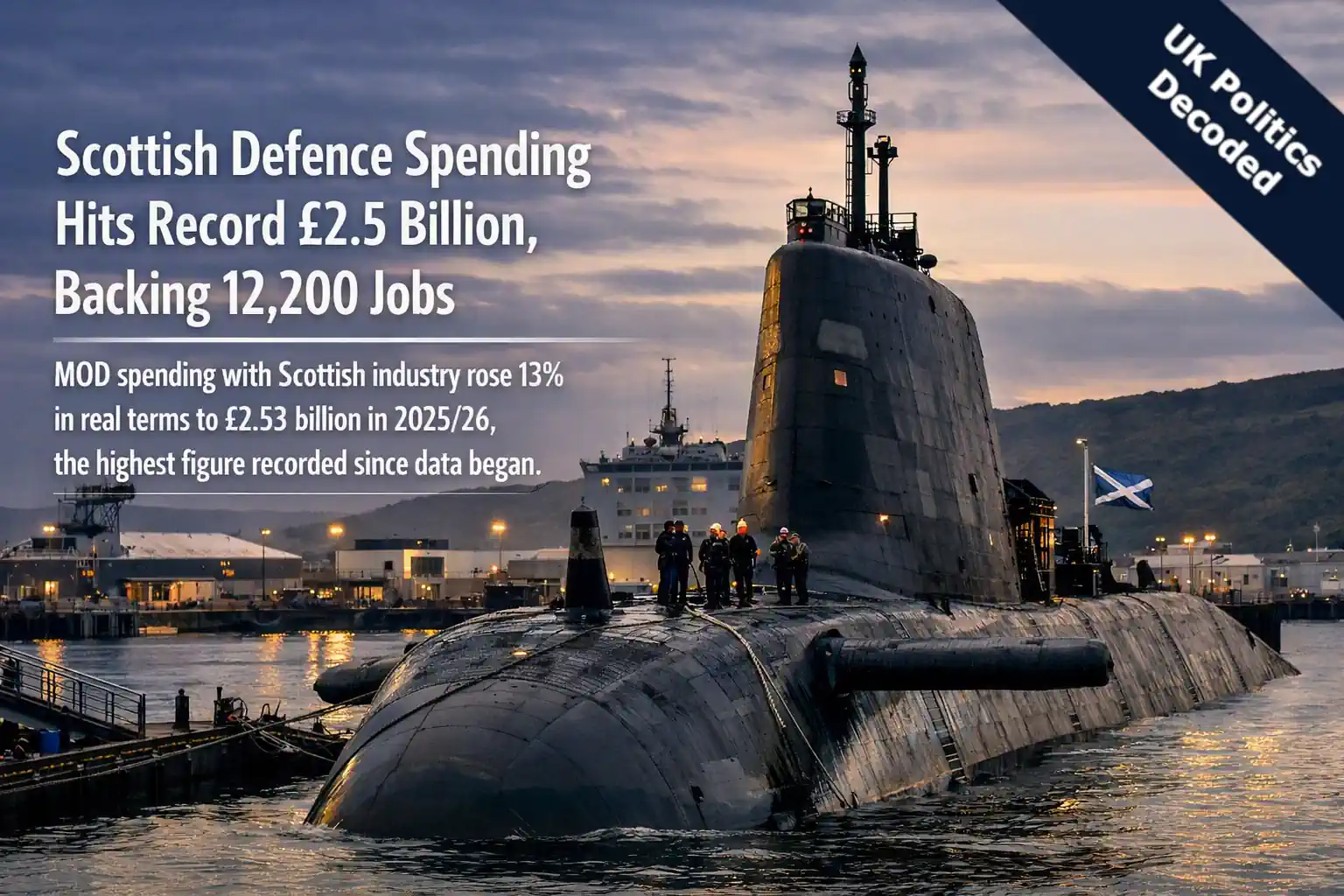
Ministry of Defence spending with Scottish industry climbed to £2.53 billion in 2025/26, a 13% increase in real terms and the highest figure recorded since records began, according to figures published on 24 September 2026. The announcement, made jointly by the Scotland Office and the Ministry of Defence, credits the rise to the government's drive to rebuild Britain's defence industrial base and expand domestic manufacturing capacity.
The increase translates to £460 of MOD spending for every person living in Scotland, up from £390 the previous year. Defence Secretary Wes Streeting and Scottish Secretary Douglas Alexander both framed the figures as evidence that investment in defence is now feeding directly into jobs and growth north of the border, rather than simply funding equipment.
At a glance
- MOD spending with Scottish industry rose 13% in real terms to £2.53 billion in the 2025/26 financial year, the highest figure since records began.
- The total works out at £460 spent for every person living in Scotland, up from £390 a year earlier.
- Investment in the electronics sector rose by 33%, part of a wider push to build sovereign UK manufacturing capability.
- MOD activity supports 12,200 jobs in Scotland, spanning shipbuilding on the Clyde, submarine work at Faslane, and cyber and radar expertise.
- The figures form part of a UK wide Defence Investment Plan committing £298 billion to defence spending over the next four years.
Why Scotland's Defence Spend Just Hit a Record High
The £2.53 billion figure covers the 2025/26 financial year and reflects direct MOD payments to companies and organisations based in Scotland. According to the Ministry of Defence's Regional Expenditure with Industry statistics, published the same day as the announcement, national MOD spending with UK industry as a whole reached £34.1 billion in 2025/26, itself a 3.2% real terms increase and the highest total since 2013/14. Scotland's growth rate outpaced that national trend.
Government ministers linked the rise directly to policy choices rather than a one off contract effect. Streeting said the increase reflects "the biggest sustained increase in defence spending since the Cold War," while Alexander described it as part of a "defence dividend" flowing to Scottish businesses, jobs and skills. Neither minister's statement specified individual contract values behind the Scottish total, and the department has not broken down the £2.53 billion by contract or company for this announcement.
The figures sit within a broader national picture. The MOD's regional expenditure statistics show the sharpest UK wide percentage rise this year was in Northern Ireland, up 63% to £464 million, driven largely by the reallocation of contract data for Fleet Solid Support vessels being built for the Royal Fleet Auxiliary. Scotland's 13% rise was smaller in percentage terms than that outlier but represents a far larger absolute sum.
What the £2.53 Billion Is Actually Buying
The announcement points to a broad spread of Scottish defence capability rather than a single flagship programme. It cites naval shipbuilding on the Clyde and at Rosyth, the UK's nuclear deterrent and submarine support work based at Faslane, and what the government calls "world leading strengths" in cyber, space, advanced radar and electronic warfare.
Nationally, the electronics sector saw a 33% increase in MOD spending in 2025/26, which the government says is helping ensure British industry can deliver "modern capability and resilience" for the armed forces at scale. The department's wider statistics show the Weapons and Ammunition industry group recorded the largest percentage rise of any sector, up 18% nationally to £2.4 billion, linked to increased spending on armoured vehicles including Boxer and Ajax programmes, though those specific contracts are based in the North West and Wales rather than Scotland.
Major employers named in the announcement include BAE Systems, Babcock International and Rolls Royce, alongside the key military sites of HMNB Clyde and RAF Lossiemouth. The statement describes Scotland as home to "a significant defence industrial base" but does not attribute a specific pound figure to any one of these companies individually.
The Jobs Behind the Numbers
The Ministry of Defence says its activity in Scotland directly supports 12,200 jobs, a figure covering the defence footprint across the country rather than jobs created solely in the past year. That sits within a wider UK picture set out separately in the department's Supported Employment Estimates for 2024/25, which found MOD expenditure supported 274,000 direct and indirect jobs across UK industry, up from 248,000 the year before, equivalent to roughly one in every 100 jobs in the country.
Those UK wide figures show the Shipbuilding and Repairing industry, closely tied to work at Clyde and Rosyth, supported 41,500 direct jobs nationally in 2024/25 and a further 32,800 indirect jobs through its supply chain, more indirect employment than any other single industry. The rise was linked partly to contracts for three Fleet Solid Support vessels and continuing work on the Dreadnought submarine programme. Scotland's own contribution to that national jobs total was not broken out separately in the announcement.
How £2.5bn in Scotland Fits Into a £298bn UK Defence Bet
The Scottish figures are presented as one strand of the government's broader Defence Investment Plan, which commits £298 billion to UK defence spending over the next four years. Ministers describe that plan as designed to drive sustained investment across British industry and support what the government calls the "reindustrialisation" of Britain, positioning defence spending as a tool for regional economic growth as much as military readiness.
The announcement does not set out how much of the £298 billion four year total is earmarked specifically for Scotland going forward, nor does it provide a forecast for whether the 13% increase will be sustained in future years. MOD officials have previously cautioned that regional expenditure figures can fluctuate significantly year to year because of the timing of large contract payments, meaning a single year's rise should not automatically be read as a permanent shift.
Key Takeaways
- MOD spending with Scottish industry reached a record £2.53 billion in 2025/26, up 13% in real terms on the previous year.
- That equates to £460 spent for every person in Scotland, compared with £390 the year before.
- The spending supports 12,200 jobs across shipbuilding, submarine support, cyber, space and electronic warfare work.
- Major Scottish defence sites named include HMNB Clyde, Faslane, Rosyth and RAF Lossiemouth, with BAE Systems, Babcock International and Rolls Royce as key employers.
- The rise forms part of a UK wide £298 billion, four year Defence Investment Plan aimed at rebuilding Britain's defence industrial base.
Sources & Further Reading
- GOV.UK - Defence spending with Scottish industry rises above £2.5 billion Archived copy (OGL): archived page
- GOV.UK - MOD Regional Expenditure with Industry 2025/26 Archived copy (OGL): archived page
- GOV.UK - MOD Supported Employment Estimates 2024/25 Archived copy (OGL): archived page