AI Use: AI tools were used to support source discovery and to structure the article for clarity. All research, verification, drafting, and final editorial decisions are fully human led. Learn about our AI policy.
UKPoliticsDecoded is an IMPRESS regulated public interest publisher. Read our editorial standards.
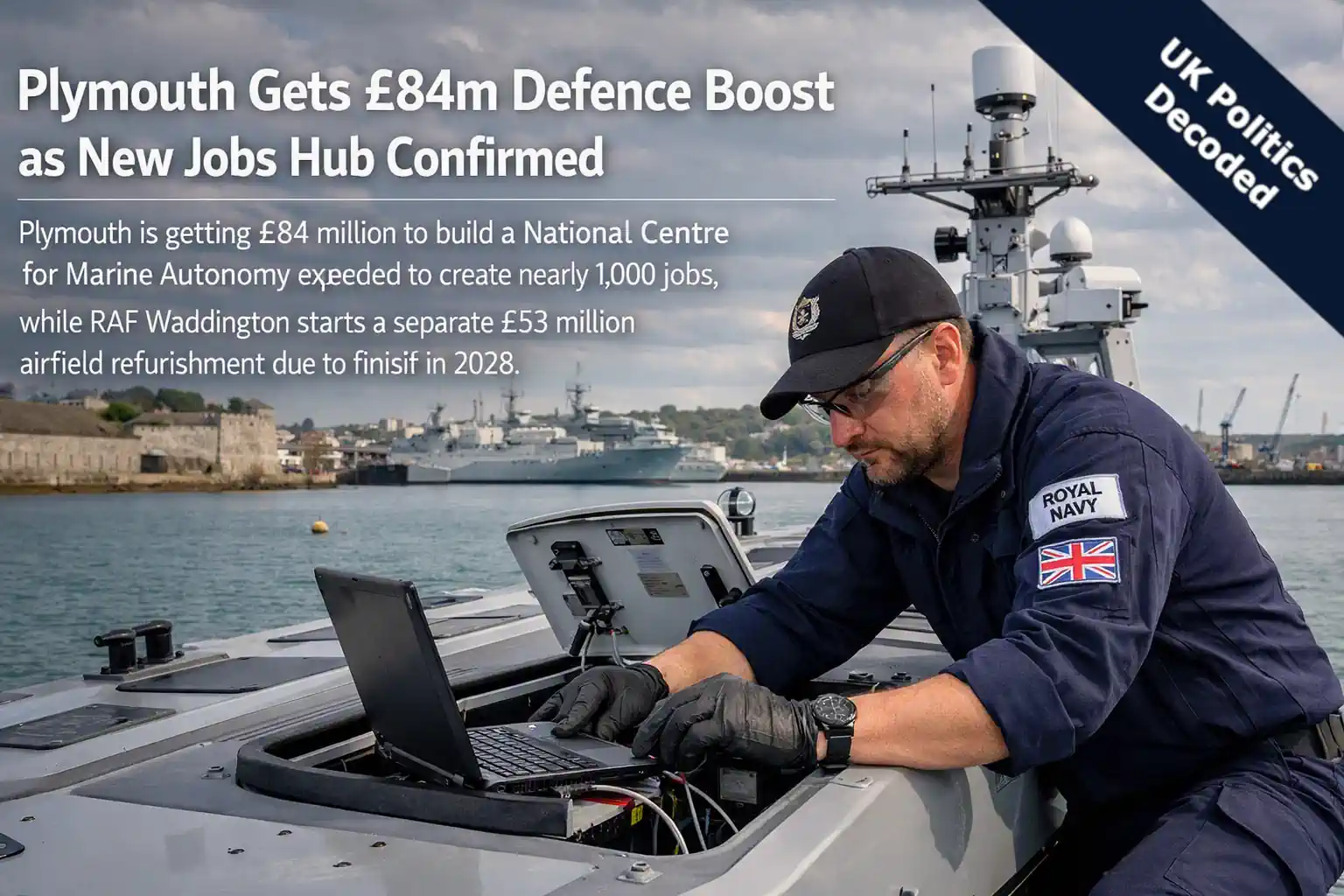
The government has confirmed two separate defence infrastructure projects this week, worth a combined £137 million between them. Defence Minister Lord Vernon Coaker announced £84 million for Plymouth's defence growth plans on 23 September, while the Defence Infrastructure Organisation confirmed a day earlier that work had begun on a £53 million refurbishment of the airfield at RAF Waddington in Lincolnshire.
Neither project is connected to the other, but together they illustrate how the Ministry of Defence is spending on two different fronts at once, backing emerging technology and jobs in the South West while keeping ageing airfield infrastructure serviceable for the RAF's existing fleet.
At a glance
- Plymouth will receive £50 million in government funding through the Defence Growth Deal, unlocking up to a further £34 million from industry and local partners.
- The investment is expected to create nearly 1,000 jobs and help 500 people into work through a new £1.5 million "Get Plymouth Working" scheme.
- A new National Centre for Marine Autonomy is expected to create 120 jobs and attract more than 30 businesses developing autonomous maritime technology.
- Separately, a £53 million refurbishment of the airfield at RAF Waddington began this week and is expected to finish in summer 2028.
- The Waddington project will resurface aircraft bays and taxiways, install new drainage and upgrade approach lighting while flying operations continue.
Why Plymouth Is Becoming a Hub for Marine Autonomy
The £84 million package announced by Lord Coaker combines £50 million from central government with up to £34 million more from industry and local partners, released after Team Plymouth's strategic business case was approved. The funding confirms delivery of the National Centre for Marine Autonomy, a facility the government says is expected to create 120 jobs directly and attract more than 30 businesses, including start ups and scale ups working on autonomous maritime technology.
The centre is designed to position Plymouth as what the Ministry of Defence calls a national leader in defence maritime autonomy, an area covering unmanned vessels, underwater sensors and related robotics used for both military and civilian purposes. More than 400 UK businesses are expected to benefit from the wider programme, according to the department, including firms working in robotics, artificial intelligence and autonomous systems, alongside larger defence contractors already based in the city.
Plymouth already carries significant weight in the UK's defence economy. The Ministry of Defence spent more than £6.6 billion in the South West in the 2024 to 2025 financial year, directly supporting 37,300 industry jobs and channelling almost £400 million to small and medium sized enterprises. A separate £7 billion programme is already under way at HMNB Devonport, described by the department as the largest naval infrastructure investment since the end of the Cold War.
£1.5 Million Scheme Set to Push 500 Plymouth Residents Into Work
Alongside the business investment, the government confirmed a £1.5 million "Get Plymouth Working" scheme intended to help 500 people into jobs across defence, advanced manufacturing, engineering and construction. The scheme is aimed particularly at veterans and young people aged 18 to 25, and the government says around 750 people will gain new technical skills and qualifications as a result. More than 7,000 young people are expected to benefit from associated STEM training.
What the Plymouth Deal Delivers
- £50 million from government, unlocking up to £34 million from industry and local partners.
- A National Centre for Marine Autonomy expected to create 120 jobs and attract 30 plus businesses.
- 500 people supported into work through the "Get Plymouth Working" scheme.
- Regeneration of the Turnchapel waterfront and new industrial and commercial space across the city.
Lord Coaker described the package as investment that "strengthens our national security while backing British jobs, businesses and communities." Sir Chris Gardner, the senior responsible owner for Team Plymouth, called the funding release "a major milestone" for the partners who developed the bid, while Babcock's nuclear chief executive Neal Misell said the deal showed what could be achieved when government, industry, education and local partners work around a shared ambition. During his visit, Lord Coaker toured HMNB Devonport, City College Plymouth and Babcock International, meeting local leaders, educators, businesses and students.
Inside the £53 Million Refurbishment at RAF Waddington
Roughly 250 miles away in Lincolnshire, a separate project got under way this week at RAF Waddington, home to the RAF's Intelligence, Surveillance, Target Acquisition and Reconnaissance Force and the Red Arrows aerobatic team. The Defence Infrastructure Organisation confirmed that a £53 million project to refurbish the base's airfield had started, covering the resurfacing of several aircraft bays and taxiways, new drainage systems and upgraded approach lighting.
The Defence Infrastructure Organisation is delivering the project on behalf of Air Infrastructure for the RAF, with contractor Lagan Aviation & Infrastructure Ltd carrying out the works and Ramboll UK providing technical services. Officials say extensive planning has taken place with RAF units and station staff so that flying operations can continue throughout construction, with completion expected in summer 2028.
Air Commodore Phil Reid, Head of Air Infrastructure, said the project demonstrated continued investment in the RAF's operational capability, describing it as one of a wider programme of airfield infrastructure works already under way. DIO project manager Pete Shaw said the refurbishment would ensure personnel have the facilities they need to train and operate effectively. Robert Weston, project director at Lagan Aviation & Infrastructure, said the works had been planned collaboratively with the station to avoid disrupting existing operations.
Why These Two Defence Deals Reveal Different Spending Priorities
Taken together, the Plymouth and Waddington announcements show a defence budget being split between backing new capability and maintaining existing capability. The Plymouth deal is explicitly about growth, jobs, skills and an emerging technology sector the government wants Britain to lead in. The Waddington project is about resilience, keeping a working RAF station able to fly and fight rather than expanding what it does.
Both projects sit within a broader pattern of regional defence investment announced through 2026, including infrastructure at Devonport, Porton Down and elsewhere, as the Ministry of Defence continues to frame spending decisions around jobs, growth and industrial capacity as much as pure military requirement. Whether that framing continues to define future funding announcements is likely to become clearer as further regional deals, if any, are confirmed later in the year.
Key Takeaways
- Plymouth has secured £84 million to build a National Centre for Marine Autonomy, backed by £50 million from government and up to £34 million from industry.
- The Plymouth investment is expected to create nearly 1,000 jobs and support 500 people into work through the "Get Plymouth Working" scheme.
- Separately, a £53 million refurbishment of the airfield at RAF Waddington began this week, expected to finish in summer 2028.
- The Waddington works cover aircraft bays, taxiways, drainage and approach lighting, and are being carried out while flying operations continue.
- Both projects form part of a wider pattern of regional defence infrastructure spending confirmed by the Ministry of Defence through 2026.
Sources & Further Reading
- GOV.UK - £84 million to boost Plymouth's defence growth plans Archived copy (OGL): archived page
- GOV.UK - RAF Waddington airfield set for major refurbishment in £53 million project Archived copy (OGL): archived page