AI Use: AI tools were used to support source discovery and to structure the article for clarity. All research, verification, drafting, and final editorial decisions are fully human led. Learn about our AI policy.
UKPoliticsDecoded is an IMPRESS regulated public interest publisher. Read our editorial standards.
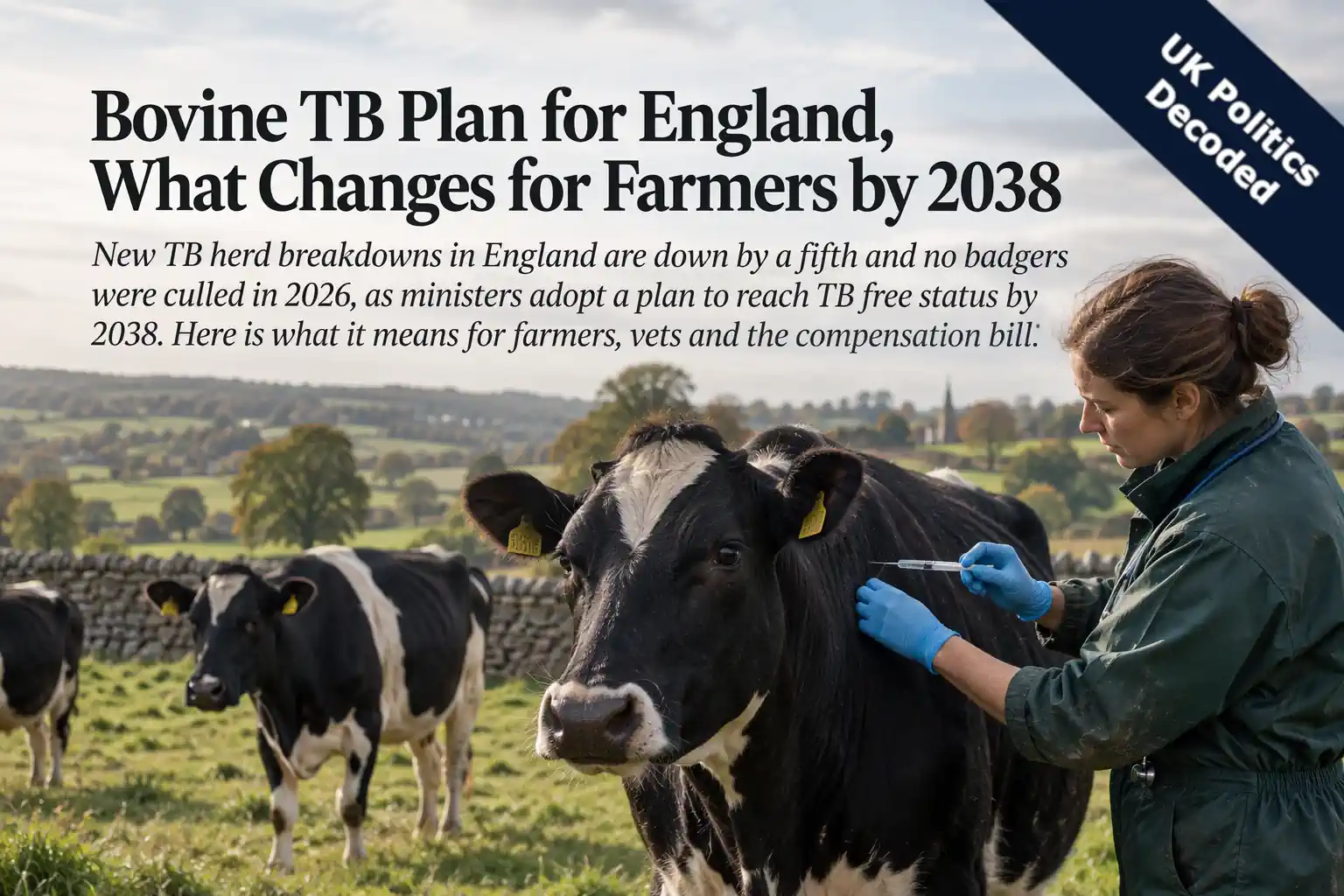
The government has formally adopted a long term strategy to make England Officially Bovine TB Free by 2038, turning a plan drawn up by farmers, vets and scientists in June into official policy. The Department for Environment, Food and Rural Affairs (Defra) announced the decision on 5 November 2026.
The announcement comes with early evidence the government says shows progress, the new TB herd breakdowns in England are down by a fifth on the previous 12 months, and 2026 is the first year in more than a decade in which no badgers were culled as part of disease control. The strategy leans on cattle vaccines, wider testing and a new industry government board, while leaving some of the hardest questions, notably compensation, still open.
Key Points at a Glance
- The government adopted the co-designed bovine TB strategy on 5 November 2026, with the aim of Officially Bovine TB Free status for England by 2038.
- The share of herds under TB restriction in England fell to 3.4% at the end of June 2026, down from 4.2% a year earlier.
- No badgers were culled for disease control in 2026, the first year without culling in more than a decade.
- Defra has an ambition to deploy cattle vaccination by 2030 and has already submitted a marketing authorisation application for the CattleBCG vaccine.
- A new industry government board will replace the Bovine TB Partnership for England, with its first delivery plan due in late spring 2027.
What the bovine TB strategy commits the government to
The strategy itself is not new. It was published in June by the Steering Group of the Bovine TB Partnership for England, after a co-design process involving more than 100 farmers, vets, scientists, industry representatives, government officials and members of the public. What changed on 5 November is its status. Defra now calls it “the government’s plan for tackling bovine TB in England”.
Its target is Officially Bovine TB Free status under World Organisation for Animal Health requirements by 2038. That date traces back to the 2025 Godfray Review, which the strategy says confirmed it as the right ambition. The strategy sets out five priorities, cutting cattle to cattle transmission, making better use of TB data and evidence, preventing infection through innovation and new tools, putting farmers and vets in the driving seat locally, and reducing disease risk from the wider environment.
There is a caveat in the small print. Defra says it will consider the pace and sequencing of delivery “alongside future funding decisions”, and describes its review of each recommendation as an initial assessment rather than a final evaluation. Adoption sets the direction. It does not, on its own, commit money to every measure.
Bovine TB cases fall in England as badger culling ends
The government’s own figures show the disease easing. The percentage of herds under restriction because of a TB incident was 3.4% in England at the end of June 2026, compared with 4.2% at the end of June 2025. Defra says it has been on a declining trajectory in the High Risk Area and England as a whole since 2017, and has fallen sharply in the Edge Area since 2024.
The number of cattle removed for TB control, which covers test reactors and direct contacts, was 20,244 in the 12 months to June 2026. That is 4% lower than the 21,126 removed in the year to June 2025, and well below the historical peak of 34,518 recorded in the 12 months to April 2018.
On badgers, Baroness Hayman of Ullock, the Minister for Biosecurity and Trade, said the plan will “ensure the continuation of the end to badger culling”. The policy paper says that over the summer no culling took place because all licences had either expired or been revoked by Natural England, and that the government has now met its manifesto commitment to end the cull by the end of this Parliament.
The strategy is more cautious about the legal position. It notes that the Protection of Badgers Act 1992 still permits the licensing of lethal badger control in some circumstances, and says this should happen only in very exceptional circumstances, as a last resort and where clearly justified. It recommends that government develop a framework to help future governments judge when that threshold has been met.
Cattle TB vaccine, blood tests and badger vaccination and where it stands
The headline new tool is a cattle vaccine. Defra says the on farm part of the third and final phase of field trials has finished, and that digital tools to track and trace vaccinated animals are progressing well. An application for marketing authorisation for CattleBCG has been submitted to the Veterinary Medicines Directorate. The department has also awarded a contract to diagnostics manufacturer Thermo Fisher to produce the reagent for a companion skin test, known as DIVA, which can tell infected animals from vaccinated ones. A separate application for that reagent is planned for 2028. Defra’s stated ambition is to deploy cattle vaccination by 2030.
Testing is changing too. Defra plans to expand government funded, mandatory interferon gamma blood testing, used alongside the standard skin test in herds already in a TB breakdown. Its economic analysis suggests wider use could deliver a net benefit by finding infected cattle sooner and shortening breakdowns. The department notes that extra testing creates upfront costs for government and farms, with the main modelled benefits going to farmers through fewer and shorter breakdowns. The Animal and Plant Health Agency is also piloting privately funded ancillary blood testing.
For wildlife, the government has contracted a new Badger Vaccination Field Force to build on a farming community led model developed in East Sussex. Three new vaccination areas have been set up this year, in North Shropshire, North Worcestershire and South East Oxfordshire, with more planned for 2027 and 2028. Later this November, a new scheme will collect found dead badgers for TB testing, starting in five counties in the High Risk Area. Separate surveillance projects on wild deer are under way in Exmoor, Cornwall and Oxfordshire.
TB compensation for farmers, what the government may change
The policy paper singles out compensation for cattle slaughtered after a positive TB test as an area “that warrants immediate further consideration”. It puts the net cost to taxpayers at typically between £25 million and £30 million a year. It also acknowledges that affected farmers face costs that compensation does not cover, including lost income, movement restrictions, extra operating costs and disruption to breeding and trading.
Defra commissioned research, which it says will be published shortly, found that simply cutting compensation rates is unlikely to produce lasting change in how farmers manage disease risk. Decisions are also shaped by whether farmers believe measures will work, whether they can put them into practice, their experience of the disease and their trust in the system. The research points to more potential in linking compensation to proportionate, evidence based expectations on biosecurity, herd management and risk based cattle trading.
What the government says it is exploring
- Linking compensation more clearly to biosecurity and safer herd management.
- Tying payments to risk based cattle trading expectations.
- Asking the Steering Group to propose how longer term financial sustainability could work.
- Testing any further reaching ideas through carefully designed pilots.
Defra wants the first delivery plan, due in late spring 2027, to set out how compensation could better support shared responsibility and disease risk reduction while maintaining confidence in the system. It says any changes would need to be fair, practical and recognise the different risks that farms face.
New bovine TB Strategy Board, what happens next and when
The biggest structural change is governance. The existing Bovine TB Partnership for England will be replaced by a new industry government Strategy Board. Defra says it will set delivery priorities, oversee progress, advise on how funding and resources are allocated and help partners resolve problems. Ministers keep statutory responsibility, including decisions on public spending and legislation.
The board will publish rolling three to five year delivery plans and regular progress reports, backed by a monitoring, evaluation and learning approach that Defra intends to publish shortly. A public appointments process for board members will launch later this year, and the board is expected to be established in 2027. In the meantime the existing Steering Group has been asked to draft the first delivery plan so momentum is not lost. Anyone interested in serving can register interest at btbengage@defra.gov.uk.
What happens next
- November 2026: the found dead badger testing scheme begins in five High Risk Area counties.
- Later in 2026: Defra launches the public appointments process for the new board.
- Late spring 2027: the Steering Group publishes the first delivery plan, the board is established during 2027.
- 2028 and 2030: a DIVA reagent application is planned for 2028, with an ambition to deploy cattle vaccination by 2030.
Local action is the other thread. The strategy calls for a strong national framework with more local leadership, and Defra sees the TB Hub becoming a focal point for connecting farmers, vets and local groups. One of the new board’s first tasks will be to publish a national framework to guide local action.
Can England be TB free by 2038? What the government admits
Neither document claims the target will be easy. The policy paper quotes Professor Sir Charles Godfray’s 2025 review “we would be offering false hope if we pretended this will be other than a protracted campaign”. The strategy, citing the same review, says achieving Officially TB Free status will require a fundamental shift in pace and investment.
Defra notes there are little more than 11 years left until 2038 and calls the response “the beginning of the next phase of delivery”. The strategy’s chair, John Cross OBE, described it as the first refresh in the approach to bovine TB control for over a decade.
For farmers the practical questions are still ahead, what the first delivery plan prioritises, whether the vaccine clears licensing and international recognition, and what any new compensation expectations look like. The next markers are the board recruitment, the published compensation research and the delivery plan due next spring.
Key Takeaways
- The government has made the June co-designed strategy its own long term plan for reaching Officially Bovine TB Free status in England by 2038.
- Defra reports that herds under TB restriction fell from 4.2% to 3.4% in the year to June 2026, and that cattle removed for TB control fell 4% to 20,244.
- Cattle vaccination is the major new tool, with a marketing authorisation application submitted and an ambition to deploy it by 2030.
- Compensation, which costs taxpayers typically £25 million to £30 million net a year, is under review but no changes have been announced.
- A new Strategy Board will be set up in 2027, and the first delivery plan, due in late spring 2027, will show which measures are prioritised and funded.
Sources & Further Reading
- Government bid to make England TB free by 2038, with vaccines for cattle and badgers (GOV.UK press release) Archived copy (OGL): archived page
- Government response to the recommended bovine TB control strategy for England (GOV.UK policy paper) Archived copy (OGL): archived page
- Recommended Bovine TB Control Strategy for England 2026 (TB Hub, PDF) Archived internally for verification (6 November 2026)
- Protection of Badgers Act 1992 (legislation.gov.uk) Archived copy (OGL): archived page