AI Use: AI tools were used to support source discovery and to structure the article for clarity. All research, verification, drafting, and final editorial decisions are fully human led. Learn about our AI policy.
UKPoliticsDecoded is an IMPRESS regulated public interest publisher. Read our editorial standards.
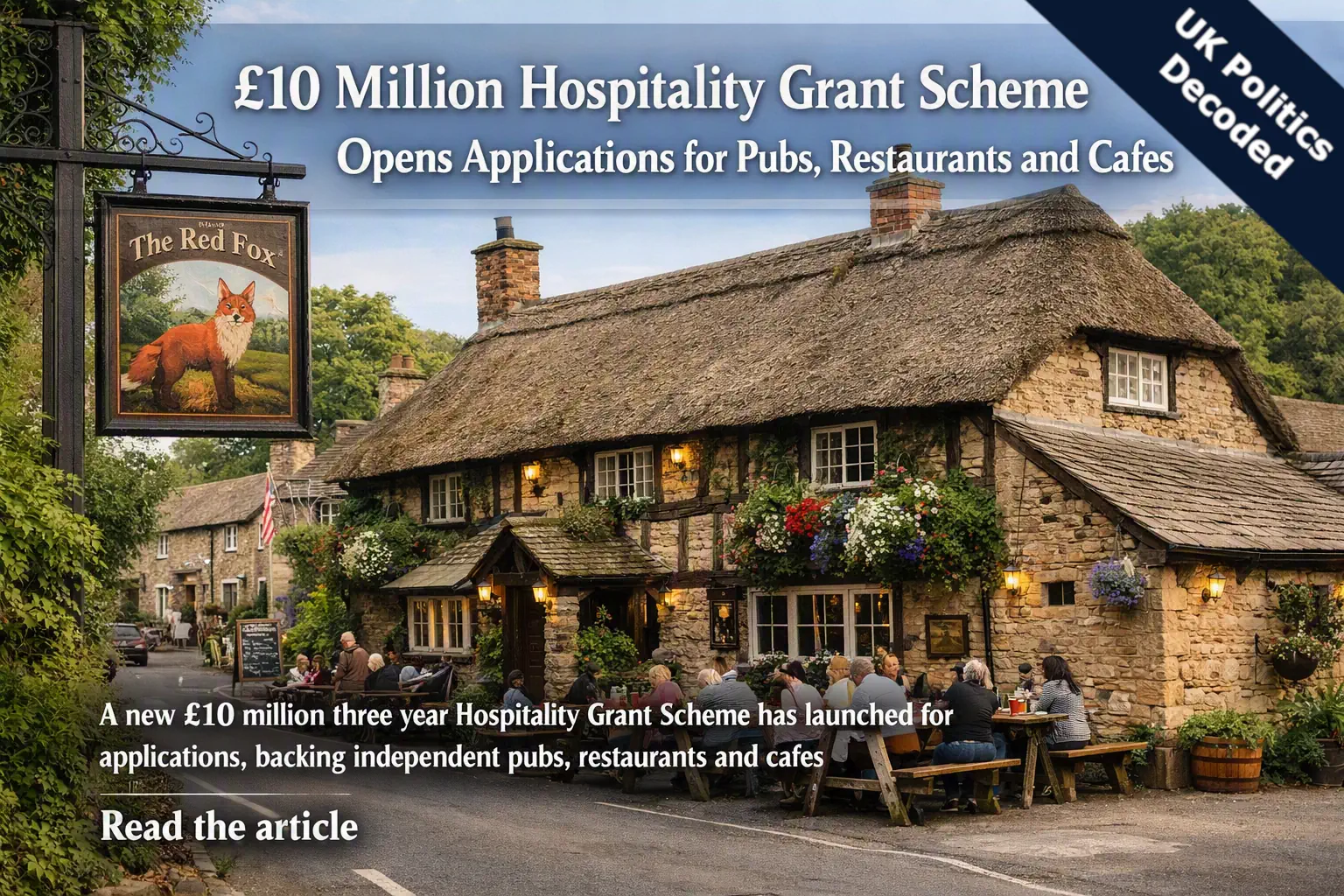
A new £10 million, three year Hospitality Grant Scheme has opened for applications, offering direct funding to independent pubs, restaurants, and cafes across the UK. Launched on 2 September 2026 by the Department for Business, Innovation, Science and Trade, the scheme is focused on backing entrepreneurs starting new businesses, bringing vacant premises back into productive use, and funding training programmes that help people including those furthest from the labour market take their first steps in the sector.
Kate Dearden, the Minister for the Future of Work, described hospitality venues as places where communities come together and where many people get their first experience of work. The scheme builds directly on a pilot programme that supported more than 70 rural pub projects, set up two hospitality training facilities inside UK prisons, and established an innovation hub connecting hospitality operators with technology companies to find new ways to reduce costs and improve how the industry runs.
At a Glance
- The government has launched a new £10 million, three year Hospitality Grant Scheme for independent pubs, restaurants, and cafes, with applications now open through the Department for Business, Innovation, Science and Trade.
- Funding is directed at three types of projects, helping new hospitality businesses get off the ground, bringing vacant premises back into use, and supporting training schemes that create entry level employment opportunities.
- £3 million of the total budget has been earmarked exclusively for Pub is The Hub, an independent non-profit that helps rural and deprived community pubs diversify the services they offer to local residents.
- The scheme builds on a pilot that delivered over 70 rural pub projects, two prison hospitality training facilities, and an innovation hub linking hospitality businesses with technology companies to improve productivity.
- Guidance is available now on GOV.UK, with the formal applications window opening at the end of September 2026.
Which Projects Qualify for Hospitality Grant Scheme Funding in 2026
The grant is not a general subsidy for the sector. Funding is targeted at specific projects, getting a new business off the ground, bringing a vacant unit back into use, or setting up training programmes that give people particularly young people and those who have never held a job the skills to build a career in hospitality. The government's case is that hospitality is one of the most accessible points of entry into the labour market and that supporting businesses to invest in training generates returns beyond the sector itself.
One of the clearest examples of what the government is hoping to replicate came from the pilot. The Right Course, a social enterprise, used pilot funding to transform two prison staff restaurants and kitchens into realistic hospitality training facilities for inmates. Participants gained practical experience in food preparation, service, and kitchen management, the kind of hands on, transferable skills that directly improve employability after release and which the government cited as evidence that the funding model can generate social value well beyond its initial cost.
The pilot also backed a different kind of intervention. The Hospitality Sector Council and L Marks, a specialist innovation lab, brought hospitality operators and leading technology companies together to identify ways of cutting costs and improving efficiency in day to day operations. The government says that work produced measurable time savings and reduced overheads for participating businesses, the sort of productivity improvement that, at scale, strengthens the sector's financial resilience against the pressures that have forced so many sites to close in recent years.
Pub is The Hub Gets £3 Million to Add Village Stores and Cafes to Rural Pubs
Of the £10 million total, £3 million has been specifically earmarked for Pub is The Hub, a non-profit organisation that has spent more than 25 years helping publicans in rural, remote, and deprived areas diversify what their premises offer. With support from the scheme, pubs can add village stores, community cafes, play areas, and arts and crafts spaces, services that have often disappeared from smaller communities as post offices, banks, GP surgeries, and other facilities have consolidated or closed entirely.
The rationale behind the earmark is straightforward. In many rural and deprived areas, the pub has become the last public gathering space, the final point of community infrastructure still standing. The problem for publicans who want to expand into community services is that the financial case rarely works on its own. A village store or community cafe run out of a pub rarely generates enough revenue to justify the capital investment required without some external support to close the gap. John Longden OBE, the chief executive of Pub is The Hub, said the funding would give publicans long term certainty to develop new services and would help lever in additional private and public match funding alongside the government grant potentially multiplying the impact of each pound invested.
Hospitality Grant Applications Open Late September and a 20% Business Rates Cut Is Coming Too
Guidance for the Hospitality Grant Scheme is available now on GOV.UK. The formal applications window does not open until the end of September 2026, giving eligible businesses several weeks to read the criteria and prepare before submissions are accepted. The scheme is designed to be accessible to a range of applicants, from established community venues looking to expand their services to first time operators trying to launch a new business in a vacant premises.
The grant scheme arrives alongside a separate piece of support for the sector announced earlier. Pubs, clubs, and live music venues are set to receive a 20 per cent cut to their business rates bills from April 2027, saving the typical pub an estimated £1,000 in its first year. That measure applies more broadly than the grant it requires no application and covers a wider range of hospitality premises but taken together, the two policies represent the government's most concentrated package of direct support for independent hospitality operators in recent years.
Why the Government Is Backing Hospitality with £10 Million to Drive Jobs and Growth
Hospitality is one of the few sectors where entry level employment functions as a genuine route into the labour market rather than a temporary stop. It has consistently argued that thin margins and the upfront cost of employing and training people with limited experience make investment in new staff financially difficult to justify without external support. The grant scheme is, in part, a test of whether targeted public funding can change that calculation and stimulate the kind of structured training investment the sector has historically underdelivered.
The pilot results offer some basis for confidence. More than 70 rural pub projects, two prison training programmes, and a productivity focused innovation hub all emerged from a comparatively modest initial investment. Whether the full programme now running at £10 million over three years can demonstrate the same value for money and community impact at scale is what the evidence from this round will ultimately need to show.
Key Takeaways
- A £10 million, three year Hospitality Grant Scheme launched on 2 September 2026, offering funding for new hospitality businesses, vacant premises projects, and training programmes across the UK.
- £3 million of the total has been earmarked for Pub is The Hub, which helps rural and deprived area pubs diversify by adding community services such as village stores, cafes, and play areas.
- The scheme builds on a pilot that delivered more than 70 rural pub projects, two prison hospitality training facilities, and a productivity innovation hub linking operators with technology companies.
- Guidance is available now on GOV.UK, with the formal applications window opening at the end of September 2026.
- Pubs, clubs, and live music venues are also set to receive a separate 20 per cent business rates cut from April 2027, saving the typical pub an estimated £1,000 in its first year.
Sources & Further Reading
- GOV.UK – £10 Million Hospitality Grant Scheme launches in boost for independent pubs, restaurants and cafes (Department for Business, Innovation, Science and Trade, 2 September 2026) Archived copy (OGL): archived page
- Pub is The Hub – About the organisation Archived internally for verification (2 September 2026)
- GOV.UK – Hospitality Sector Council Archived internally for verification (2 September 2026)