AI Use: AI tools were used to support source discovery and to structure the article for clarity. All research, verification, drafting, and final editorial decisions are fully human led. Learn about our AI policy.
UKPoliticsDecoded is an IMPRESS regulated public interest publisher. Read our editorial standards.
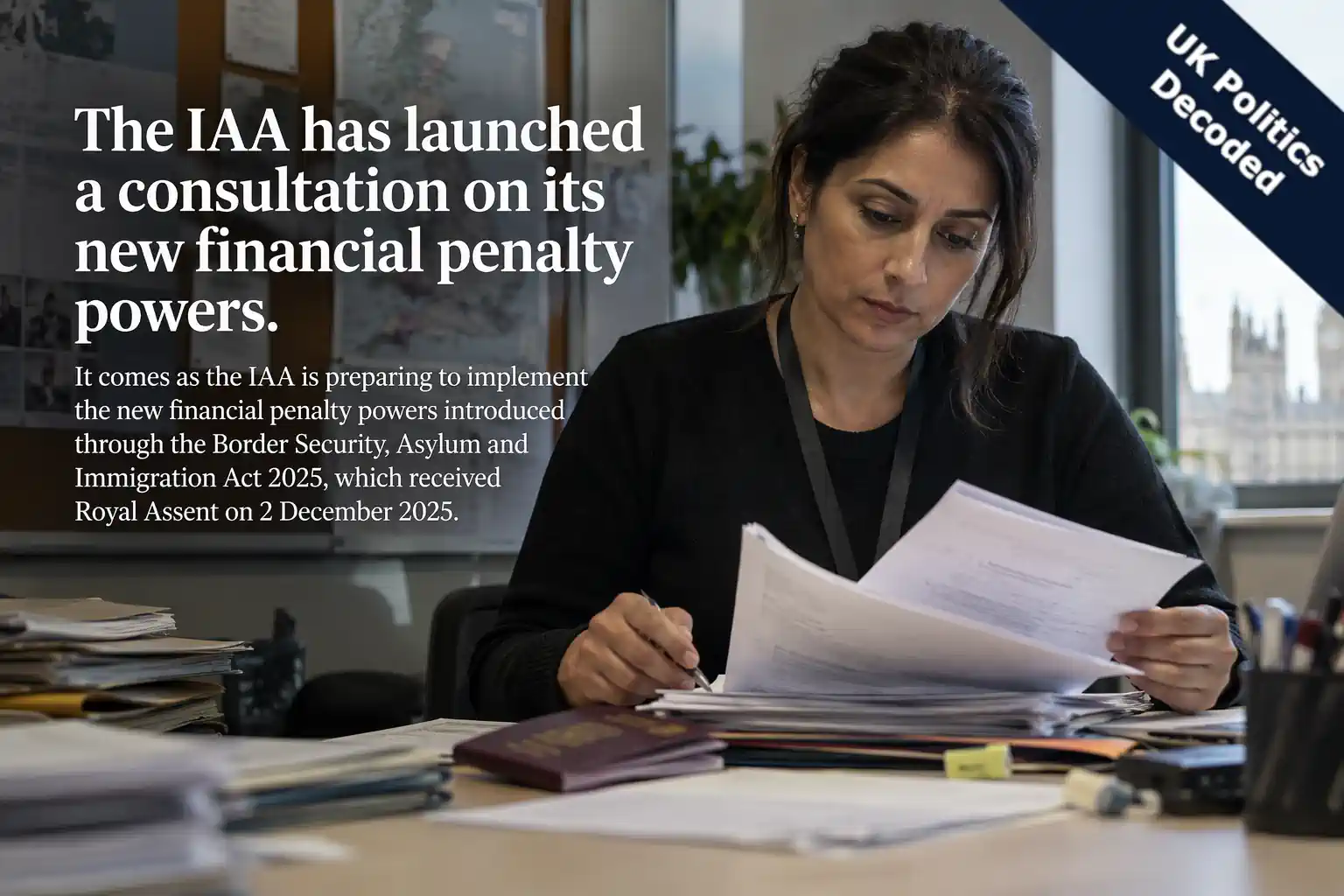
The Immigration Advice Authority (IAA) has opened a consultation on how it will use new powers to fine immigration advisers who break the rules. The powers, which let it impose financial penalties of up to £15,000, were created by the Border Security, Asylum and Immigration Act 2025 and are not yet in force.
Announced on 23 November 2026, the consultation asks advisers, organisations and anyone else with an interest in the sector how the penalties should work in practice. It closes at 11:59pm on Monday 18 January 2027.
At a Glance
- The IAA can fine regulated organisations and individuals up to £15,000 once the new powers are introduced.
- The same powers will also let the IAA fine people who provide immigration advice without the necessary authorisation, up to £15,000.
- The consultation closes at 11:59pm on Monday 18 January 2027.
- The financial penalties form part of wider regulatory reforms due to be introduced by October 2027.
- A second consultation, covering the IAA complaints scheme and a compensation scheme for advice seekers, is due in 2027.
What the Immigration Advice Authority's new fining powers cover
GOV.UK describes the new powers as an additional enforcement tool for the IAA. Once they are in force, the regulator will be able to impose a financial penalty where a regulated organisation fails to meet its compliance obligations.
According to GOV.UK, the powers apply in two directions. The first covers regulated organisations and individuals who fail to meet their compliance obligations. The second covers people and businesses who give immigration advice illegally, without the authorisation they need to do so.
The headline figure is £15,000. GOV.UK says regulated organisations and individuals can be fined up to that amount, with a maximum of £15,000 for each serious or repeated compliance failure. Individuals providing unregulated immigration advice can also be fined up to £15,000.
The IAA says the aim is to act more quickly where harm is identified, protect people seeking advice and support the many professional advisers who already work to high standards. It also argues that swifter intervention helps stop legitimate advisers being undermined by poor practice or by people operating outside the regulatory framework.
How the £15,000 penalty process works under the 2025 Act
The detail sits in the Act itself, which was given Royal Assent on 2 December 2025. It inserts a new section 92C into the Immigration and Asylum Act 1999 and sets out who can be fined and for what. The Act words these functions as belonging to the Commissioner rather than the IAA by name.
A registered person can be given a penalty notice if the Commissioner is satisfied, on the balance of probabilities, that they failed to comply with the Code of Standards, failed to assist with the investigation of a complaint, or breached another requirement under the relevant part of the 1999 Act. Obstructing an inspection without reasonable excuse is also covered. People who are not registered can be penalised for failing to help with a complaint investigation, and unqualified people can be penalised where the Commissioner is satisfied they have committed certain offences under sections 91 or 92B.
How a penalty would work under the Act
- The Commissioner must first tell the person of the intention to issue a penalty, the proposed amount and the reasons for it.
- The person must be given at least 28 days to make representations, and the Commissioner must have regard to them.
- A penalty notice can be a fixed amount set in regulations or a variable amount set by the Commissioner, and can include an early payment discount or a late payment increase.
- The person can appeal to the First tier Tribunal, which can cancel the penalty, confirm it or, for variable penalties, change the amount.
The £15,000 ceiling is not fixed forever. The Act allows the Secretary of State to change it through regulations. A separate rule applies where someone is penalised for an offence under section 92B, the penalty cannot exceed the maximum fine a court could impose on summary conviction for that offence.
Can immigration advisers appeal a penalty?
Payment is suspended while an appeal could still be brought and while one is pending, unless the person tells the Commissioner they do not intend to appeal. No extra amount accrues from a late payment provision during that suspension period.
If a penalty remains unpaid, the Commissioner can recover it through the county court in England and Wales and Northern Ireland, or through the sheriff court in Scotland. The Act also says a person who must pay a penalty for an offence under section 91 or 92B cannot later be convicted of that same offence for the same act or omission.
The Commissioner must also publish guidance on how the penalty power will be used. That guidance has to explain when fixed or variable penalties are likely to be used and what is taken into account when setting a variable amount. Before writing or revising it, the Commissioner must consult whoever they consider appropriate.
Who is affected and how to take part in the consultation
The consultation, published on GOV.UK on 23 November 2026, seeks views on how the powers should be applied, including the principles and methodology for assessing penalties. Responses will help shape the final financial penalties framework and guidance. The IAA describes it as a targeted consultation and says it wants feedback that makes the powers fair, proportionate and effective.
Regulated advisers and organisations
- Can be fined up to £15,000 for compliance failures.
- Face up to £15,000 for each serious or repeated failure.
- Receive a notice of intent and at least 28 days to respond.
- Can appeal to the First tier Tribunal.
Unregulated providers and advice seekers
- People giving advice without authorisation can be fined up to £15,000.
- The IAA says the powers are meant to protect people seeking advice.
- A compensation scheme is expected to be covered in a later consultation.
- Details of the process remain subject to the current consultation.
The IAA is inviting advisers, organisations and other interested stakeholders to respond. The consultation document is a 13 page PDF, available through the GOV.UK consultation page. People who use assistive technology and need another format can email info@immigrationadviceauthority.gov.uk.
What happens next? October 2027 reforms and a second consultation
The financial penalties are one piece of a longer programme. The IAA says wider regulatory reforms will be introduced by October 2027, aimed at raising standards, improving protections for advice seekers and supporting what it calls a trusted, professional immigration advice sector.
A second consultation is due in 2027. It will cover changes to the IAA complaints scheme and new measures to improve redress for advice seekers, including a compensation scheme. That connects to another change in the same Act, which allows the complaints scheme to order refunds or compensation where advice was given by someone who was not authorised. The Act caps the total that can be ordered in respect of one complaint at £250,000, though the Secretary of State can change that figure by regulations.
No date has been given for when the financial penalty powers will come into force. GOV.UK says only that the IAA is preparing to implement them and has been working with partners across government since the Act became law.
Key Takeaways
- The IAA will be able to fine regulated advisers and unauthorised providers up to £15,000 once its new powers are introduced.
- The powers come from the Border Security, Asylum and Immigration Act 2025, which received Royal Assent on 2 December 2025.
- The Act requires at least 28 days for representations before a penalty is issued, and gives a right of appeal to the First tier Tribunal.
- The consultation on how the powers will be applied closes at 11:59pm on Monday 18 January 2027.
- A second consultation on the complaints scheme and a compensation scheme is due to be published in 2027.
Sources & Further Reading
- GOV.UK: Have your say on new financial penalty powers Archived copy (OGL): archived page
- GOV.UK: IAA consultation on new financial penalty powers Archived copy (OGL): archived page
- legislation.gov.uk: Border Security, Asylum and Immigration Act 2025 (as enacted) Archived internally for verification (23 November 2026)