AI Use: AI tools were used to support source discovery and to structure the article for clarity. All research, verification, drafting, and final editorial decisions are fully human led. Learn about our AI policy.
UKPoliticsDecoded is an IMPRESS regulated public interest publisher. Read our editorial standards.
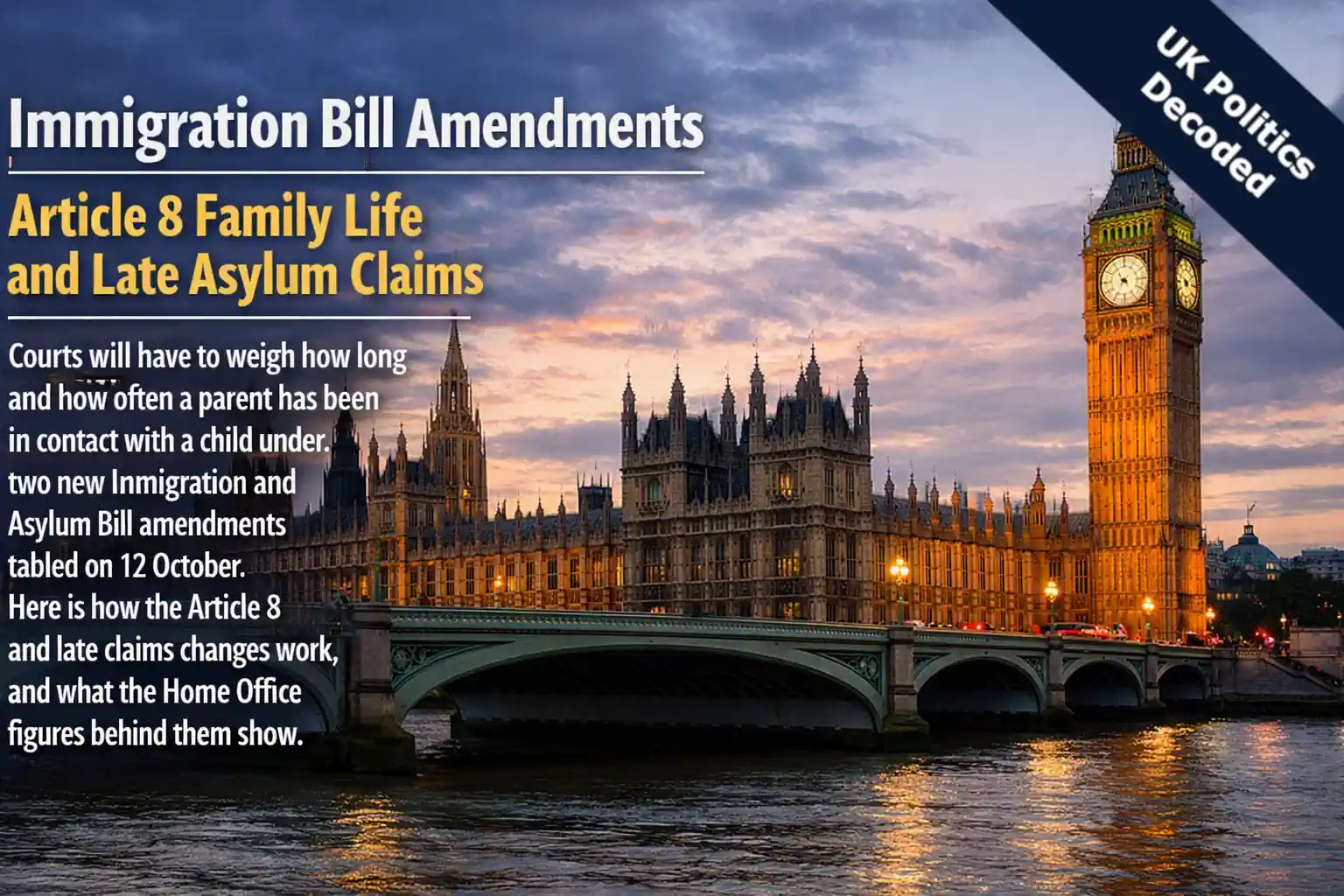
The government has tabled two amendments to the Immigration and Asylum Bill that would change how courts and decision makers treat claims to family life and claims made at the last minute. The Home Office announced the amendments on 12 October 2026, describing them as a way to close Article 8 loopholes and crack down on late asylum claims.
Article 8 of the European Convention on Human Rights protects the right to respect for family and private life. Under the amendments, courts will have to look at how long and how often a parent has been in contact with their child when deciding whether family life exists, and claims raised late without good reason will count against a person's credibility.
At a Glance
- The government tabled two amendments to the Immigration and Asylum Bill on 12 October 2026, covering Article 8 family life claims and minute immigration claims.
- Courts will have to consider how long and how often a parent has been in contact with their child when deciding whether family life exists.
- Claims made at the last minute without good reason will damage a person's credibility, and decision makers must factor in the timing of evidence.
- The Home Office estimates that each main applicant granted leave on Article 8 grounds carries a net lifetime fiscal cost of £141,000 to the taxpayer.
- The bill passed its second reading in the Commons with a majority of 174 in July and enters line by line scrutiny next week.
What the Two New Immigration Bill Amendments Change
The first amendment deals with family life. The bill already defines family life under Article 8 as typically limited to core, co-habiting family relationships. The new amendment adds a test of contact between a parent and child, courts will have to consider how long, and how often, the parent has been in touch with the child. According to the Home Office, the aim is to stop migrants bolstering a claim by moving back into the family home shortly before making it.
The second amendment targets timing. New rules will let a claim made at the last minute, without good reason, damage the person's credibility. Decision makers will be required to take into account when evidence was produced as well as what it says.
Home Secretary Shabana Mahmood said the public "must trust that their immigration system is secure, controlled and not open to abuse". She added that the reforms would "protect its integrity, prevent exploitation and ensure that those with no right to be here are swiftly removed", while still providing sanctuary to those who need it.
Why the Home Office Says Article 8 Needs Tightening
Article 8 is a qualified right, meaning it has to be balanced against the public interest, including public safety and the prevention of crime. The government's factsheet argues the current tests do not give enough weight to that public interest. It says the bill will make clear that deporting foreign criminals is in the public interest, and will always be appropriate unless the individual impact is out of all proportion to it.
The Home Office puts figures on the problem. Based on published statistics for 2025, it estimates that annual in country grants of Article 8 family and private life applications run at around 76,500. It also estimates each main applicant granted on Article 8 grounds carries a net lifetime fiscal cost of £141,000, which it says comes to £4.9 billion for the cohort granted in 2025.
A sample of first time in country family and private life grants from 2022 showed that 71% went to illegal entrants or overstayers, and 67% went to applicants with a qualifying child. The department reads the second figure as showing how far children are relied on to establish a basis to remain. These are Home Office estimates drawn from its own impact assessment, and the factsheet does not set out the assumptions behind the fiscal cost.
How the Bill Reforms Article 8
- The bill rebalances the public interest test so that issues such as effective immigration control and economic prosperity are considered.
- It defines family life in legislation, telling decision makers and courts that it should not normally extend beyond immediate family members.
- It requires Article 8 family life claims from people outside the UK to be made through a UK based sponsor.
- It sets a framework requiring courts to weigh the public interest in every foreign national offender case.
Can Foreign Criminals Still Use Article 8 to Avoid Deportation?
For people facing deportation after a criminal conviction, the Home Office points to a historical figure. Between 1 April 2016 and 8 November 2021, 1,011 foreign national offender deportation appeals were allowed on human rights grounds at the First tier Tribunal. The department estimates that around 70% of those were allowed solely on Article 8 grounds.
That data covers a period that ended almost five years ago, and the factsheet cites a statistical note rather than recent figures. The government says that, alongside wider appeals reform, the new framework should increase the number and speed of deportations of foreign national offenders. It has not published a projection of by how much.
The reforms also include safeguards. The Article 8 factsheet says the impact on children and vulnerable people has been carefully considered, and that there are specific provisions for particularly exceptional circumstances. It does not list what those circumstances are. The government also says it remains committed to the ECHR and does not need to withdraw from it to reform the current system.
How Late Asylum Claims Will Be Treated as the Appeals Backlog Hits 90,000
The late claims amendment builds on measures already in the bill. The bill introduces an expedited decision making process for late claims, and a claim notice for people liable to removal or deportation. That notice requires them to submit any immigration or modern slavery claim up front. A claim made outside the deadline will have consequences for how decision making progresses, according to the Home Office.
The pressure on the system is the department's main argument. As of June 2026, there were around 156,000 outstanding appeals, of which 90,000 were asylum appeals, which the factsheet describes as the highest level on record. Outstanding asylum appeals rose 51% year on year. About 61,000 new asylum appeals were lodged in the year to June 2026, compared with around 31,000 decided.
The mean time to clear appeals across all categories stands at 65 weeks this quarter, 13 weeks longer than a year ago. To address this, the bill would create an Independent Immigration Appeals Authority and a single appeal route, with claimants required to raise every relevant matter up front. If an appeal fails, they could only seek permission to appeal to the Upper Tribunal on a point of law. A single definition of a protection claim would also combine refugee status and humanitarian protection.
What Happens Next for the Immigration and Asylum Bill
The bill passed its second reading in the House of Commons in July with a majority of 174. The Home Office said on 12 October that it would enter the line by line scrutiny stage next week, which is where the two new amendments will be debated and can be challenged.
The bill also includes a mechanism requiring asylum seekers who receive taxpayer funded accommodation and support to contribute to the cost when they are financially able. This would be a flat rate charge, with eligible adults making regular payments above a threshold set by the Home Secretary.
Whether the amendments survive committee unchanged is not yet known, and the published material does not say how courts will weigh contact evidence in practice. The Home Office has not said what level of contact would be treated as enough to establish family life.
Key Takeaways
- Two government amendments to the Immigration and Asylum Bill, announced on 12 October 2026, target Article 8 family life claims and last minute asylum claims.
- Courts will have to consider how long and how often a parent has been in contact with their child, and claims made late without good reason will damage credibility.
- The Home Office estimates about 76,500 annual in country Article 8 grants and a £141,000 net lifetime fiscal cost for each main applicant granted on those grounds.
- Around 156,000 appeals were outstanding in June 2026, including about 90,000 asylum appeals, with a mean clearance time of 65 weeks across all categories.
- The bill enters line by line scrutiny in Parliament next week after passing its second reading with a majority of 174 in July.
Sources & Further Reading
- GOV.UK - Migrants exploiting human rights laws targeted in fresh reforms Archived copy (OGL): archived page
- GOV.UK - Immigration and Asylum Bill: Article 8 reform Archived copy (OGL): archived page
- GOV.UK - Immigration and Asylum Bill: Article 8 foreign national offenders Archived copy (OGL): archived page
- GOV.UK - Immigration and Asylum Bill: Independent Immigration Appeals Authority Archived copy (OGL): archived page