AI Use: AI tools were used to support source discovery and to structure the article for clarity. All research, verification, drafting, and final editorial decisions are fully human led. Learn about our AI policy.
UKPoliticsDecoded is an IMPRESS regulated public interest publisher. Read our editorial standards.
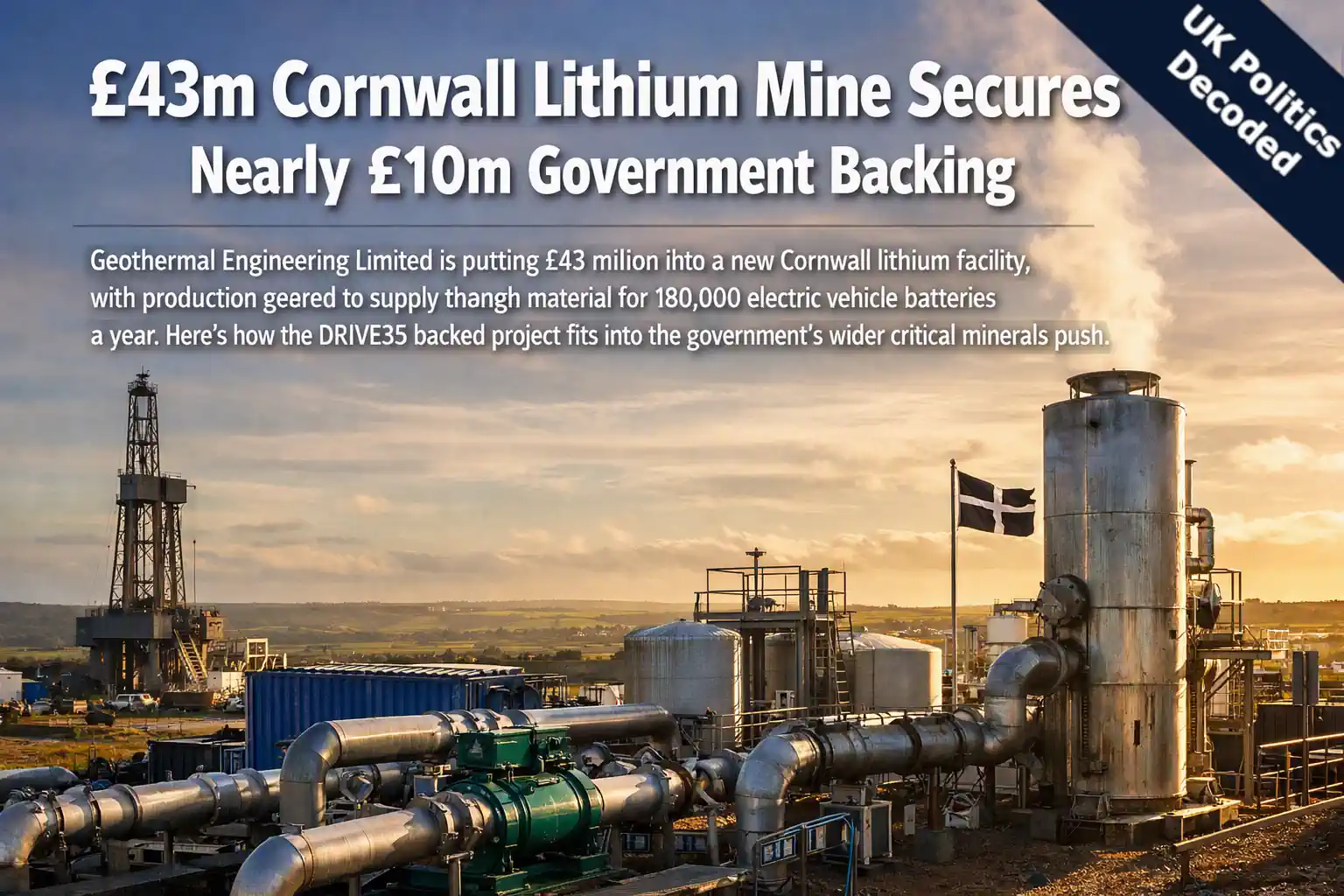
Geothermal Engineering Limited will invest around £43 million in a new lithium extraction facility in Cornwall, the Department for Business, Innovation, Science and Trade announced on 27 September. The project has received an Offer in Principle worth nearly £10 million through the government's DRIVE35 Automotive Transformation Fund, and is expected to create close to 50 direct jobs plus around 80 more across the supply chain.
The company plans to extract lithium from geothermal brine deep underground, a technique it says can supply a critical mineral needed for electric vehicle batteries without the environmental footprint of conventional hard rock mining. Ministers are framing the announcement as part of a broader effort to secure the raw materials that back Britain's automotive, clean energy and advanced manufacturing sectors, at a moment when global demand for lithium is forecast to grow sharply.
At a glance
- Geothermal Engineering Limited will invest around £43 million in a new lithium extraction facility in Cornwall.
- The project has received an Offer in Principle worth nearly £10 million through the government's DRIVE35 Automotive Transformation Fund.
- It is expected to create nearly 50 direct jobs and support around 80 more across the supply chain.
- Global demand for lithium is forecast to increase by 1,100% by 2035, according to the government.
- Commercial production in Cornwall is due to begin in 2029, targeting around 1,500 tonnes of lithium carbonate a year.
Why Cornwall's Geothermal Brine Is Key to Britain's Lithium Supply
Cornwall has a long mining history, and the government is presenting this investment as the next chapter of that heritage rather than a break from it. Geothermal Engineering Limited's approach draws lithium from naturally occurring geothermal brine found deep underground in the region, a resource the company argues can provide a reliable domestic source of the mineral once extraction is running at commercial scale.
Business Secretary Jonathan Reynolds said companies "like Geothermal Engineering are helping to write its next chapter in unlocking the South West's industrial potential," framing the project as evidence that Britain "produces" rather than only innovates. He linked the announcement to a wider run of automotive sector investment, describing it as "a big step towards building our industrial resilience" following more than £1 billion in automotive investment secured earlier the same month from firms including Bentley, McLaren and Nissan.
Dr Ryan Law, chief executive of Geothermal Engineering Limited, said lithium is "fundamental to the technologies underpinning the automotive sector's transition to zero emission vehicles." He added that the company believes the UK has "an important opportunity to develop the resources, technology and expertise needed to establish a domestic lithium supply," giving the country greater control over what he called an increasingly important raw material.
How the £10m DRIVE35 Funding Deal Actually Works
The near £10 million offer to Geothermal Engineering Limited comes through DRIVE35, the government's flagship automotive programme. DRIVE35 provides £4 billion of capital and research and development grant funding through to 2035, intended to unlock private investment and support the sector's shift to zero emission vehicles. It is delivered by the Department for Business, Innovation, Science and Trade in partnership with the Advanced Propulsion Centre UK and Innovate UK.
Crucially, the money is not yet guaranteed. The government has confirmed the offer is an Offer in Principle, meaning it remains subject to completion of due diligence and final approvals before funds are released. A near identical caveat applies to a second DRIVE35 award announced alongside it, for a lithium refinery in Teesside.
What Still Has to Happen Before Funding Is Confirmed
- Geothermal Engineering Limited's Offer in Principle must clear due diligence before it becomes a binding funding agreement.
- Final government approvals still need to be granted for both the Cornwall and Teesside DRIVE35 offers.
- Construction and commissioning of the extraction facility must be completed ahead of the 2029 production target.
- The facility needs to reach the output required to supply lithium carbonate at commercial volumes.
What the Cornwall Deal Means for Britain's Lithium Supply Chain
The Cornwall project is one half of a two site push. The government says the combined DRIVE35 offers to Geothermal Engineering Limited and Tees Valley Lithium have helped unlock nearly £230 million of private investment into lithium projects in Cornwall and Teesside. Tees Valley Lithium is separately investing £185 million to build what is described as one of Europe's largest lithium refineries, backed by its own DRIVE35 Offer in Principle worth £18.3 million.
What's Confirmed
- Geothermal Engineering Limited will invest £43 million, backed by a near £10 million DRIVE35 offer.
- The Cornwall facility is expected to create around 130 jobs in total, direct and supply chain combined.
- Commercial production is targeted for 2029, at around 1,500 tonnes of lithium carbonate a year.
- That volume is described by the government as enough to power more than 180,000 typical EV car batteries.
Julian Hetherington, automotive transformation and engagement director at the Advanced Propulsion Centre UK and Zenzic, said the project "aligns with the UK's Critical Minerals Strategy 2035 by expanding domestic production of critical minerals, reducing reliance on imports." He argued that extracting lithium domestically reduces dependence on supply chains dominated by China and supports the batteries needed for the UK's shift to zero emission vehicles, while also diversifying the supply chain against risks tied to concentrated global lithium production.
Why This Fits a Bigger Reindustrialisation Drive
The government has been keen to place both lithium announcements inside a longer pipeline of DRIVE35 backed activity. Recent support through the fund has included research and development projects led by Cornish Lithium, Watercycle Technologies, Weardale Lithium and Northern Lithium, aimed at developing new extraction technologies and accelerating commercial deployment across the sector.
Ministers are pitching all of this as evidence of progress under the Modern Industrial Strategy, the government's framework for supporting sectors it judges to be nationally strategic. The lithium investments are being presented alongside the recent £1 billion of automotive sector investment from Bentley, McLaren and Nissan, part of what the department describes as the Prime Minister's mission to "reindustrialise" the country.
It is worth being clear about what this investment is, and is not, expected to achieve. As Hetherington noted, the case for domestic lithium rests on cutting dependence on supply chains "dominated by China" and reducing exposure to concentrated global production, not on undercutting existing manufacturing costs. Neither the government nor Geothermal Engineering Limited has claimed that Cornish lithium will make British made batteries cheaper than those produced abroad, where energy costs, labour costs and manufacturing scale remain significant factors. The stated goal is supply chain security and resilience, a different measure of success from cost competitiveness.
Whether the Cornwall and Teesside projects deliver at the scale promised will depend heavily on the due diligence process that still lies ahead, and on whether Geothermal Engineering Limited can move from an underground brine resource to reliable commercial output within its 2029 timeline. For now, the government has a headline investment figure and a jobs number to point to. The harder test, of turning an Offer in Principle into tonnes of lithium carbonate actually leaving a Cornish site, is still three years away.
Key Takeaways
- Geothermal Engineering Limited will invest £43 million in a Cornwall lithium extraction facility, backed by a near £10 million DRIVE35 Offer in Principle.
- The project is expected to create around 130 jobs in total, and target commercial production of roughly 1,500 tonnes of lithium carbonate a year from 2029.
- A parallel £185 million Tees Valley Lithium refinery, backed by an £18.3 million DRIVE35 offer, forms the second half of the government's lithium push.
- Together the two DRIVE35 offers have helped unlock nearly £230 million of private investment, though both remain subject to due diligence and final approval.
- The announcements follow more than £1 billion of automotive investment this month from Bentley, McLaren and Nissan as part of the Modern Industrial Strategy.