AI Use: AI tools were used to support source discovery and to structure the article for clarity. All research, verification, drafting, and final editorial decisions are fully human led. Learn about our AI policy.
UKPoliticsDecoded is an IMPRESS regulated public interest publisher. Read our editorial standards.
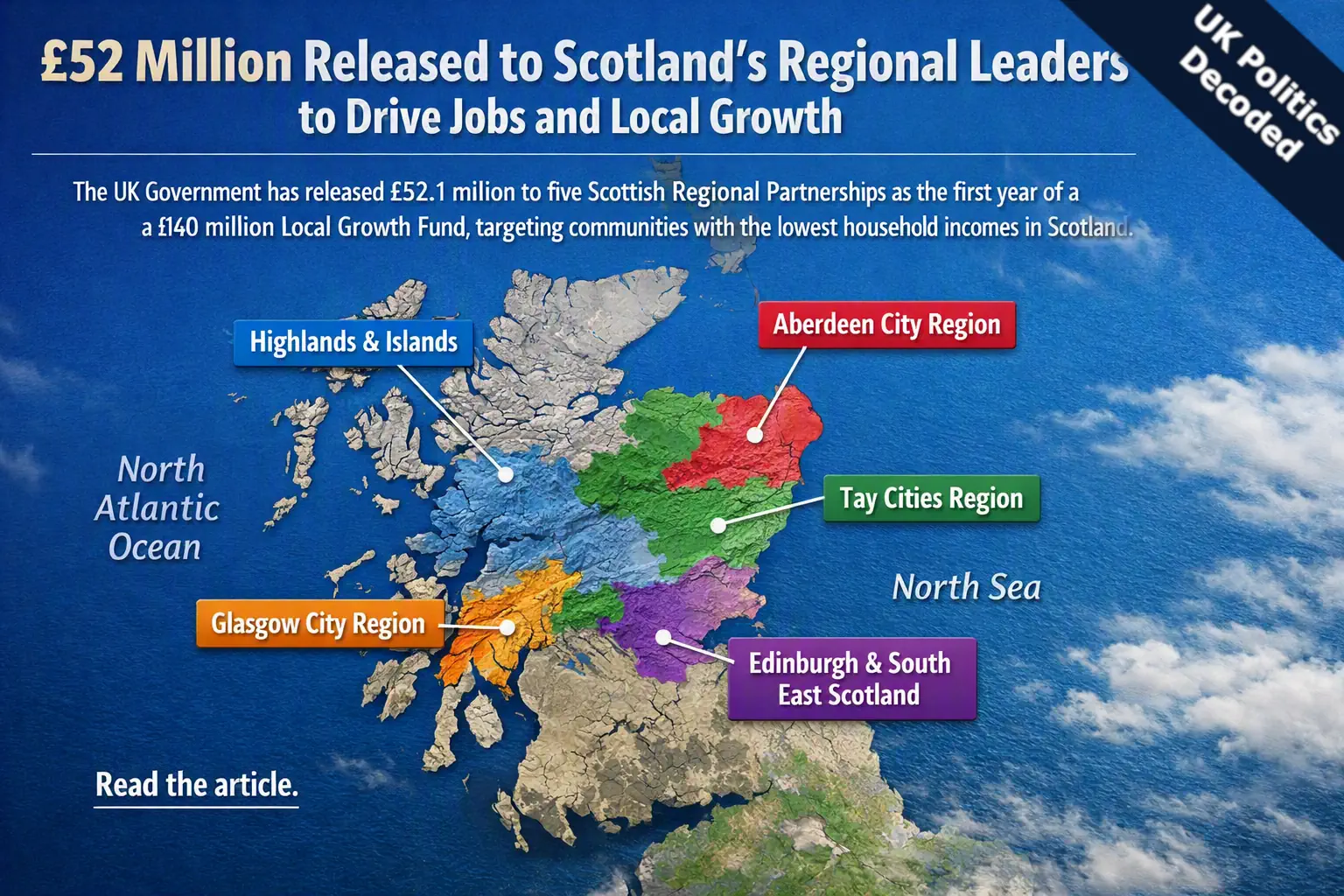
The UK Government has released £52.1 million to Scotland's five Regional Partnerships, clearing the first year of a £140 million Local Growth Fund aimed at closing the economic gap between Scotland's most and least prosperous communities. Scottish Secretary Douglas Alexander confirmed the funding on 3 September 2026, with Year 1 money cleared to Accountable Bodies on or around 28 August meaning procurement and physical delivery can begin immediately.
The fund runs across three financial years, from 2026/27 to 2028/29. Rather than requiring competitive bids, it allocates money proportionally by population across the five eligible regions, those containing local authority areas identified as having the lowest Gross Disposable Household Income (GDHI) per capita in Scotland. Communities in West Dunbartonshire, North Ayrshire, Dundee, Clackmannanshire, and Fife sit within the qualifying regions.
At a Glance
- The UK Government has cleared £52.1 million to five Scottish Regional Partnerships as the first year instalment of a £140 million Local Growth Fund.
- Glasgow City Region receives the largest Year 1 allocation at £22.7 million, with a total three year allocation of £60.9 million.
- Eligible regions were identified using Gross Disposable Household Income data, targeting Scotland's least prosperous communities.
- Funding for Years 2 and 3 is subject to annual progress reviews, giving the UK Government ongoing oversight of delivery.
- Scotland is projected to receive up to £25 million more through this fund and two related programmes than it would have under the previous Shared Prosperity Fund.
Which Regions Qualify and How the Money Divides
Glasgow City Region holds the largest three year allocation at £60.9 million, with £22.7 million released now. Edinburgh and South East Scotland follows with a total of £37.8 million (£14.1 million in Year 1), while Tay Cities Region has a three year allocation of £19.5 million (£7.3 million now). Ayrshire receives £11.8 million in total, with £4.4 million cleared in Year 1 and Forth Valley, the smallest of the five regions receives £9.8 million across three years, with £3.7 million released immediately.
The proportional by population model was a deliberate design choice. It avoids the competitive application processes that characterised previous schemes, and ensures smaller eligible regions receive a meaningful share without having to outbid larger, better resourced areas. Eligibility was determined using objective data, no region applied for inclusion, and none were required to make a case for their need.
Year 1 funding was cleared directly to Regional Accountable Bodies, which are responsible for financial oversight within each partnership. This structure separates the fund from both central Whitehall control and the Scottish Government's block grant settlement, which covers day to day public services and community grants.
What Each Regional Partnership Is Expected to Deliver
Regional Partnerships are not single bodies. Each is a collaboration involving local councils, the private sector, education and skills providers, enterprise agencies, and the voluntary sector. Each partnership spent several months working directly with the UK Government to develop its three year investment plan, and each plan has been approved in full before any money was released.
Investment is directed at three broad priorities, physical infrastructure, high growth commercial space, and closing skills gaps in local labour markets. The UK Government has been explicit that delivery decisions sit with the Regional Partnerships themselves, Douglas Alexander described the approach as trusting "local knowledge over top down directives." Whitehall approves the strategy, the regions decide how to spend it on the ground.
How the Fund Is Released
- Investment plans are developed jointly between each Regional Partnership and the UK Government over several months.
- Plans are approved at headline level before any Year 1 funding is cleared.
- Year 1 funding is released directly to Regional Accountable Bodies to enable procurement to begin.
- Regions submit regular progress updates and are subject to annual review before Years 2 and 3 are released.
Where the Local Growth Fund Sits in a Wider Scotland Commitment
The Local Growth Fund is not the UK Government's only financial commitment to Scotland. More than £2.3 billion is being invested in local and regional Scottish projects over ten years, covering a range of economic and community renewal programmes.
For Regional Communities
- Infrastructure spend is directed specifically at areas with the lowest household incomes in Scotland.
- High growth commercial space will be created to attract businesses into underserved regions.
- Skills investment is designed to close labour market gaps that have persisted in these communities for years.
- Regional Partnerships set delivery priorities, decisions are not made by Whitehall ministers.
Conditions and Caveats
- Years 2 and 3 of funding are not guaranteed, both require annual UK Government review before release.
- Regional Partnerships must demonstrate measurable local impact to continue receiving tranches.
- The UK Government retains oversight through regular progress updates from each region.
- The fund is separate from the Scottish Government's block grant, which covers day to day public services.
When combined with the Growth Mission Fund and the Pride in Place programme, Scotland is expected to receive up to £25 million more than it would have under the equivalent Shared Prosperity Fund allocation. Across those three programmes together, up to £250 million of investment is projected over the three year period a figure the UK Government attributes partly to the structural shift away from the Shared Prosperity Fund's competitive bidding model.
What Happens Once Year 1 Spending Begins
With money now cleared to Accountable Bodies, Regional Partnerships can move straight into formal procurement and infrastructure contracts. The significance of having all five plans approved simultaneously rather than staggered is that every region starts from the same position, with no competitive advantage for those quicker off the mark in the planning phase.
Years 2 and 3 will follow only if annual reviews show progress. Regions that demonstrate jobs created, skills gaps reduced, and commercial space filled will unlock continued funding. Those that fall behind face delayed or withheld tranches. It is an accountability mechanism built into the release structure rather than bolted on afterwards.
What the Local Growth Fund Means for Scotland's Deprived Areas
For the communities within Scotland's five eligible regions many of which have struggled with structural economic challenges well before any national conversation about levelling up, this funding represents a direct attempt to rebuild from the ground up rather than direct money through existing channels. The Shared Prosperity Fund, which this effectively replaces, allocated money through competitive processes that favoured areas with stronger capacity to write bids and manage delivery. The Local Growth Fund removes that barrier by design.
Whether the three year framework delivers measurable change will be tested through the annual review process. Regional leaders now have both the resources and the accountability to show what locally led investment can achieve in places where national economic growth has historically been slow to land.
Key Takeaways
- £52.1 million has been cleared to five Scottish Regional Partnerships, enabling immediate procurement and infrastructure delivery to begin.
- Glasgow City Region holds the largest three year allocation at £60.9 million, with £22.7 million released in Year 1.
- The fund prioritises Scotland's lowest income communities, identified through GDHI data, including areas in West Dunbartonshire, North Ayrshire, Dundee, Clackmannanshire, and Fife.
- Years 2 and 3 are conditional on annual progress reviews, with continued funding dependent on demonstrated local impact.
- Scotland is projected to receive up to £25 million more through this and two related programmes than it would have under the Shared Prosperity Fund over the same period.