AI Use: AI tools were used to support source discovery and to structure the article for clarity. All research, verification, drafting, and final editorial decisions are fully human led. Learn about our AI policy.
UKPoliticsDecoded is an IMPRESS regulated public interest publisher. Read our editorial standards.
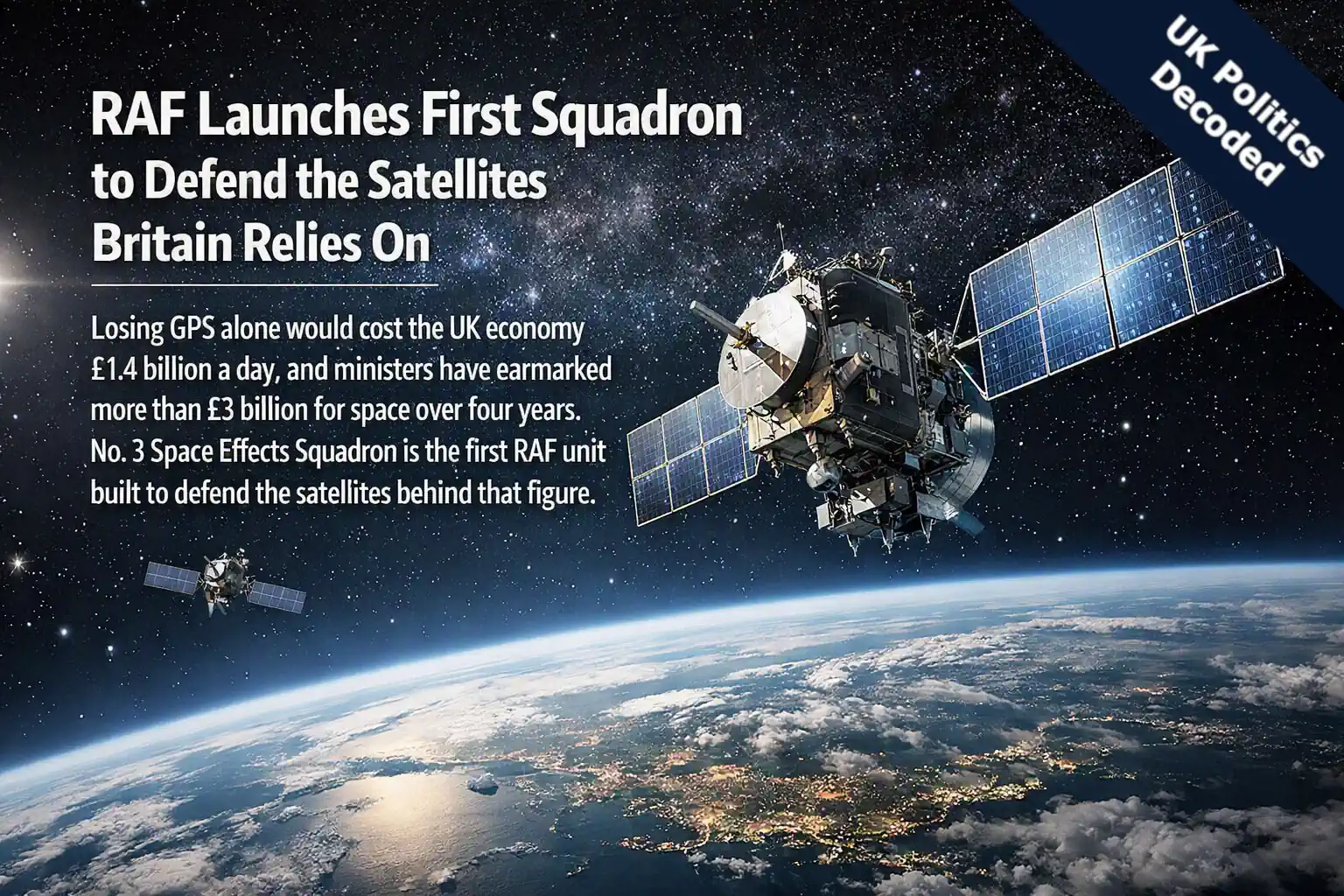
The RAF has formed No. 3 Space Effects Squadron, its first unit dedicated to the Control of Space mission. Defence Secretary Wes Streeting announced the squadron in a keynote at the UK Space Power Conference on 23 September 2026, the same day the Chief of the Air Staff, Air Chief Marshal Sir Harv Smyth, confirmed the formation. The Ministry of Defence styles the unit No. III Space Effects Squadron.
Streeting opened the speech with a separate operational update. A T2 Hawk had gone down shortly after take off near RAF Valley on Anglesey that afternoon. Both crew members ejected and had been taken to hospital. He said the crash was under investigation.
At a glance
- No. 3 Space Effects Squadron is the UK's first unit dedicated to the Control of Space mission, announced on 23 September 2026.
- The squadron is tasked with offensive and defensive operations, including disrupting, degrading and denying hostile activity against UK interests in space.
- The Defence Investment Plan earmarks more than £3 billion for space capabilities over its first four years.
- Streeting said satellites underpin almost a fifth of the UK economy, and that losing GPS alone would cost £1.4 billion a day.
- The UK space sector is worth around £20 billion and employs upwards of 55,000 people, according to the Defence Secretary.
What the RAF's First Space Effects Squadron Will Actually Do
Streeting described the squadron as the armed forces' means of protecting the satellites the country depends on, deterring those who would threaten them, and operating in a domain he called increasingly contested. Its mission, he said, supports work already under way on orbital warfare, electronic warfare and counter satellite weapons, "all designed with deterrence in mind."
The Ministry of Defence put more operational detail around that role in its announcement the same day. No. I Space Operations Squadron and No. II Space Warning Squadron already give the RAF the ability to watch space and warn of threats. No. III is the unit that acts on those threats. It will draw specialist personnel from across the armed forces, use electronic warfare among other tools, and expand as further capabilities enter service.
What ministers say the squadron is for
- It will conduct offensive and defensive operations to strengthen deterrence and reduce opportunities for coercion.
- It is tasked with disrupting, degrading and denying hostile activity against UK interests in space and on Earth.
- Its mission supports development of orbital warfare, electronic warfare and counter satellite weapons.
- The Ministry of Defence says it will expand over time as new capabilities enter service.
Smyth told the conference the squadron would safeguard the benefits space gives the integrated force and be capable of denying those benefits to adversaries. He also said Nos. 4, 5 and 6 Squadrons are planned, including a Space Tactics and Training Squadron and squadrons to deliver a deep space radar, plus a space defence function in the newly established Integrated Air, Space and Missile Defence Operations Centre.
Streeting's case for the squadron rested on how much of ordinary life already runs through orbit. Satellites, he said, are critical to intelligence gathering and missile warning, and they underpin almost a fifth of the UK economy. Weather forecasts, energy supplies, financial transactions, sat nav, mobile connections and deliveries all depend on them. The loss of GPS alone, he said, would cost the economy £1.4 billion a day.
The Ministry of Defence made the same point in plainer operational terms. Ambulances, firefighters and the police use satellite navigation for emergency responses. Energy networks use the same systems to organise power grids. Ships are guided by satellites, and missile warning depends on them too.
What satellites already support
- Streeting said satellites underpin almost a fifth of the UK economy, from weather and energy to payments and deliveries.
- He said the loss of GPS alone would cost the economy £1.4 billion a day.
- The Ministry of Defence says emergency services and energy grids rely on satellite navigation.
- Military intelligence, missile warning and the ability to move and fight as one force also depend on space systems.
What the government says is changing
- Streeting said Chinese and Russian operational satellite fleets grew by a combined 70% between 2019 and 2021.
- He said two Russian satellites had intercepted communications from at least a dozen European satellites since 2022.
- The Strategic Defence Review treated space as a conflict domain alongside land, sea and air.
- The UK has ruled out destructive anti satellite missile testing, the Ministry of Defence says.
On the threat, Streeting said adversaries are investing in weapons that can take out satellite systems. Between 2019 and 2021, he said, the combined Chinese and Russian operational satellite fleets grew by 70%. He also said that this year it was revealed two Russian satellites had intercepted the communications of at least a dozen European satellites since Russia's invasion of Ukraine in 2022. He presented that as evidence of both capability and intent.
He listed tools the UK already fields intelligence, surveillance and reconnaissance, deep space radar, and satellite communications. He called existing space operations world leading, and said Britain still has to keep pace if it is to control space, defend its assets, and deny hostile states the use of space if required.
Where the £3 Billion Space Budget and the New Strategy Sit
Streeting tied the squadron to three documents. The Strategic Defence Review, he said, put space on a par with land, sea and air as a conflict domain for the first time. The Defence Investment Plan earmarks more than £3 billion for space capabilities over its first four years. The UK Space Strategy, launched earlier in September, puts defence and national security at the centre of the government's approach to space.
The Ministry of Defence says £880 million between 2026/27 and 2029/30 will go to space based intelligence, surveillance and reconnaissance and to space control. At the same conference, Smyth repeated figures he said he had just heard from the Minister for Space, discussed in the context of the Defence Investment Plan, from this year to 2030, £2.3 billion for satellite communications, £880 million for space based ISR and space control, and £440 million for novel space technology. He said £9 billion of new space capability is already earmarked for 2030 to 2035.
When the UK Space Strategy was launched earlier this month, Streeting said national security depends on freedom of action in space and, if necessary, the ability to protect UK and allied space assets. He said the Defence Investment Plan backs more than £3 billion so defence capabilities in space keep pace with the threats.
The government has also set a limit on how far that protection goes. The Ministry of Defence says the UK has formally ruled out destructive anti satellite missile testing, and that it continues to work through the UN Committee on the Peaceful Uses of Outer Space on norms for responsible behaviour in space. Streeting told the conference that any capability would be deployed responsibly and in line with a commitment to a safe, secure and sustainable space domain. "As on Earth, we do not seek conflict," he said.
Streeting argued the same spending is an industrial policy as well as a defence one. He said Britain's space sector is already worth around £20 billion and employs upwards of 55,000 people. Scientists and engineers, he said, build instruments that look to the edge of the universe and will service satellites in orbit. Expanding the defence presence in space, he said, would open routes for young people in uniform and outside it, including apprenticeships in digital technology, artificial intelligence, telecoms and robotics.
He put a geography on the jobs claim. Investment in defence, he said, is investment in British industry, skills and jobs, almost 70% of which are already outside London and the South East. He linked that to the Prime Minister's re-industrialisation agenda. The speech did not name firms, sites or a jobs target attached to No. 3 Squadron itself.
On alliances, he endorsed a line set by his predecessor but one, John Healey's NATO first, but not NATO only. The NATO alliance, he said, remains the cornerstone of Britain's defence, and none of the space ambition can be done alone. He described adaptability and innovation as the alliance's main assets, and pointed to Ukraine as the lesson behind the focus on space. He has been in the defence job for about nine weeks, he told the conference.
What Was Announced, and What Is Still a Statement of Intent
The announcement on 23 September is a new RAF squadron with a defined mission. Existing units watch and warn. This one is meant to act, defensively and offensively, against hostile activity aimed at UK interests in space. The sums Streeting and Smyth cited are the figures already attached to the Defence Investment Plan and the UK Space Strategy launched earlier this month.
The announcements do not give a commissioning date, a base, a headcount, or name the counter satellite systems the squadron will operate. Smyth said further squadrons are planned. No. 3 Space Effects Squadron is the first named unit for a mission the government now treats as part of deterrence, alongside the ships, aircraft and jobs programmes funded from the same defence budget.
Key Takeaways
- No. 3 Space Effects Squadron, is the RAF's first unit dedicated to the Control of Space mission.
- It will conduct offensive and defensive operations to disrupt, degrade and deny hostile activity, alongside existing squadrons that watch and warn.
- The Defence Investment Plan earmarks more than £3 billion for space capabilities over four years, including £880 million for space based ISR and space control from 2026/27 to 2029/30.
- Streeting said satellites underpin almost a fifth of the UK economy and that losing GPS would cost £1.4 billion a day.
- The UK has ruled out destructive anti satellite missile testing and says capabilities will be used in line with a commitment to responsible behaviour in space.
Sources & Further Reading
- GOV.UK - Defence Secretary Wes Streeting MP, keynote speech at UK Space Power Conference Archived copy (OGL): archived page
- GOV.UK - RAF launches first ever space squadron dedicated to defending Britain's satellites
- GOV.UK - Chief of the Air Staff, Air Chief Marshal Sir Harv Smyth's speech at the UK Space Power Conference
- GOV.UK - New space strategy will bolster UK defences against threats from space