AI Use: AI tools were used to support source discovery and to structure the article for clarity. All research, verification, drafting, and final editorial decisions are fully human led. Learn about our AI policy.
UKPoliticsDecoded is an IMPRESS regulated public interest publisher. Read our editorial standards.
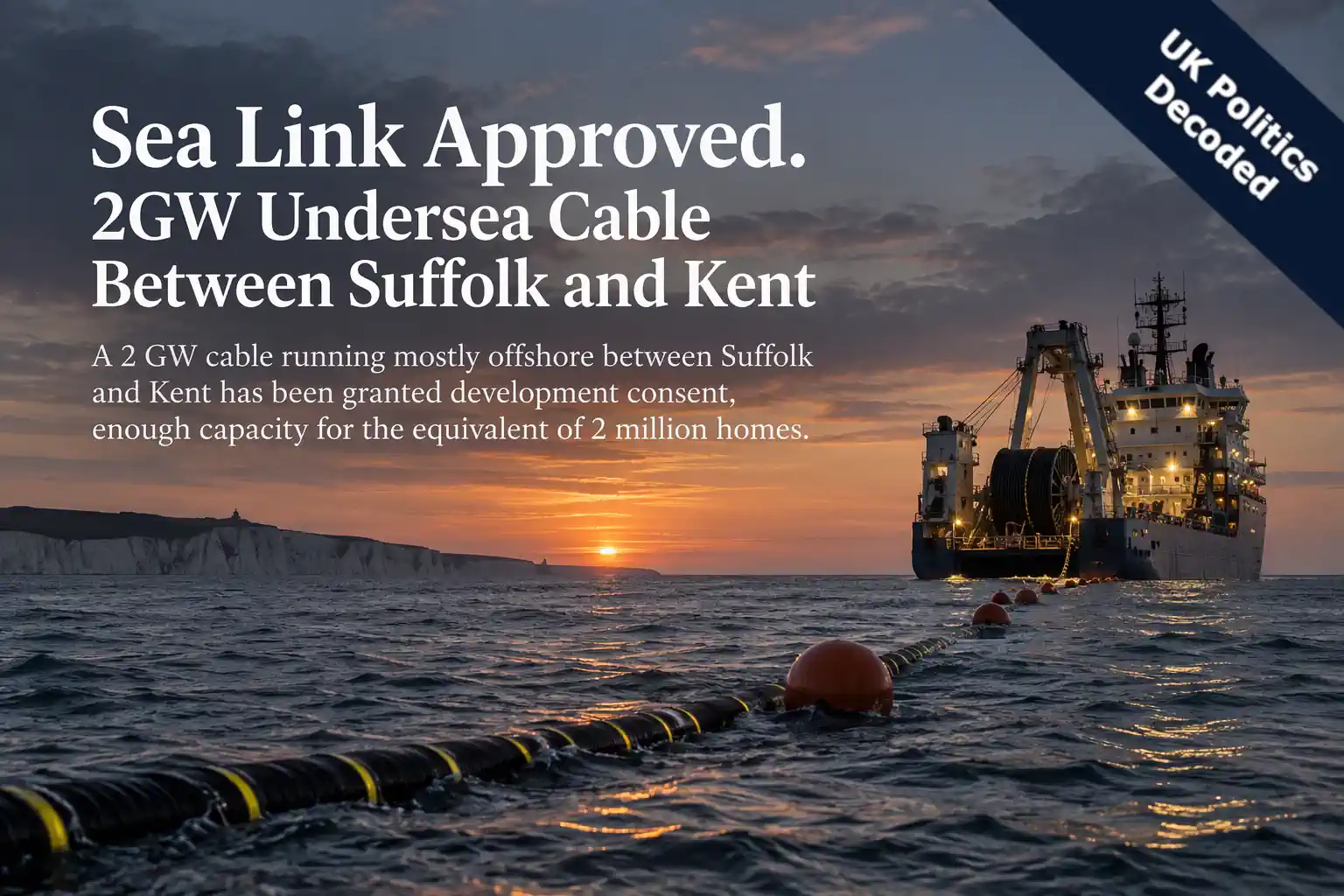
Sea Link has been approved. On Friday 30 October 2026 the Department for Energy Security and Net Zero granted development consent for the project, a 2 GW electricity connection between Suffolk and Kent that runs primarily offshore.
National Grid Electricity Transmission is behind the scheme. Ministers say it will carry power from where it is generated to where it is needed, and cut the bill for paying generators to switch off when the network is full.
At a Glance
- The government granted development consent for Sea Link on 30 October 2026, following a recommendation from the Examining Authority.
- Sea Link is a 2 GW link between Suffolk and Kent, which the government says could carry enough electricity to power the equivalent of 2 million homes.
- National Grid will deliver a community benefits scheme with more than £1 million each for community funds in Kent and Suffolk.
- The decision brings the number of nationally significant clean energy projects approved since July 2024 to 39.
- Challenges to the decision can be made to the High Court, and must be brought within six weeks.
What Has Sea Link Approved? The Route From Suffolk to Kent
Most of what has been approved will be out of sight. The Planning Inspectorate describes the route as a sub sea cable from the Sizewell area in Suffolk to Richborough in Kent, but there is a good deal of equipment at either end. In Suffolk, a new converter station within 5km of the proposed Friston substation connects to it through underground alternating current cables.
From the converter station, direct current cables run underground to the coast, where they join a new offshore cable. That section is approximately 130km long and comes ashore at Pegwell Bay in Kent.
A second converter station, within 5km of the existing Richborough substation, completes the link. An approximate 1km alternating current connection then feeds straight onto the overhead line.
Why Ministers Say Sea Link Matters for Bills and Energy Security
The government's case is about moving electricity, not making more of it. The 2 GW link could carry enough power for the equivalent of 2 million homes, according to the department, and easing pressure on the grid should reduce how often generators are paid to switch off because the network cannot take their output.
The department also says the project will make the network more resilient and cut wasted energy, which it argues will help bring down costs for consumers. Energy Minister Michael Shanks said rebuilding the national grid lets renewable energy and businesses connect, and reduces exposure to volatile global fossil fuel markets.
The press release does not put a figure on any saving for households, so the bill claim is a stated aim, not a quantified result.
How Sea Link Got Through the Planning System
Schemes of this size are decided through a Development Consent Order under the Planning Act 2008. National Grid Electricity Transmission submitted its application to the Planning Inspectorate on 27 March 2025, and it was accepted for examination on 23 April 2025.
A six month examination followed. The public, the local authority, statutory consultees and other interested parties could all give evidence, and the Examining Authority sent its recommendation to the Secretary of State on 30 July 2026.
How a Nationally Significant Project Is Decided
- The applicant consults locally and prepares detailed documents, including on environmental impact, before submitting to the Planning Inspectorate.
- The Inspectorate has 28 days to decide whether to accept the application for examination.
- The Examining Authority questions the applicant and registered parties during an examination of up to six months.
- The Examining Authority has three months to send a recommendation, and the Secretary of State then has three months to decide.
The Inspectorate counts Sea Link as the 118th energy application out of 186 examined so far, and says it was again completed within the statutory timescale. Baroness Curran took the decision on behalf of the Energy Secretary's legal authority. The decision letter, recommendation report and evidence are all published on the National Infrastructure Planning website.
Sea Link Community Fund, What Kent and Suffolk Get
Communities along the route get a funding pledge with the approval. National Grid will deliver a benefits scheme worth more than £1 million each for community funds in Kent and Suffolk. The department says the money could go towards community facilities, green spaces and local skills, but it has not named specific projects.
What the Decision Settles
- Development consent has been granted for the full Suffolk to Kent connection.
- The project route, including both converter stations, is now covered by the consent order.
- Community funds of more than £1 million each are committed for Kent and Suffolk.
- The Planning Inspectorate lists the project as post decision.
Anyone wishing to contest the decision can go to the High Court, which then decides whether there are grounds for a judicial review. The Planning Inspectorate says that must happen within six weeks. None of the published sources say whether a challenge has been lodged.
Great British Grid and Solar Approvals, The Wider Picture
Ministers present Sea Link as part of a bigger programme. The approval, they say, builds on the Prime Minister's announcement of the Great British Grid, a publicly owned body within Great British Energy that will bring together public and private investment to speed up network upgrades. The government is also bringing forward reforms that would let developers and businesses build their own grid connections where appropriate, which it says will reduce delays and costs.
The cable decision followed approval of two major solar farms, in Nottinghamshire and Cheshire. The larger is Great North Road Solar and Biodiversity Park, near Newark, with a generating capacity of 800 MW. The government calls it the joint biggest solar farm in the country by generating capacity, level with Springwell Solar Farm, which was approved earlier this year. Its developer, Element Green, estimates it could meet the power needs of approximately 400,000 homes.
The plans go beyond panels. Element Green intends to plant 64,500 new trees and over 50 km of hedgerows, and to provide 34.8 km of new walking and riding routes. Almost 4,000 sheep are expected to graze beneath and between the panels, potentially rising to 9,000 during lambing, which the government says keeps the grass down while allowing farming to continue alongside electricity generation.
Frodsham Solar, north of Frodsham, takes a different approach. It will combine solar panels with battery storage, so some of the electricity generated can be stored until it is needed. Its developer says it could generate enough electricity for 40,000 homes.
In the government's account, the two approvals show that solar and farming can share the same land at Great North Road, and that panels can be paired with battery storage at Frodsham.
What Happens Next for Sea Link
The project now leaves the planning system and passes to National Grid to deliver. Neither the government nor the Planning Inspectorate has given a building timetable, so there is no confirmed date for when electricity will flow.
The first thing to watch is the end of the six week challenge period, followed by any word from National Grid on construction and the community fund. Readers who want the detail can find the Development Consent Order as made, the Habitats Regulations Assessment and the rest of the decision documents on the Planning Inspectorate's project page.
Key Takeaways
- Sea Link, a 2 GW link running primarily offshore between Suffolk and Kent, was granted development consent on 30 October 2026.
- The route includes a roughly 130km offshore cable landing at Pegwell Bay in Kent, plus converter stations at each end.
- The government says the link will reduce the need to pay generators to switch off, though it gives no figure for the effect on bills.
- National Grid will deliver more than £1 million each in community funds for Kent and Suffolk.
- No construction timetable has been published, and the six week window for High Court challenges is still running.
Sources & Further Reading
- GOV.UK: Sea Link development consent decision announced Archived copy (OGL): archived page
- GOV.UK: Major undersea power cable given green light Archived copy (OGL): archived page
- Planning Inspectorate: Sea Link project information Archived copy (OGL): archived page