AI Use: AI tools were used to support source discovery and to structure the article for clarity. All research, verification, drafting, and final editorial decisions are fully human led. Learn about our AI policy.
UKPoliticsDecoded is an IMPRESS regulated public interest publisher. Read our editorial standards.
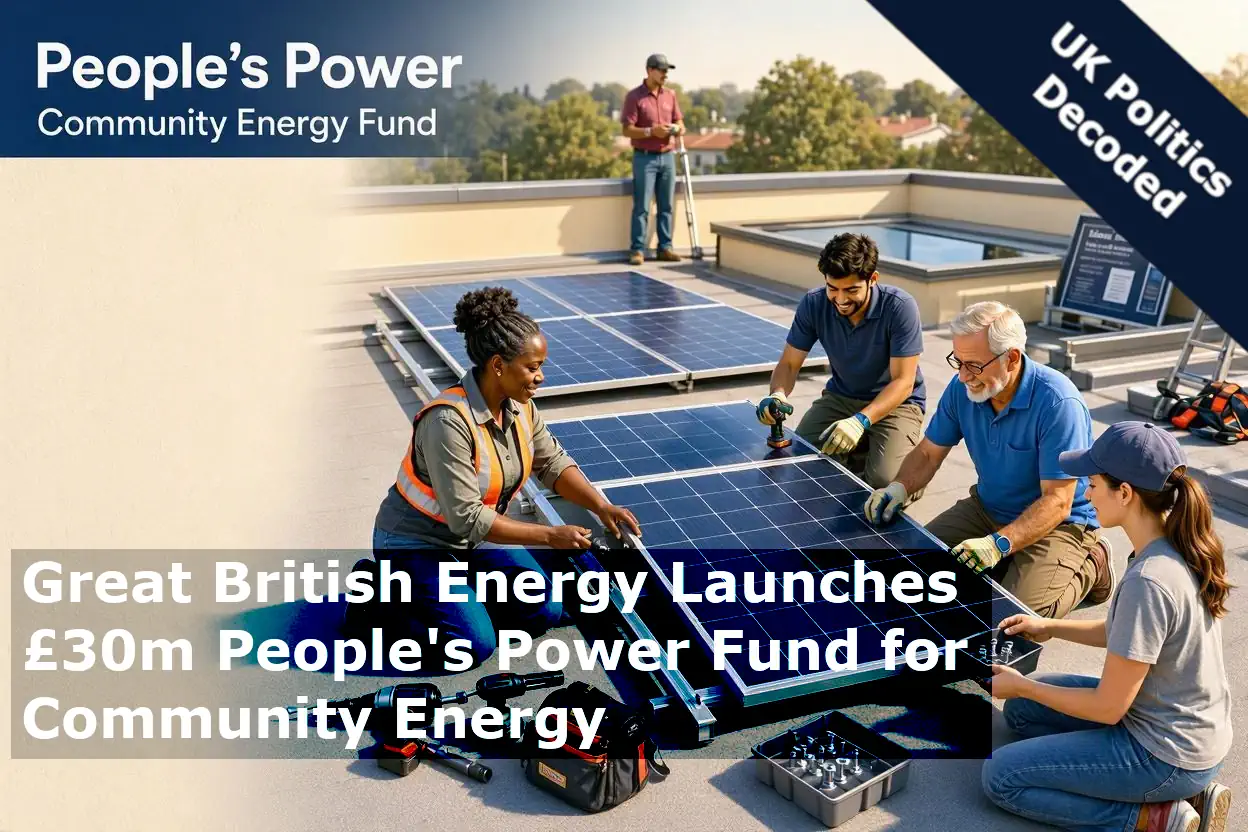
Local authorities and community groups across the UK can now apply for a share of £30 million in new government grants to build and own their own clean power projects. Great British Energy opened the funding on 17 September 2026, describing it as the first instalment of the "biggest public community energy investment in UK history".
The £30 million is the initial payment on a larger commitment. Ministers announced in February 2026 that up to £1 billion would be made available through the Local Power Plan, aimed at putting solar panels, wind turbines and hydro schemes into the hands of the people who live near them rather than commercial energy companies.
At a Glance
- Great British Energy opened £30 million in new community energy grants on 17 September 2026, the first wave of a promised £1 billion Local Power Plan.
- The funding aims to support more than 1,000 local and community owned clean energy projects across the UK, from rooftop solar to village owned wind farms and hydro schemes.
- A £20 million Community Fund covers England, Wales and Northern Ireland, alongside a new £5 million Partnerships Grant for English councils working with community groups.
- Scotland receives £1.8 million through its existing CARES programme, on top of more than £10 million already provided earlier in 2026.
- Ministers plan to set out further details this autumn on giving community groups an ownership stake in renewable projects built by commercial developers.
How the £30 Million Community Energy Fund Is Being Split
The headline figure covers four strands of support. The largest is a £20 million Community Fund, open to community organisations in England, Wales and Northern Ireland, to develop and build clean energy assets the community itself will own. To qualify, a project must show the community holds a defined legal and financial interest in it, and that a set share of the benefits will be retained for, or delivered to, the local area rather than an outside investor.
Alongside it sits a new £5 million Partnerships Grant, helping English local authorities team up with community energy organisations to get joint projects off the ground faster. Scotland's sector is supported separately, with £1.8 million added to the Scottish Government's existing CARES programme, on top of more than £10 million already channelled through it earlier this year. A further £2.9 million funds advice services across England, Wales and Northern Ireland, recognising that many groups need practical guidance before they can even apply for a grant.
Where the £30 Million Is Going
- £20 million Community Fund, for community organisations in England, Wales and Northern Ireland to develop and build community owned clean energy assets.
- £5 million Partnerships Grant, helping English local authorities and community energy partners deliver joint projects.
- £1.8 million allocated to the Scottish Government's CARES programme, on top of more than £10 million provided earlier in 2026.
- Up to £2.9 million for advice services helping community groups across England, Wales and Northern Ireland develop project plans.
Why Ministers Want Villages and Councils to Own Their Own Power
The government's case rests on a simple idea, if a community owns the wind turbine or the solar array on its library roof, the money that energy generates stays local instead of flowing to a private supplier. Prime Minister Andy Burnham said the funding was designed to give people a direct say in "what clean energy projects they want" and to make sure they "feel the benefits of the clean energy transition in their pockets too". Energy Secretary Miatta Fahnbulleh, referencing the record temperatures seen this summer, said communities should be able to "reap the full benefits of clean energy, reducing emissions, cutting bills and reinvesting profits to benefit local areas, instead of big energy companies".
Ministers point to Germany and Denmark as evidence the model can work at scale. The Local Power Plan notes that more than half of Denmark's wind capacity and roughly half of Germany's solar capacity is citizen owned, a level of ownership the UK has not matched. Beyond this week's grants, the government says it will set out further detail this autumn on letting community groups take an ownership stake in projects built by commercial developers, creating a formal route for proceeds from privately developed wind and solar farms to flow back into the areas that host them.
157 Rooftops Already Switched On, But the Numbers Are Still Small
The £30 million launch follows an earlier phase of support that has already reached dozens of public buildings. Up to £16 million in Great British Energy funding has gone to England's Mayoral Combined Authorities, resulting in 157 new rooftop solar installations, from fire stations to leisure centres. Officials estimate that scheme could deliver up to £50 million in total bill savings, reinvested into local services rather than absorbed by rising running costs.
What Communities Gain
- Grant funding to develop solar, wind and hydro projects the community itself will legally own.
- A route for councils to partner formally with community groups via the new Partnerships Grant.
- Advice and feasibility support for groups lacking the expertise to develop a project alone.
- A future share of ownership stakes in developer led renewable projects, expected this autumn.
What's Still Unclear
- £30 million is a fraction of the £1 billion total, with no full release timetable yet.
- How the promised developer ownership stake scheme will work has not been published.
- Groups must still prove a defined legal and financial interest to qualify for funding.
- Whether 157 rooftop projects can scale to the 1,000 project target remains to be seen.
What Happens Next for Community Energy Groups
Great British Energy chief executive Dan McGrail said the organisation's "vision is that every community should have the chance to build and own its own renewable energy", describing the two grants as giving groups "the practical support they need to get clean energy projects off the ground". Community Energy England chief executive Dr Matt Vickers welcomed the launch as "the first step" in the wider billion pound commitment, but said his organisation had "long advocated" for exactly this kind of partnership fund, so councils and community enterprises could "work together to transform places".
Great British Energy has also said it is separately seeking information from investors to help size and scope future community energy products, suggesting the £30 million grants are meant to sit alongside loan finance and private capital rather than replace it. Community organisations and local authorities wanting to apply are being directed to the relevant funding stream depending on where they are based and the kind of project they are proposing.
The real test will be whether this first £30 million translates into projects actually built and generating power, rather than a funding announcement. With ownership stake details still to come this autumn, much of the plan's substance is yet to be tested.
Key Takeaways
- Great British Energy has opened £30 million in grants for community owned clean energy projects, the first wave of a promised £1 billion Local Power Plan.
- A £20 million Community Fund and a new £5 million Partnerships Grant cover England, Wales and Northern Ireland, with £1.8 million separately allocated to Scotland's CARES programme.
- The plan aims to support more than 1,000 community owned projects, following on from 157 rooftop solar installations already delivered on public buildings.
- Ministers plan to announce further details this autumn on letting communities take an ownership stake in projects built by commercial developers.
- Community Energy England has welcomed the funding but says it is only a first step towards the full £1 billion commitment.
Sources & Further Reading
- GOV.UK - 'People's Power' projects to give more control over local energy Archived copy (OGL): archived page
- GOV.UK - Local Power Plan Archived internally for verification
- Great British Energy - Local Power Plan Archived internally for verification (18 September 2026)
- Community Energy England - Great British Energy Community Fund Archived internally for verification