AI Use: AI tools were used to support source discovery and to structure the article for clarity. All research, verification, drafting, and final editorial decisions are fully human led. Learn about our AI policy.
UKPoliticsDecoded is an IMPRESS regulated public interest publisher. Read our editorial standards.
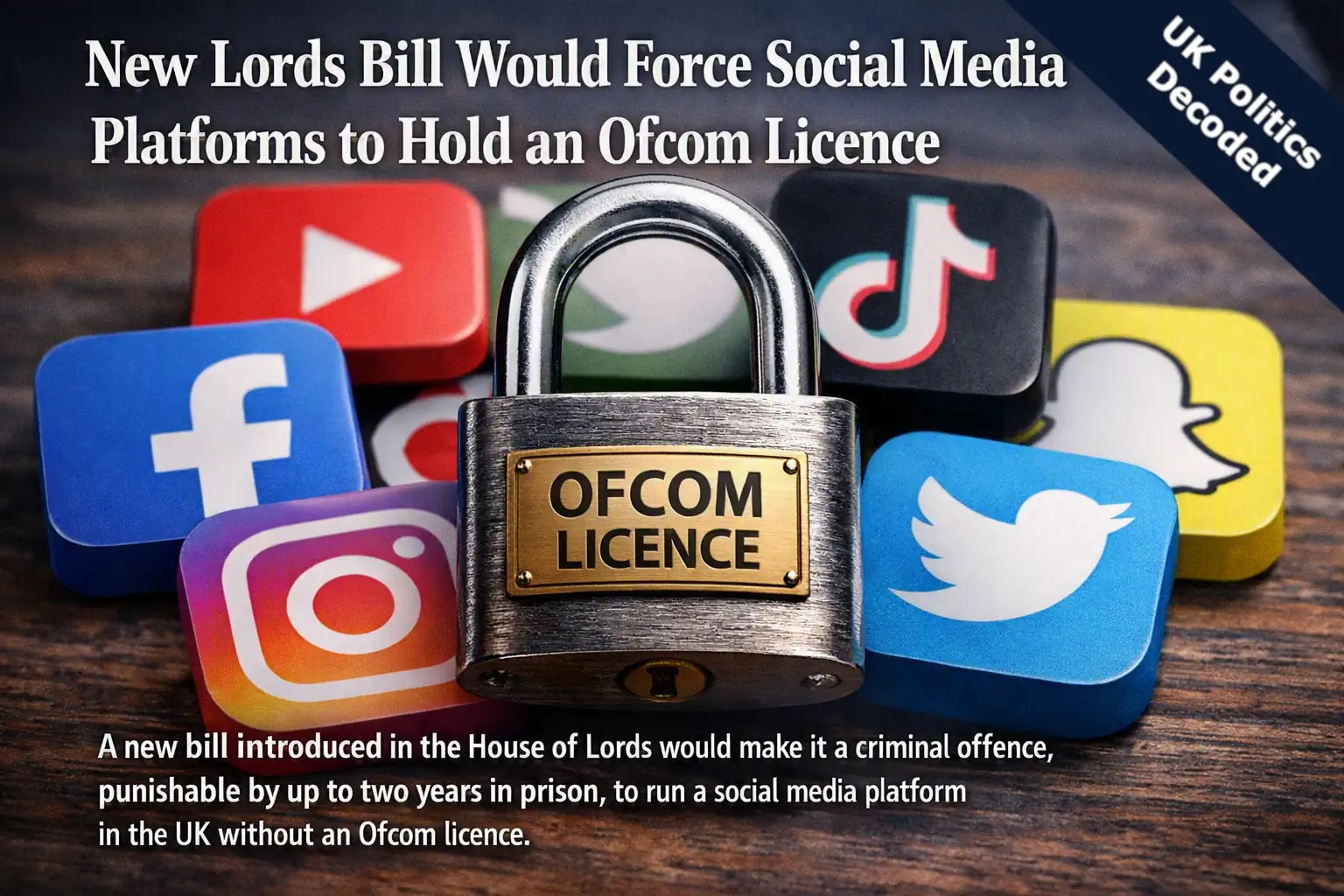
A new bill introduced in the House of Lords would make it a criminal offence to run a social media platform in the UK without a licence from Ofcom. The Social Media Platforms (Ofcom Licensing) Bill [HL] was presented by crossbench peer Baroness Floella Benjamin and had its first reading on 7 September 2026, adding a licensing regime on top of the duties platforms already carry under the Online Safety Act 2023.
Under the bill, any platform accessible to UK users would need Ofcom's approval before it could legally operate here, and Ofcom would be handed the power to suspend or revoke that approval if a platform broke its conditions.
At a glance
- The Social Media Platforms (Ofcom Licensing) Bill had its first reading in the House of Lords on 7 September 2026, sponsored by crossbench peer Baroness Floella Benjamin.
- It would make it an offence to operate a social media platform available to UK users without an Ofcom licence, carrying an unlimited fine or up to two years in prison on indictment.
- Ofcom could grant licences for a fixed period of up to ten years and would set binding conditions covering content moderation, transparency and user safety.
- Breaches could lead to a warning notice, mandatory remedial action, licence suspension or revocation, with courts able to order internet service providers to block access.
- As a private member's bill, its progress depends on parliamentary time and government backing, and it had not yet been debated as of early September 2026.
What the New Ofcom Licensing Bill Would Actually Require
The bill's central mechanism is simple, no licence, no platform. Section 1 states that a person must not operate a social media platform available to UK users unless authorised by an Ofcom issued licence, and that operating without one is a criminal offence. Anyone convicted on indictment could face up to two years in prison, a fine, or both, while summary conviction carries a fine up to the statutory maximum.
The bill defines a "social media platform" broadly, covering any service whose sole or significant purpose is letting users create, share, discover or consume user generated content, and which lets users discover, interact with or follow the content or accounts of people they don't communicate with privately. That wording is wide enough to potentially catch far more than the household name platforms typically associated with online safety debates, a point already raised by commentators examining the bill's text.
Licences would not be indefinite. Ofcom could grant one for any fixed period up to ten years, attaching whatever conditions it considers necessary. Renewal would require a fresh written application, with Ofcom weighing any past breaches or enforcement action before deciding whether to renew, renew with extra conditions, or refuse outright.
How Ofcom Would Decide Which Platforms Get a Licence, and For How Long
Sections 4 and 5 of the bill set out what licensed platforms would actually have to do. Licensees would need to take reasonable and proportionate steps to ensure content on their platform complies with UK law, isn't materially harmful to users or the public interest, and doesn't incite criminal conduct, violence, hatred or public disorder. They would also need systems to limit the spread of materially false or misleading information, transparency about who is publishing content, and a process for removing or restricting harmful content within a timeframe Ofcom sets.
Beyond content rules, platforms would need to show their compliance machinery works. That means employing enough staff who understand the Act and Ofcom's codes, having procedures ready to act on Ofcom's directions, keeping records that demonstrate compliance, and supplying Ofcom with details of those procedures on request. Where Ofcom is satisfied a licensee has had no material breaches during its licence term, the bill allows for an expedited renewal process.
How Ofcom Could Respond to a Breach
- Issue a warning notice setting out the breach and what's needed to fix it.
- Require specific remedial action from the platform.
- Suspend the platform's Ofcom licence.
- Revoke the licence entirely and apply to a court for an order requiring internet service providers to block UK access to the service.
Why the Licensing Bill Would Sit Alongside the Online Safety Act
The bill doesn't arrive in a regulatory vacuum. The Online Safety Act 2023 already places duties on regulated user to user and search services to assess and mitigate risks from illegal content, and from content harmful to children on services children use. Ofcom can already issue enforcement notices and fines of up to £18 million or 10% of a company's qualifying worldwide revenue for non-compliance, with senior manager liability possible in certain circumstances. Ofcom can also require platforms to use accredited technology to detect terrorism and child sexual exploitation and abuse content, subject to minimum accuracy standards.
What the new bill would add is a market access mechanism rather than a purely after the fact enforcement tool. Instead of relying mainly on fines once a breach has happened, continued access to the UK market would become conditional on holding, and keeping, an Ofcom licence. Suspension or revocation would give the regulator a more direct lever over whether a platform can operate here at all, layered on top of the existing enforcement notices and financial penalties under the Online Safety Act.
Who's Behind the Bill, and How Far Could It Go in Parliament?
Baroness Floella Benjamin, a crossbench peer known for her work on children's rights, is sponsoring the bill in the House of Lords. As a private member's bill rather than a government bill, its fate depends heavily on how much parliamentary time it's given and whether ministers choose to back it. That's a familiar hurdle for private members' bills, many of which stall long before reaching a vote.
As of early September 2026, the bill had been introduced and recorded in Parliament but had not yet been debated. It would still need to clear further stages in the Lords, pass through the House of Commons, and receive Royal Assent before becoming law, and its short title, the Social Media Platforms (Ofcom Licensing) Act 2026, would only take effect once that process is complete. If passed as drafted, the Act would come into force six months after passing and would extend across England and Wales, Scotland and Northern Ireland.
Key Takeaways
- The Social Media Platforms (Ofcom Licensing) Bill would require any platform available to UK users to hold an Ofcom licence, with operating unlicensed treated as a criminal offence.
- Penalties for operating without a licence include an unlimited fine on summary conviction, or up to two years in prison, a fine, or both on indictment.
- Ofcom could suspend or revoke a licence for breaches, and revocation could allow Ofcom to seek a court order forcing internet service providers to block UK access.
- The bill would add a licensing layer on top of the existing Online Safety Act 2023 framework, which already allows fines of up to £18 million or 10% of global revenue.
- Sponsored by Baroness Floella Benjamin as a private member's bill, it had its first reading in the Lords on 7 September 2026 and still needs further debate, Commons approval and Royal Assent to become law.